Chapter 1
Crypto audience does not understand its enemy
48 min read · 33 sections · starts on p. 11
Fifteen years of crypto cycles (wonder, hope, crash, repeat) read as a symptom. Crypto never named its real rival: the Lender-of-Last-Resort (LOLR) consensus, working at global, national and social layers. The chapter introduces the four Money Frames and asks whether crypto can match LOLR in scale and depth.
This is my 15th year in the world of crypto. The Bitcoin price has moved from double digits to six digits during this period. My eyes can’t still believe the number of coins jumping from a single digit to seven digits. Not just that, the market cap of crypto-industry kept surprising me while jumping from $1 billion to over $3000 billion. When I looked at Bitcoin for the first time, it was a sheer wonder that I could not let go for months. I was sufficiently trained in a field called “Politics of Money” that convinced me to see this event as a big disruption. No phenomenon was seen ever-at-scale in monetary history that was not centralized. It was unbelievable to see the merger of ledger and money in a system that was peer-to-peer. Now, anybody could transfer this “electronic cash” to anybody else! The kind of censorship-resistance it introduced was a God-like defence of human freedom. This feeling was not static like the seven wonders of the world; rather it was an experience like the invention of gravity, invention of wheel, invention of steamengine and invention of internet. It led to a cascading of hope that could hardly be contained. However, all these years have been a series of wonder, hope, crash and that too with not only one cycle but with many cycles recurring again and again. This chapter aims at understanding these cycles that have become a hallmark of the crypto-world since beginning. It is an exploration into four embedded questions as mentioned below: i) an addictive power of creating wonderful disruptions followed by ii) the rise of exponential hope cycle and iii) Destroyed by a huge disillusionment after a market crash iv) Cycle of wonder rising again
1.1.0 Cycle One
If I start from 2012, the price of Bitcoin was in double digits but within a year, it jumped to nearly four digits. It was an event that brought BTC on to the financial stage and people noticed its power as an asset. It created a huge momentum but sooner than later, the price crashed back to double digits. What happened? Nobody could explain, but the broad answer could be that Bitcoin was too good to be a true asset. This was just the beginning of something novel that had yet to grow its roots. This crash was not the only shock. By early 2014, Mt. Gox, the world's largest BTC exchange, was hacked and people lost nearly a million bitcoins. It was hardly possible to comprehend that a decentralized system was damaged by a centralized custodian. Instead of keeping their private keys with themselves, the people put their trust in something they were used to trusting. A centralized server was not something that they could lose faith in, so easily. Not only that, Bitcoin was being mined on laptops and desktop computers in early years, but the moment its price potential manifested, the mining ecosystem moved from low-power computing chips to high power ones. First, from CPUs to GPUs3, then to FPGAs4 and finally to ASICs5, the entire mining architecture went from a retail friendly one to a high capital intensive one. The fundamental layer where Bitcoin was supposed to originate was now beyond the reach of a normal person. Though this shift added a huge censorship-resistance to the ecosystem, the degree of decentralization was compromised a bit. From 2012-2015, this cycle went up and down leaving a taste, half bitter, half sweet.
1.1.1 Cycle Two
The next cycle started in 2015 when using a Bitcoin like consensus mechanism, Ethereum emerged wonderfully. It was supposed to be a world computer on the blockchain. If Bitcoin could compute, it was just a calculator in front of Ethereum. The BTC chain was built for a single task i.e. moving value from user A to user B. Ethereum demolished this straight jacket. With the help of smart contracts, anybody could deploy a decentralized application on its blockchain, and it could be used by anybody anywhere. Whatever was digitally expressible, could be built on Ethereum as it was a Turing-complete machine. By the beginning of 2016, the ICO6 wave started and within a year, it went like wildfire. Not just 100s but 1000s of projects were able to raise money in the easiest way possible. Swap your Ethers with altcoins a project is issuing. Billions of dollars moved from retail investors to founders. Nothing of that sort had happened ever in the history of the venture capital investment industry. What started with a world computer turned into democratization of venture equity space. It happened so fast that even regulators could not notice what happened. Augur, BAT, Filecoin and many more projects came out of this wave but by the beginning of 2018, the initial exuberance died with a sudden crash of crypto markets. Bitcoin, Ethereum and all the new coins nosedived, and the mood changed from hope to despair. The first cycle was a BTC-centric cycle, but this cycle had over a thousand coins. Things changed but still, they remained the same.
1.1.2 Cycle Three
The third cycle started in the second half of 2020 and went on till the beginning of 2022. It was a bit unique one. It created new narratives, first of DeFi, then of NFTs and later on shifted to Layer 2 chains. Things emerged in such a fresh and quick succession that it was impossible to figure out what was new and what turned old in such a short span. This was a phase when crypto market cap even crossed $3000 billion; when BTC crossed $60,000; Ethereum crossed $4000; and altcoin share crossed 50% of the market cap once. The change was massive but by the beginning of 2022, markets crashed again. If the first cycle had a million participants, the third cycle clocked 100 million participants. New use cases, new sectors of growth and a wall-street-like asset variety surprised everybody. The third cycle changed a lot but still, things remained the same. Since then, the crypto markets have added unique milestones like institutional adoption via ETFs, Digital Asset Treasury Companies, emerging regulatory frameworks, return of privacy coins, a serious roadmap for web2-like adoption curve of dApps via account abstraction, gasless payments, stablecoins and so on. However, the markets are still down in the middle of 2026. A long-term bear market has captured the audience despite a lot of positive things. The question is why things don’t change despite a big change. Why do we end up on the same trajectory?
1.2.0 Crypto audience does not understand its enemy
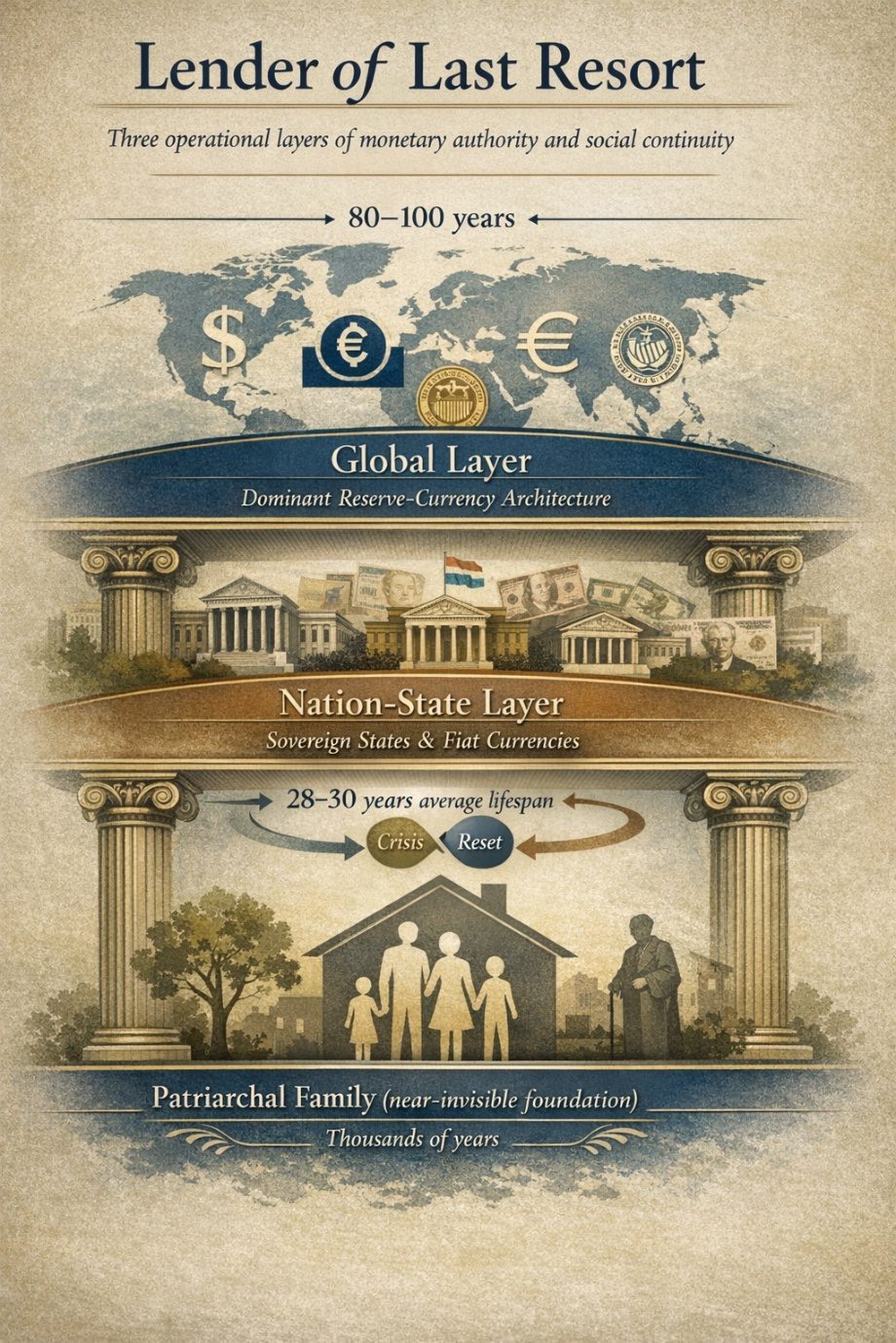
Crypto-world has built a strange curve since beginning and it is important to see its deep but sad pathology. The despair behind this needs to be deconstructed. One must understand what happened and where things went wrong. To do this, one thing needs to be decoded. Whenever you create a new alternative order, you must understand what legacy order you are replacing. You must also calculate the reaction that would come from the legacy order. Crypto audiences failed to comprehend the same. Few have any idea of the power their enemy has. Yes, cypherpunks, the original provocateurs did start on a right note four decades ago but down the line, the crypto community lost track of what they were fighting against. Aristotle used a term “architectonic” for politics that meant master science. It was a term he used to suggest the scale and complexity of an order. Crypto never built its architectonic equivalent before trying to rule the price charts and monopolize the market caps. In a sense, the crypto audience did not realize that it was reinventing statecraft; it was transcending all political borders; it was touching a layer of freedom that needed support but was difficult to receive. So, it was both an architectural and a philosophical challenge that was only half-met. One question was never fully answered; what exactly was crypto going to replace? Most of the proponents said that they will replace a world of centralization. This answer was not wrong, but it was not a fully baked one. From a political sense, it was the right perspective. From an economic view, it was also not wrong but from a social lens, this was far from adequate. What order was crypto going to replace? Can we give a name to it even if it is a theoretical one? The one obvious thing was that crypto was not just going to replace one American imperial order; rather it was aimed against all kinds of imperial orders. So, the challenger-in-front was not a decades-old system, but it was a centuries-old one. Such a system can have ancient forms of social defence that is difficult to sabotage. I tend to call that order the “Lender-of-last-resort (LOLR)” consensus system. It is a design template for all the systems, social, economic and political systems that we have built in the last nearly 5,000 years. It assumes that the real centre of power lies in a small group or a person sitting at the top who shall take the final decision regarding the issues around money, law, ledger and labour reward. Humans realized that economies of scale are possible in transactions if there is a common metric of value. If a user A owes to user B, user B owes to user C and user C owes to user D and user D owes to user A, all parties need to have a common “I owe you” (IOU) unit to strengthen economies of scale. Barter was never scalable but a regular settlement via a credit instrument was always a rational choice. The question was “Who would become lender-of-last-resort so that an IOU can be issued?” Money was not just a balance-sheet issue, but it was an institutional issue. Who would decide the monetary standard? Who would decide the denominations of money? Who would decide the supply of money? Who would have the emergency powers in case of a monetary disaster? LOLR was an existential choice of its times. It reflected in money first but was not confined to it. LOLR was an architectonic choice too. It created not only money but also developed ledger, law and labour incentives. When a contemporary scholar, Anush Kapadia calls money as “frozen institutions plus balance-sheet”, he is hinting at the architectonic nature of monetary order.
1.2.1 Lender-of-last-resort (LOLR): Global
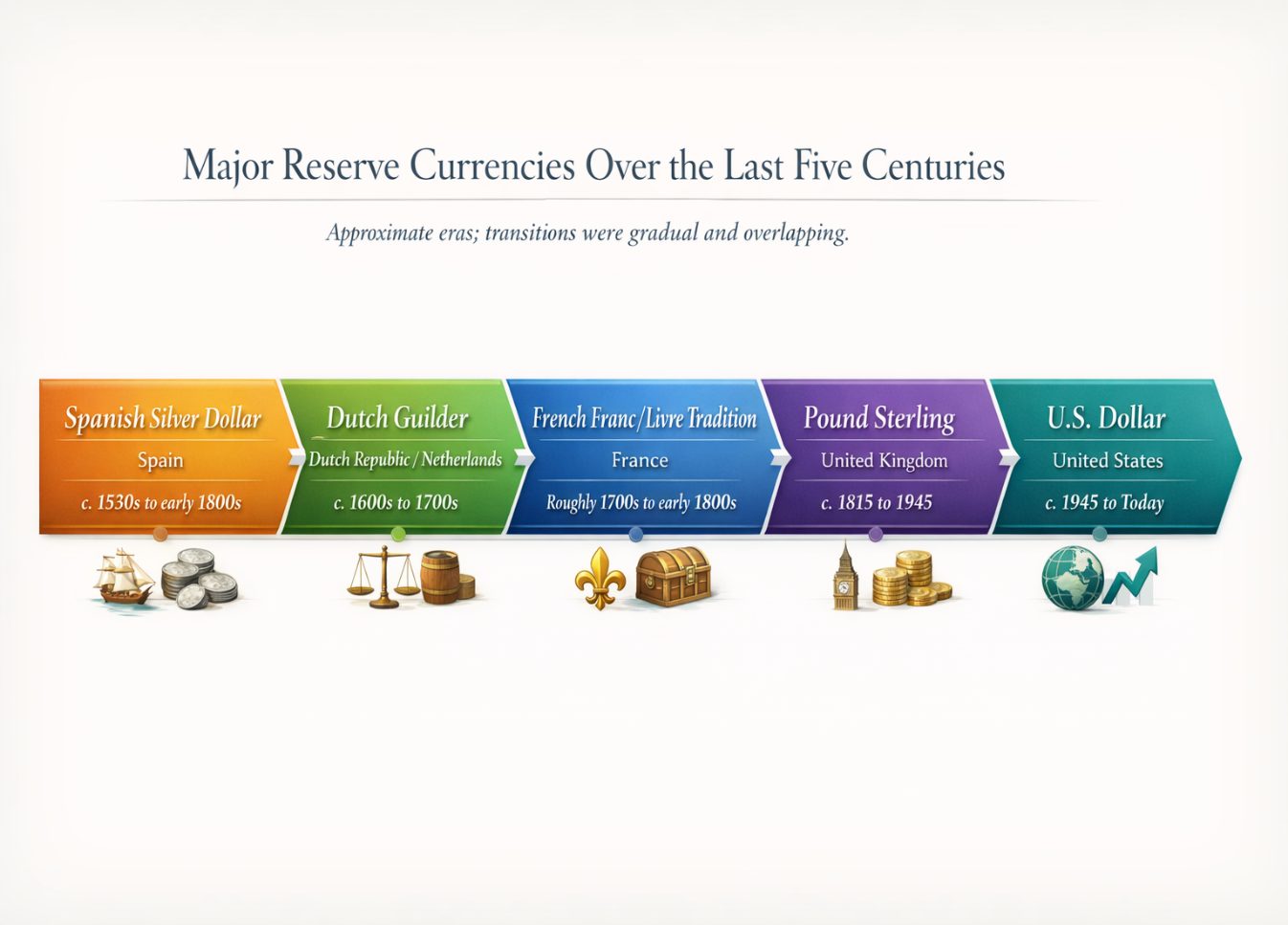
LOLR has three major layers of authority. Let us try to understand them one by one. To begin with, LOLR has a global layer where all the predominant actors agree on one currency as global reserve currency. Again, it is not a matter of choice rather it is an existential compulsion. The default state of global power is anarchy or lack of order. It means that all actors will act in proportion to the power they exercise in the global domain. That introduces hierarchy-in-anarchy and establishes LOLR as a compulsion as well as the political nature of reality. If you look at the last five centuries, you will notice that the world had a global reserve currency all the time though different ones at different times. What does it mean? LOLR had been an optimal design choice for human beings in a preblockchain era whenever they worked at scale. Whosoever could fulfil all the necessary conditions of becoming an LOLR, would become the one. Even if it was an agency carved out by the principal human being, it was a permanent necessity. It was some sort of “LOLR (King) is dead…………. long live the LOLR (King). Spanish Silver was the first global reserve currency in terms of scale. It stayed its course till Dutch Guilder replaced it. French Livre came after, then followed Sterling Pound and the current one is the US Dollar. You can allot roughly a century to each of these global reserve currencies with different periods of ascent and descent.
To issue an IOU to the world is a very big power with a huge incentive. If you can lend to the entire planet, you would love doing so. For any currency to become a global reserve one, it must become a national currency first. That means that there should exist a second layer of LOLR and that layer is the national one. Competition among national currencies creates the necessity of a global reserve currency but it is extremely difficult for a national currency to transcend its borders. The one who does, runs a global empire.
1.2.2 Lender-of-last-resort (LOLR): National
Do you notice the irony here? Global reserve currency is an event horizon because it is gravitational. There are competing national currencies. Despite five currencies becoming global reserve asset in the last five centuries, the LOLR slot at the global level was never empty. Why? The answer is that it is only a manifestation of an underlying layer of LOLR that works at the national level. The way LOLR works, leads to a uniform model of power distribution from bottom to the top and vice-versa. Since it is an automatic event, it is nearly impossible to determine whether the top layer determines the next layer or vice-versa. The irony does not stop here only. Though sitting at the top appears a political victory yet this is a byproduct of rivalry among national currencies. Whosoever is accepted a common benefactor can choose to manifest a moral victory over others. It is right that a nation should govern itself in all spheres including the monetary one. Japan should have Yen as its national currency or India should have INR as its currency. However, all currencies must have some global machinations and that results in the emergence of the top layer of LOLR. The design template does not change.
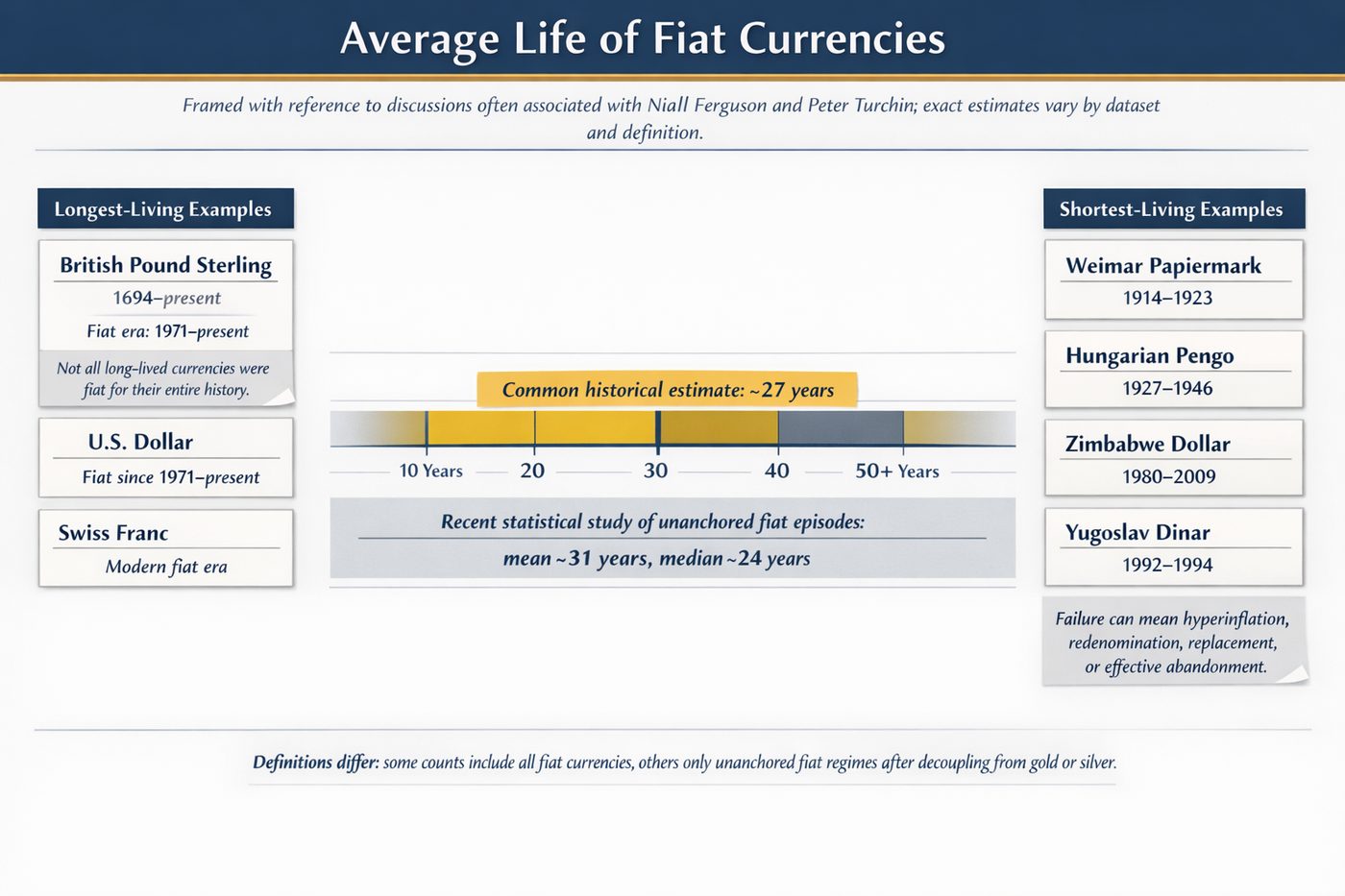
LOLR at the global level is a manifestation of whatever happens at the national layer. The irony doubles here. Rarely, any country had a stable fiat currency over a long duration. The average lifespan of a fiat currency is around 28 years, but the question is why a country chooses to have a fiat currency despite having a bad experience with the past one. The answer is again the same. This design template is not only gravitational but also universal. Economies of scale are impossible if a large sum of money exists as peer-to-peer physical cash or a large population is still using multiple coins.
1.2.3 Lender-of-last-resort (LOLR): Social
Why does LOLR survive at national and global level despite persistent troubles? The answer is again the same. LOLR is gravitational and keeps pulling all into a single sphere of influence. What powers this mechanism to emerge at national and international levels? The answer is unique but a disturbing one too. You might not be able to digest it. Please wait for a moment…………………. Lender-of-lastresort is not just a political or economic design template rather in its true origin, it is a social design template. Its third rather the most intrinsic layer is family, the patriarchal version where the patriarch has the final authority on all matters regarding money and power. Females may have autonomy in certain matters regarding kitchen, kids and other matters but to imagine a family without a patriarch is simply impossible in the world. To extend it further, to imagine a family with a matriarch is a rarity in the world also. Patriarchy may be diffused in its distribution across countries and societies, but it is compact and united in restraining emergence of family set-ups outside its influence.
My dear readers, I can understand that this may be too much to handle. Ok. Let me try to put it more objectively. It is more of a social contract between man and woman. LOLR at the family level is a very paradoxical architecture. It gives disproportionate power in the hands of the males, but it also loads them with too much responsibility. It restricts the autonomy of females in certain areas but also frees them from critical responsibilities like sole bread-earning, physically hazardous jobs, field wars etc. Now, you look at the implications of this reality. Males get regular food, sex and care from a regular partner while females get security, comfort and legacy. I am not saying that these all are the advantages rather they may be traumatic choices for some. It is not a question of a particular man or a particular woman. It is all about a wider equation that men and women adopted during a certain historical moment. While there is no clear-cut proof of why this social contract became the norm, it is highly probable that humanity might have suffered a traumatic period of famine or disaster at some juncture. This period must have been so severe that embracing a settled agrarian lifestyle was the best alternative to build a calorie-surplus society. In a certain context, this choice was like entering a prison without any chance of freedom. The decision to leave nomadic lifestyle might have been joyless but for the majority, a future towards fixed settlements might have become an irreversible choice at a certain moment. This choice created villages first and villages created cities next. Cities created currencies, currencies essentialized empires, empires necessitated armies and thus was created a wholesome gravity around LOLR. Now, you look at this equation loaded with the national layer and the global layer. Once this scale was achieved, it turned into a solid frame. Now, the question was whether a man or a woman could get rid of this consensus? Could a small group of men and women carve out their own space out of patriarchy. This was possible up to a certain limit but not beyond that. Why? To create a new man-woman social contract, the world needed a new consensus system that could scale equally fast and equally big. Alas! It was missing. That is why it is safe to say that LOLR was accepted not out of any moral compulsion rather it became gravitational and hence existential. It created monarchies and empires. The national layer and global layers became a manifestation of an invisible social contract that became too heavy to reverse or too strong to cancel. Even if a national currency flopped or a global currency failed, the turmoil was never sufficient to change the core man-woman equation. Wherever this equation was not functional like those in hostile zones, inside extreme inequality or trading centres, the exceptions were allowed via acceptance of prostitution, gay culture, polygamy, drugs and other kinds of deviant behaviours. The true opportunity of creating a new and scalable version of manwoman social contract did not emerge. Could you scale up prostitution? The answer is no because the question was not only about sex, but it was also about long-term childcare and human togetherness also. Could you scale up polygamy or polygyny? The answer is again no. They were naturally not possible at a universal level because man and woman generally tend to have a pair-bonding. Could you scale up gay or lesbian culture? The answer is again no because humans tend to take a pronatalism stance on fundamental questions of life. LGBTQ was a minor protruding irritant of history that would not have raised its voice if man-woman social contract had not monopolized sex and care under a label of heterosexual monogamous marriage.
1.3.0 Was crypto able to rival LOLR consensus?
Blockchain is fundamentally a consensus system. It may have proof-of-work as the mode of consensus or proof-of-stake or delegated PoS or something else. It may operate at the level of computer nodes but fundamentally, there are human beings at the end. They may be entrepreneurs, thinkers, investors or normal users but the point is whether they are building a belief system that can rival LOLR consensus in depth and scale. What is operational for thousands of years cannot be uprooted if the new shared consensus does not go beyond the technical definitions.
1.3.1 Bitcoin succeeded but only partially
Let us get into the points where things went wrong or where they did not go right. Let us start from Bitcoin. For the first time in monetary history, a ledger network was also a payment network. Bitcoin was both a cash and a geography-transcendental system. Its unit operation was a peer-to-peer transaction between two global human beings, but its base was a shared ledger that was tamper-proof. A BTC transaction was a big rupture in the existence of global reserve currency. If you look at the mechanics of LOLR, global reserve currency was a necessary evil that came from competing national currencies. It meant that national governments should have looked at Bitcoin with a positive mindset. They should have moved away from a competing philosophy to a value-neutral approach for a global payment layer. This should have become the true goal because Bitcoin removed the ledger-keeper intermediaries at the national and global level. Contrary to the expectations, these ledger-keepers felt threatened by BTC instead of getting inspired. The result was a lot of friction in adoption and near-zero progress in supportive regulation for a long time. It did not mean that Bitcoin was not adopted. It was; but by those people who could see a global currency both as a hedge against their fiat currency and a permissionless system. Decentralization was a big enabler, but it was never a sufficient goal.
1.3.2 Ethereum built the scale but not the depth
What Bitcoin alone could not do was pushed ahead by the coming of Ethereum as there were thousands of cryptocurrencies now, not just one. This accelerated not only the adoption of cryptocurrencies across the world but also enabled the public to realise the potential of circular economies. All nation-states run circular economies in the name of fiat currency. They issue a currency as a legal tender and make rules for the users to pay taxes and debts in the same currency only. One may call it ledger-keeping fee or monetary licence fee but if users keep paying taxes in the currency, the loop remains sustainable. Most of the utility coins were replicas of fiat currencies though with a tiny operational field. This motivated a lot of people to think in a direction that emerged later in the form of “Network State” as propounded by Balaji Srinivasan in his famous book with the same name. He made it not only popular but also catalysed the rise of micro ventures like his own Network School to prepare the world for an emergent phenomenon of network states. With abundance of use cases, currencies and multiple experimentations, the weight of crypto-world was now beginning to grow so much that smaller nations like El Salvador, Bhutan, Marshall Islands and many other tourism-friendly nations started adopting cryptocurrencies with open heart and fiat currency-like respect. However, this trend did not move as fast with bigger and powerful states. There was no serious erosion of friction against crypto. It was still a field of start-ups only. Very few considered it an emerging statecraft and almost nobody could see the architectonic potential behind crypto-world.
1.3.3 Success was less impactful than the failure
Crypto was able to create its economics to an extent but failed at creating its politics. The primary reason was that its impact field could never rival LOLR consensus that was working both vertically and horizontally across the world. There was no underlying social belief powered by men and women of the crypto-world. Unfortunately, the proportion of women in crypto remained so small that the emergence of a new man-woman social contract did not catalyse ever. Bitcoin was great but it did not touch this social layer. Men in the family saw BTC as a safety raft against inflation and debasement. Altcoins were appropriated into a “get rich quick” model of meme coins. The majority of users were running after insane profits so that they could take care of their own families. They could not see that LOLR was a mutual artifact of man-woman social contract and till this was replaced, the design template would force people to take a gambling approach to the top.
Let me throw out a conspiracy theory but only for the sake of understanding. Imagine altcoins having a market cap of $200 billion a few years back. A group of big national actors sponsor some hedge funds and VCs to invest in crypto. Within a few months, a big rush of money moves in. Altcoins start becoming hot favourites. Some coins rose 20x, some rose 50x, some even 100x. Everyone thought that good times had come and then these very players started dumping these coins at their all-time-high. Within a few months, the liquidity vanished. 90% of the coins went down by over 90%. Tokenization does have an underside. A price crash can reduce the value of a project overnight. This makes it easy to subvert the future of a project. Before an altcoin could ever think of a sustainable community, it needed a critical mass of early believers who were not ready to leave the project at any cost. LOLR players could kill a big chunk of token projects without much effort. I am not a proponent of any conspiracy theory. This was just a trope, but I would say that crypto was way more fragmented and the situation has gone from bad to worse. The belief-builders took a backseat in the last cycle and could never come back in any serious way. If people were working in crypto, they were working for their own families rather than building a new notion of family. Whatever insecurity they had, they tried to plug them with more money without ever challenging the fundamentals of how man-woman social contract carved out scarcity in a space when there was none. LOLR had so much gravity that it sucked all crypto audiences into it with minor rashes.
1.4.0 Is LOLR-equivalent scale and depth in crypto-world possible?
The answer is yes but also difficult. Building crypto like a statesman is the right way but to succeed like the one is a very tricky task. It is still an evolving story. For example, nobody could have imagined 20 years ago that something like Bitcoin would emerge and go parabolic. Around 15 years back, it was impossible to predict that a world computer would emerge and there would happen a Cambrian explosion of cryptocurrencies. There was no way one could predict things like onchain privacy, account abstraction, gasless payments, multi-currency wallet explosion, insane rise of both DEX (Decentralized Exchanges) and CEX (Centralized Exchanges), tens of millions of on-chain transactions per day. In a simple sense, it is a story of a desert turning forest in a short period. If you start with barren land, how do you share the imagination of forest with others? That is why crypto has yet not fully acknowledged the theoretical challenges because a lot is invisible.
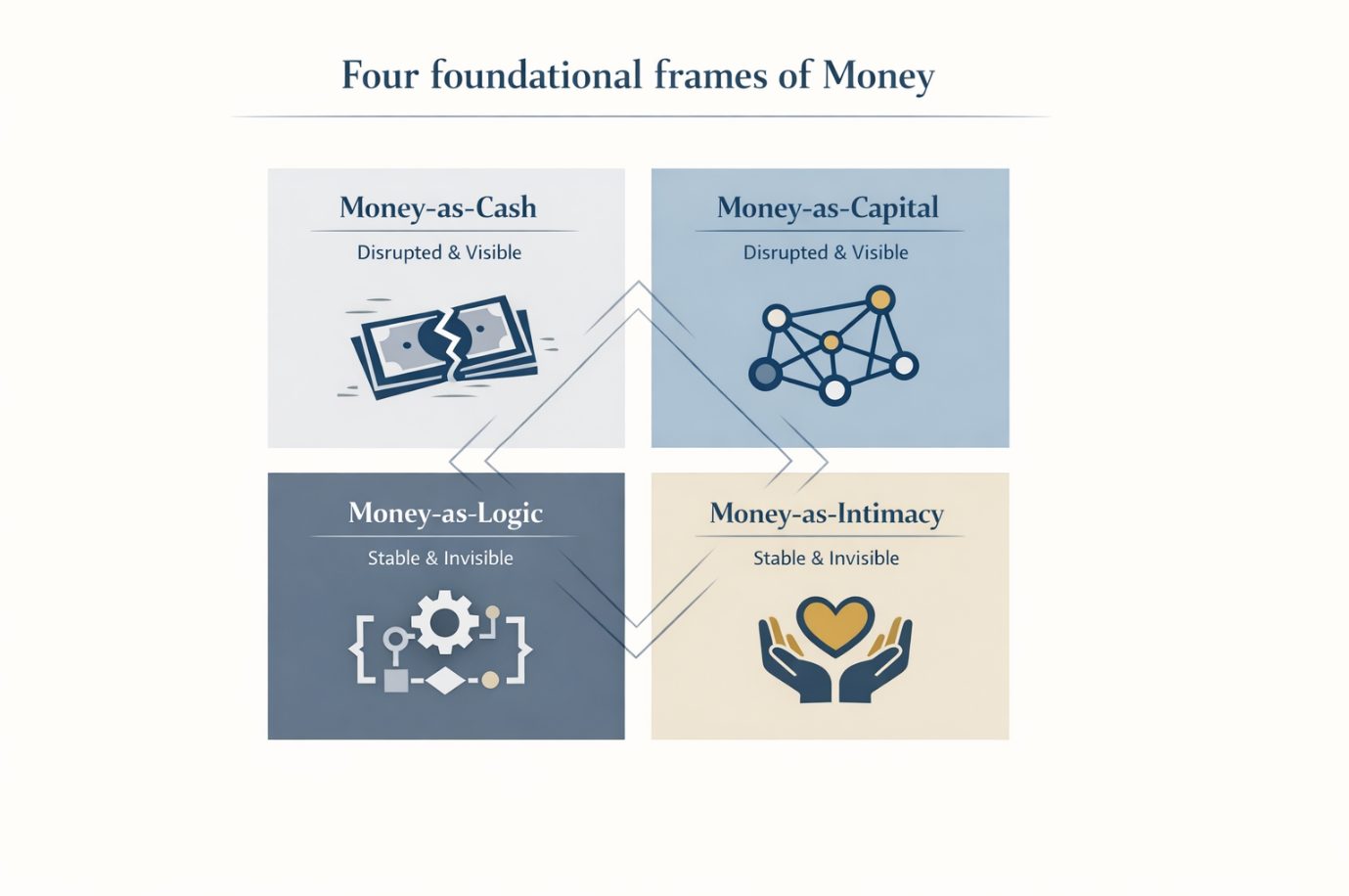
The best way of resolving this paradox is to paint a picture that is half-built, but a viewer can see that the other half is there but not fully visible. That may not be the perfect choice but in my opinion, it is the best way to merge the rational and speculative designs. For this, an image of four disruptions would be quite accurate where already-done crypto disruptions are visible but would-be disruptions are invisible. That is what I have chosen to call Money Frames. The approach here is more foundational than functional. Money has four frames out of which crypto has already reinvented two but has yet not touched the other two. Let us have a look at them as follows: - Money-as-Cash (Disrupted and hence visible)
Money-as-Capital (Disrupted and hence visible)
Money-as-Logic (Not disrupted and hence invisible)
Money-as-Intimacy (Not disrupted and hence invisible)
1.4.1 Money-as-Cash as Money Frame One
The earliest and the most regular use of money happens in cash mode but for centuries, the cash was a localized event. Transaction was peer to peer. People loved it because the transaction was also a settlement itself. There was no payment trail involved also. Bitcoin recreated the digital version of cash as its whitepaper itself calls “a P2P electronic cash”. For the first time in human history, cash could become a global event also. Anybody could send payment to anyone anywhere. How? Bitcoin merged currency and ledger into one entity. Every transaction was an auto update operation on the ledger also. It was not just an update, but it was also an irreversible operation because the blockchain was a decentralized database spread over thousands of nodes across the world. The settlement guarantee was coming from the blockchain. The identity was pseudonymous that meant preservation of cash-like behaviour. Since payments and audits were happening simultaneously, the system was so smooth that it provided ultimate peace to the users. This disruption was too big to ignore. It unleashed a galaxy of blockchains because digital cash was now a reality as well as equally large in terms of scale to digital money payments. The game got so interesting that even corporations and governments could feel the pinch. They could not afford their absence from this new space anymore, and we started hearing of stablecoins and CBDCs.
1.4.2 Money-as-Capital as Money Frame Two
Ethereum was not a wonder less than that of Bitcoin. Its beginnings were quite similar to those in Bitcoin, but something happened very organically in the space once the ERC20 smart contract emerged. Ether was not only money-as-cash, but it went one big step further also. Now, anybody could mint a coin and swap the same against Ether on chain. Suddenly, someone in Argentina could invest $100 in a project launched by a team in Zurich and could participate in the new-age wealth. No KYC, no securities’ law, no national borders and no gap between rich and poor. Few could digest it for months. Ethereum made venture capital move so fast into so many unpredictable hands that some people declared the death of “wall street”. The power of smart contracts was not limited to ERC20 only. Sooner, innovators started building DeFi platforms like P2P lending and borrowing, yield staking, decentralized exchanges and much more. Not only that, Ethereum was simulated by many new blockchains with better features and utility. Tron, Binance Smart Chain, EOS, Solana, Sui, Sei and Layer2 blockchains multiplied this thing very fast. Though the ICO wave petered out after 2018, but DeFi and other technological marvels stayed in the public memory. Using the same, ICOs reincarnated as IEO7, IDO8 or even pre-IPO platforms too. Stablecoins did not stop this phenomenon rather they ended up becoming the universal side of a pairing swap. With the coming of NFTs, the game got extended to the Real-World Assets (RWAs) also. What started as a disruption of money-as-capital has now reached a scale that is now being co-opted by established players. LOLR stakeholders could see the efficiency of this disruption as well as eventual gains. If Bitcoin suffered friction for 10 years, Ethereum faced the same for less than half. Regulators approved ETFs not only for Bitcoin and Ethereum but also approved issuance of Stablecoins on Ethereum and other smart contract-enabled blockchains in a big way. The way investigative agencies went on and on to find Satoshi Nakamoto, the founder of Bitcoin, the founder of Ethereum, Vitalik Buterin was always in the open. LOLR players were far quicker to embrace Ethereum than they were in case of Bitcoin. Hedge funds, VCs, big banks, corporations and interbank ledger players like VISA and Mastercard used Ethereum and similar blockchains in a big way.
1.4.3 Money-as-Logic as Money Frame Three
This is a difficult frame. Few people tend to focus on this. It is nearly absent in the crypto world with a couple of exceptions. When you look at a fiat currency like USD, Yen, Yuan, INR, Peso etc, you are basically looking at simulations of LOLR consensus logic. All such currencies are issued by their respective central banks, their denominations are standardized by central banks, their allocation is done by central banks, and their supply (M0) is managed by central banks. Despite name and form being different, the inherent logic of all remains the same. The political and physical layers are both centralized and top-down. When Bitcoin emerged, it introduced a new logic of shared consensus. It had decentralized layers in both political and physical sense. Nobody had ever seen such a logic in human history. This was such a big change that crypto gained the virtuous tag of decentralization encoded. LOLR stakeholders could accuse crypto with many weaknesses, but decentralization was not among them.
1.4.3.1 Governance is both downstream and upstream
Fundamentally, decentralization is a property of governance. It is all about who will set the rules of the game. That is what all put as the fundamental definition of a democracy but there is an irony behind it. Governance is a multi-tier problem. Let us assume that a democracy allows majority vote as a fair principle. Look at this formulation again. Does it say something about who can propose something for a vote and what proposal can be voted upon? The answer is no. Why? Most of us believe in the downstream processes of a democracy but a true democracy should be equally applicable in the upstream process too. If you look at this side of democracy, the following questions become critical.
- Can a democracy defend a minority even if there is only one opposing member?
- Can a democracy be as far-reaching in allowing what to vote upon along with how many to vote upon?
- Can a democracy allow all voters to propose changes all the time instead of once or twice or periodically?
Now, bring blockchains here and apply above-mentioned principles. Can a common man change the block size of Bitcoin blockchain? The answer is no because only a Bitcoin developer can propose a BIP (Bitcoin Improvement Proposal). Bitcoin may be a developer democracy, but it is not accessible to a common man. Can something similar be done in Ethereum blockchain? The answer is again no. The limitation repeats itself. Ok. Even if the developer vote is accepted, it must be approved by the majority otherwise the blockchain would get divided into two chains, majority chain and minority chain with one being called the fork of the former. Most of the chains won’t allow votes that might contain the possibility of a fork.
Now, bring the world of AI and merge it with blockchains. What to talk of protocol rules, can a dApp allow upgrade rules to an individual or an AI agent in its architecture? For example, can an individual add one’s stake inside a DeFi app with self-imposed two conditions? The first is that all withdrawals above $ 1 million must have a delay period of 48 hours and must be authorised by admin keys. This may look strange to you but today, individual investors cannot add defensive rules in their investments because the dApp software does not allow it. Once published, it is permanently etched on to the blockchain. From a decentralization perspective, blockchains have been quite fuzzy. They don’t seem to have a participatory and evolutionary flow at a micro level though they may proclaim legitimately to have the same at the macro level. Blockchains do have rules, but they don’t seem to have rules of changing rules where a common man can propose a change in a simple natural language. Despite a big progress, blockchains have a top-down logic instead of a bottom-up logic. So, at a popular level, blockchains are democratic but from a logical perspective, they are still centralized or to be more precise, they are far from decentralization.
1.4.3.2 Intent Vector as integral arche of blockchain
Now, you may find my position quite untenable here. Let me ask you a few questions. Why DAO (Decentralized Autonomous Organizations) are still not capable of replacing the current form of corporate governance where board members can ask for new rules, new voting proposals without creating forking risks. Why are most Defi investors at the receiving end when a platform is hacked? If AI agents or individuals can offer an upstream rule, the platform should be able to assimilate it rather than being closed about it. A large amount of cyber security challenges in crypto-world is due to lack of upstream governance. Do we have a blockchain where a common man can propose a rule change as if she/he is putting a prompt in ChatGPT? The answer is a categorical no. The reason is that software synthesis and scalable collaboration are intrinsic parts of a true democracy and it is increasingly necessary when AI agents are becoming a larger part of on-chain transactions. To put it more concisely, I would tend to call that blockchain needs to carry the past and future implications of what a human intends. Let us call it Intent Vector. Imagine a blockchain where even the smallest minority of one vote matters. Imagine a decentralized world where each next-generation LLM hyperscaler is launched on a blockchain. Imagine a world where nation states with offline written constitutions are replaced by network states with on-chain, real-time, upgradable smart constitutions. Now, let me go back to where I started.
Let us re-look at the problem from the perspective where I started. I must remind you of the speculative design that is as critical in this framework as rational design is. What is invisible does not mean that it is not going to happen. Bitcoin was invisible once, it happened. Ethereum was invisible once, it happened. Blockchain is yet to disrupt money-as-logic and hence, it is invisible. The way Bitcoin is known as disruptor of money-as-cash and Ethereum is known as disruptor of money-as-capital, we don’t have any contender who can be called a disruptor of money-as-logic.
1.4.4.0 Money-as-Intimacy as Money Frame Four
To remind you, this frame is again speculative and is still invisible. To make it concrete in front of your eyes, let me take a reference from two great works and then elaborate.
1.4.4.1 Mode X is coming
The first reference is that of Kojin Karatani, Japanese historian and philosopher who wrote a path-breaking book “From mode of production to mode of exchange: the structure of world history”. To summarize this work, it says that human history can be easily understood from the mode of exchange that is basically peer to peer one. He says that societies have gone through three modes of exchange till date. The first is Gift and Reciprocity that was a dominant mode when society lived as hunter-gatherers or in small villages/tribes. People lived by exchanging things as gifts and sustaining it via a way of reciprocal activities. This was the longest surviving mode of exchange for humanity. It stays even today but it has moved to the peripheries of social life now. It was followed by another mode of exchange called Domination and Subordination. It was an era of kings and empires when large armies and big administrative systems emerged. The economies of scale were ensured by this mode as people found subordination as an easy way to move around and grow up in social and economic life. It started around 5000 years ago. The next big mode was buy-and-sell when markets started outgrowing empires and states. People used currencies to exchange utilities and goods. One can say that this mode was there in small circles from the beginning but in the 20th century, it gained a prominence and after online markets, it surpassed all other modes of exchange in terms of intensity and scale. Though human beings have mastered and enjoyed all three modes of exchange, the global society needs a fourth mode of exchange that he calls Mode X. Gift and reciprocity had mutual care at the centre but did not have scale. Domination and subordination did redistribute resources across the population but downsized human liberty. Buy-and-sell did increase utility of goods and services, but equality and fair distribution of resources suffered a lot. Mode X would be the one where the good features of all the previous modes of exchange would converge into surplus of care. It can be a convergence of mutual care, human care and natural care. Has Mode X emerged? May be not. Does crypto-world signal the beginning of Mode X. May be yes.
1.4.4.2 Fourth Frontier is opening
The second reference is that of a recent book “A Hunter-Gatherer’s Guide to the 21st century: Evolution and the Challenges of Modern Life” by evolutionary biologist duo of Heather Heying and Bret Weinstein. To summarise this book, they have structured human evolution via three frontiers. The first was the geographical frontier when human beings kept travelling from one part of the world to the other part. Earth was big enough to assimilate human need and greed. This was the longest surviving way of life when new openings started going down gradually till the beginning of 20th century when this frontier almost closed with the maturing of the nation-state. The next big frontier was the political one that enabled human beings to transfer resources from one population to the other. They made states, empires, nations etc to execute the mechanics of this frontier. The third frontier was technological one that started with fire and then went on to add a lot of depth to human life with wheel, steam engine, printing press, electricity, computer chips, internet and artificial intelligence. This frontier is the latest one. The authors maintain that despite opening these three frontiers, human imagination is still unable to handle big problems like global warming, human loneliness, extreme gap between rich and poor, rise of refugee population and so on. Humanity needs a clear-cut fourth frontier to solve that. What constitutes this frontier? I don’t have a clear answer, but my hunch is that it will be sociological. It will not create new boundaries rather it will purge the ones that exist already. Does crypto-world have the potential to play a big role in forging this frontier? The answer is yet not clear, but possibilities are huge.
1.4.4.3 Cash Surplus vs. Care Surplus
I hope that these two references would have prepared your mind to see the fourth frame that I am calling “Money-as-Intimacy”. Let me remind you that it is yet not there and hence it is yet not visible. My attempt is a speculative one, but I believe in this as much as Kojin Karatani believes in Mode X or Bret and Heather believe in the Fourth Frontier. When I see money from a gender perspective, I see a subtle difference between man and woman. For men, money is structural while for women, money is relational. For example, men are more bothered about having enough cash in the pocket after having a house, car and bank balance while for women, it is about having enough support for daily cooking, washing, baby care, old age care, self-care, beautifying intimate surroundings, planning micro activities around social zones etc. For men, money is cash surplus but for women, money is care-surplus.
1.4.4.4 Cash & Care evaporated but men and women entered a warzone
For a long time, the zones of male and female activities had their own boundaries but in the last two generations, things have categorically shifted. Three things have cumulated together to build something unseen earlier. The contraceptive pill has given women control over their sexual lives and hence mate choice. They have moved out of households to prioritize career as the top preference. The metro life culture has reduced marriage into less of a social compulsion and more of an economic necessity so that both can earn enough to afford modern lifestyle. Men and women have embraced somewhat homogeneous careers, educational qualifications and living styles. During these two generations, two very repulsive trends have emerged. The cost of entering marriage has escalated too fast. It has not just happened with entry cost but even the exit cost has also increased. Due to this, youngsters are either denying themselves marriage or delaying the same. Over 90% of the world’s population living in developed and developing countries have gone into total fertility ratio below 2.1 kids per woman. It is a minimum requirement for a stable population. Some countries like Japan and China show a TFR around 1. In South Korea, it has gone down to 0.7. Things are so worse there that a popular but anti-social movement like 4B has emerged. It means no dating, no sex, no marriage, no kids. The situation is not much different across the major parts of the world particularly among GenZ and Millennial populations. With the coming of AI-driven job loss, the situation has only worsened. What we have today is an army of desperate men and women who hate each other. For an unethical LOLR player, it is very easy to fool them or exploit them. It is very easy to create a very negative and punitive regulatory infrastructure. Punishing a hope is easy but building an alternative world is very difficult. One became a votary of token A, the second became the follower of Token B and the next one became the proponent of Token C. Deep down, the rival forces knew that we are fragmented with no sociological base. We did not have a new social contract. Crypto failed not because it performed badly outside, it failed because it never looked inside.
1.4.4.5 Return of money-as-intimacy
The world today is beset with poly-crisis. Environmental pollution, global warming, income inequality, depopulation crisis, urban poverty and many big problems are knocking at the door simultaneously. Ironically, crypto is completely absent from all these big debates. The sad reality of the crypto-world is its get-rich-quick agenda. If it cannot make you rich, it has no meaning for you. That is why the core layer of LOLR comes into serious relevance. That is where man-woman social contract needs to be revisited. Crypto needs an army of free-range men and women to kickstart a world full of fresh ideas and new practices. They should get out of the traps put in front of them by LOLR stakeholders. Why should heterosexual lifelong marriage remain as the sole definition of man-woman togetherness? If markets could manage food, shelter, clothing, sex, kid’s care, employment, why should they not be transferrable to a middle space between family and market? It means community, it may mean floating families. If one can order costly food from a nearby restaurant via a delivery app, one should be able to walk into a community kitchen five minutes away from your room. If one can send kids to school an hour away from home via a bus, why can’t they be sent to a homeschooling couple residing in their own locality? Young cannot afford homes and the old cannot manage themselves in lonely homes, why can they not come together to create a mutually beneficial arrangement? It means that old boundaries need to be erased and new bonds need to be built. People used to marry for a surplus of both cash and care but if both are not forthcoming from marriage, let the same goals be transferred to floating families or the new tribes. People may opt for floating marriage before full one. A single mother may partner with some single man or a couple for co-parenting. A community with over-supply of housing may solve the problem by sponsoring single pregnant women with free homes and free child-care. Once you approach the world with a money-as-intimacy lens, you can be reasonably sure that crypto can have a new social contract that promotes diversity of relationships and get freedom from the monoculture of nuclear family. Crypto needs to create a taboo-free world.
1.5.0 Can blockchains execute Money Frames fully?
This book explores the human journey from LOLR consensus era to a shared consensus times where all above-mentioned four frames of Money are fully executed. Since this is an incomplete task yet, there are several question marks. This book converts those into a design map that will make this journey possible as well as complete. The map will offer design templates for eight potential sectors: Housing Economy Attention Economy Urban Village Economy Carbon Economy Learning Economy Materials Economy Relationship Economy Governance Economy
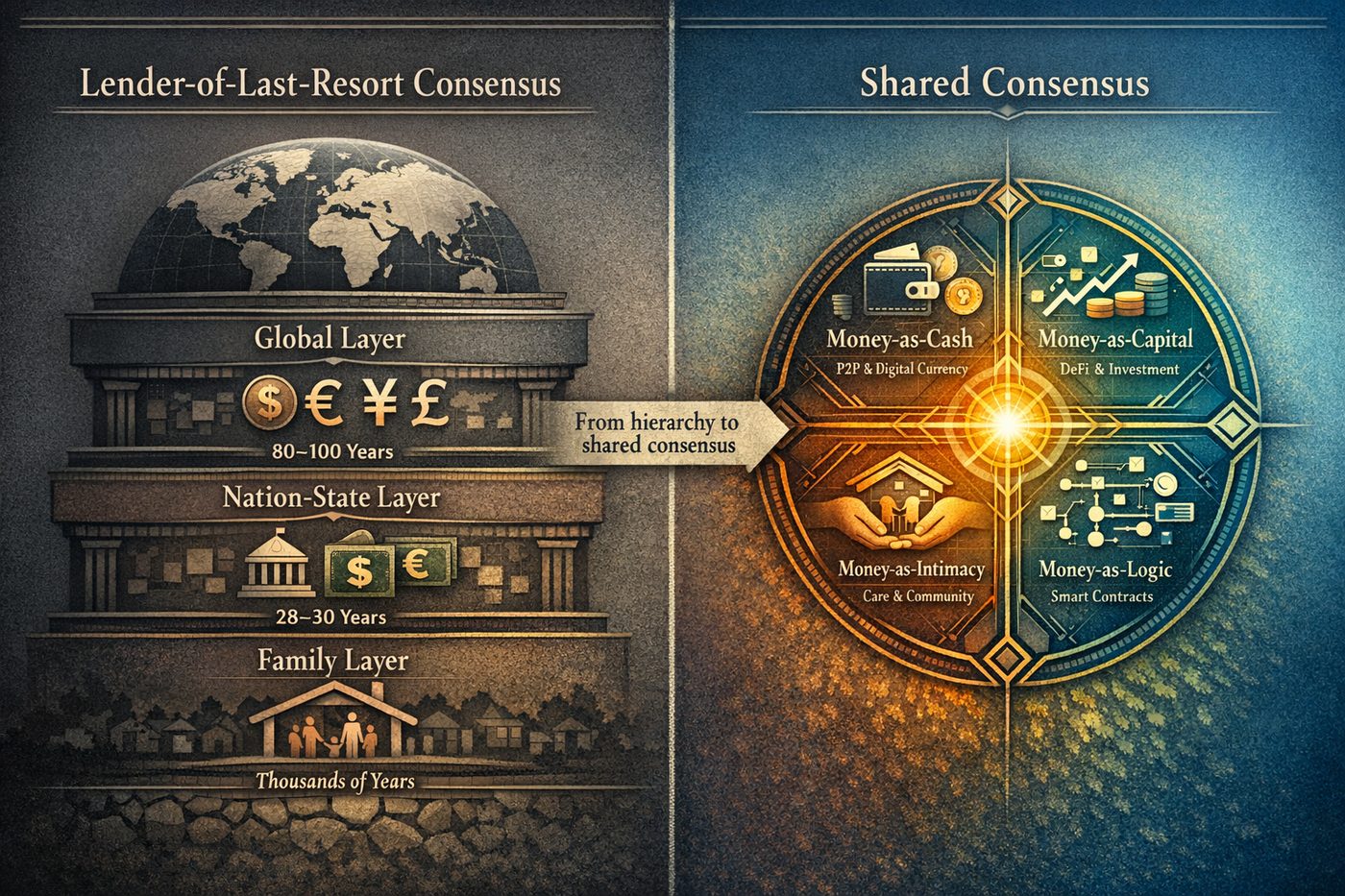
This is a humongous task. That is why this book restricts itself to an offering of design templates for these different economies. Let the entrepreneurs work out the intricacies like their business models, market structure, user targeting and regulatory labyrinth. It means movement of each design from the LOLR consensus to a shared consensus one. That needs to consider deeper forces at work in the legacy order and a serious avoidance of narrow compromises. Bitcoin was a great victory but still it is half-baked. Ethereum was a great multiplier force, but it is yet to build deeply embedded communities. Crypto infrastructure is technologically mature now, but it is yet to build a soft power in the mainstream. This needs a continuous engagement with LOLR stakeholders. Crypto needs to evolve into an avatar of architectonic science the way LOLR claimed this status over centuries.
1.5.1 Is LOLR an evil force?
LOLR consensus system is deeply resilient. It is at least 5,000 years old, even maybe 10,000 years old. Now even if the top layer collapses, it reconstructs itself in a very short period. Even if the second layer collapses, it reconstructs itself in a very short period. So, it means that this compulsive relapse is not a geographyspecific problem rather it is a design template issue. Now the question arises whether this consensus system is inherently evil. The answer is no. Okay. If a consensus system has survived for so long, it cannot be an evil system. But the point here is it has certain fallacies that makes it an evil force during certain socioeconomic circumstances or certain political circumstances. This evil was never spread over a long time and distance because of certain historical factors. For example, whenever LOLR used to print money, the metallic nature of money was a big deterrent factor. The king/emperor could debase coins, but it could not be ignored by the public beyond a certain point. Whether it was silver, gold or copper, the people could see the value crashing right in front of their eyes. All big empires or global reserve currencies could not hold on to their power once people stopped using those currencies. The alternative was not a nonLOLR choice, but people did move from a bad LOLR to a good LOLR. People could move from copper to silver or silver to gold or something else, but options were available. They chose an alternative with better intent at the top. In a nutshell, the coinage era was a big deterrent over LOLR going evil. The second deterrent factor was the geography and topology. A central regime in early days could not exercise long-distance policy impact because of lack of telecommunications and fast-moving transport systems. Local cultures did continue with their currency alternatives within their respective zones. For example, agricultural things like wheat, barley, cattle, horses, goats, sheep, cotton, mud pots were still used as local currency alternatives in many parts of the world along with national currencies. One may call it barter or some sort of remnants of gift-andreciprocity mode of exchange also.
1.5.2 Rise of restraint-free LOLR and colonization of the planet
That is why LOLR remained as the default thinking choice for thousands of years because it was not considered as an evil model. People could not transcend it, but they could reconstruct it all the time. Something changed seriously in the 20th century because two things happened. The metallic era of money was replaced by paper-based IOUs, and the geographical barriers were crossed by the fast and sophisticated telecommunications. This enabled the rise of modern central banking. In 1914, the Federal Reserve started operating, and it had a unique reason behind the shift. Before that, America had hundreds of private currencies, and they were predominantly paper currencies. Around 1860, there were over 8000 banknotes issued by state-chartered banks, railroad companies, canal operators and even churches. During the civil war in the 1860s, the nation imposed a penalty of 10% tax on all such currencies, but banks could still issue notes. For merchants, bills of exchange were primary tools of clearing long-distance payments. For example, if a merchant is to travel from California to Texas, carrying cash was a huge risk but carrying a bill of exchange was not. However, there was a small problem. The bill used to be encashed but only after paying a discount fee to the correspondent bank in Texas. Basically, it was a non-par cheque. The Federal Reserve changed this permanently. It introduced an at-par checking facility. $10,000 remains $10,000 at any bank branch wherever in America you go. This resulted in a death blow for private currencies, and they were obliterated over time. The Federal Reserve removed friction by creating a uniform national clearing system and hence a universal money. Before ruling the world, the USD needed to win at the domestic level.
From 1914 to 1945 formally, the sterling pound was still the global monetary standard. After 1945, the global reserve currency was replaced by dollar but not without putting a metallic restraint of $35 to an ounce of gold. Things appeared somewhat similar as they had over the last few centuries. But in 1971, America decided to do away with this gold peg. The moment this happened; the global reserve currency regime became an unrestrained force. This event was unique. It occurred for the first time in human history. Now, the entire global regime became a regime of floating currencies with one currency at the top and all the other currencies in the hierarchy number two, three, four and so on. Secondly, this was the era of rising power of telecommunication. Fast internet basically meant that geographical restraint also went away. So, in the last 55 odd years, an unrestrained LOLR became the default monetary grammar of the entire world. It simulated itself in an octopus-like manoeuvres into different economies from attention to governance, from housing to agriculture, from materials to relationships and from learning to urban habitat economies. This expansion into every corner of planet gave it a gravitational pull over the entire humanity. It has colonized the entire planet. A strangely faceless colonizer has been ruling us since then. Nothing of that sort had ever happened in monetary history when a restraint-free force prevailed over everything. National currencies simulated the similar lack of restraint too. What was left to decide for the bottom man-woman layer under this massive weight. It got diluted but not transformed. The family system was still patriarchal even if it was far more accommodative of female empowerment. Manwoman social contract did not have much leeway to redesign itself.
1.5.3 Self-inflicted decay of restraint-free LOLR
A restraint-free LOLR descended into a Ponzi pyramid like formation. We did not have kings or emperors anymore. We were democratic but also unrestrained by metallic standards or any geography. Money supply started getting inflated and it built stakeholders across the population. If governments could borrow via the securities market, corporations could also do the same.
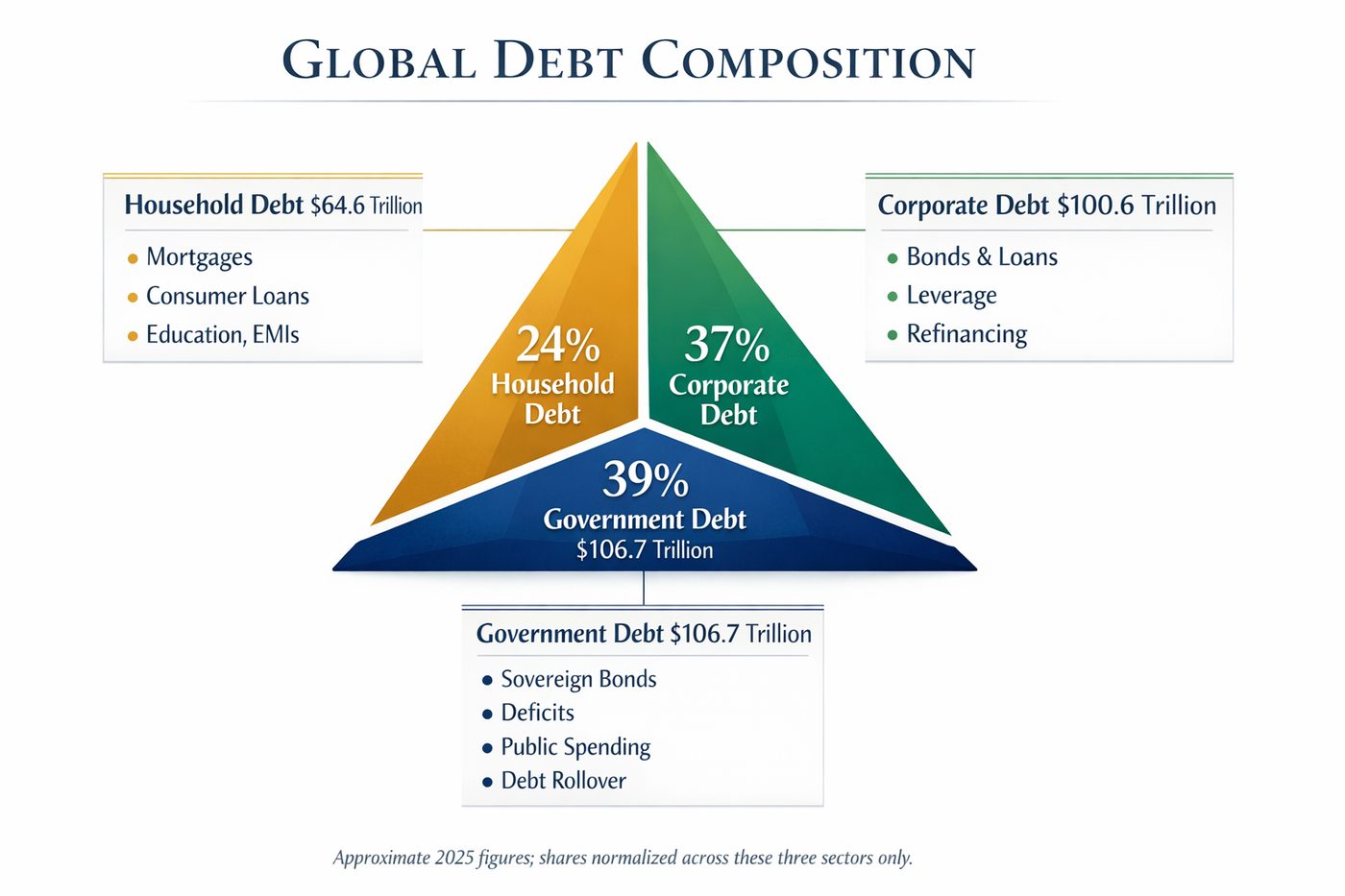
Households were never behind too. The EMI culture exploded with home loans, car loans, personal loans, education loans, credit cards and so on. LOLR ballooned so much and so fast at both global and national level that in five decades, the global debt multiplied to over three times of global GDP. During the earlier eras, Kings or emperors used to declare debt jubilee across their territories to establish their authority. Now, there were no kings, and banking systems were designed to offset any possibility of debt cancellation. So, what used to be done by debasement was replaced by inflating the debt, merger of commercial and investment banking, stock market manipulation by passive investing, real estate boom, yield curve control, euro dollar mechanics and so on. This has become the norm all around the world now. I used to wonder why David Graeber chose to name his book “Debt: the First 5000 years”. The answer was right in front of me. All the eight billion people on this planet are now living in a state of indebtedness, but nobody knows whom they are indebted to.
1.5.4 Bitcoin enters a world of people, indebted head to bottom
This is the debt-laden world where Bitcoin emerged in Jan 2009. The audience of Bitcoin and cryptocurrencies is basically the one that is living under a pile of debt from top to bottom. If early movers made 100x or 1000x from crypto move, the message they delivered to the world was not that of a true alternative of LOLR. The actual message was freedom from their own debts. It got converted into a get-rich-quick scheme for a normal human being. LOLR was the root illness not the individual poverty or family debt. Early crypto believers did solve for symptoms, but the real cancer was deep down. The pathology was architectural not individual. So, the entire crypto market was converted into a prediction market, and every token was treated as a memecoin. The true utility of a project of a token was sidelined which basically alienated people from the true purpose of crypto. And as a result, crypto went through this cycle of wonder, hope, disillusionment, and repeat. Crypto builders kept on innovating, but the audience kept on treating it to get out of their debt laden system because the way out of LOLR was never visible to them. Multi-level marketing players entered crypto in a big way. Marketmakers became pump-and-dump players. Liquidity engines were running a gambling like infrastructure. Everyone needed a quick exit. Sadly, crypto operated more as a subset of LOLR than an actual replacement of the same.
1.6.0 LOLR is old & weak but not dead yet
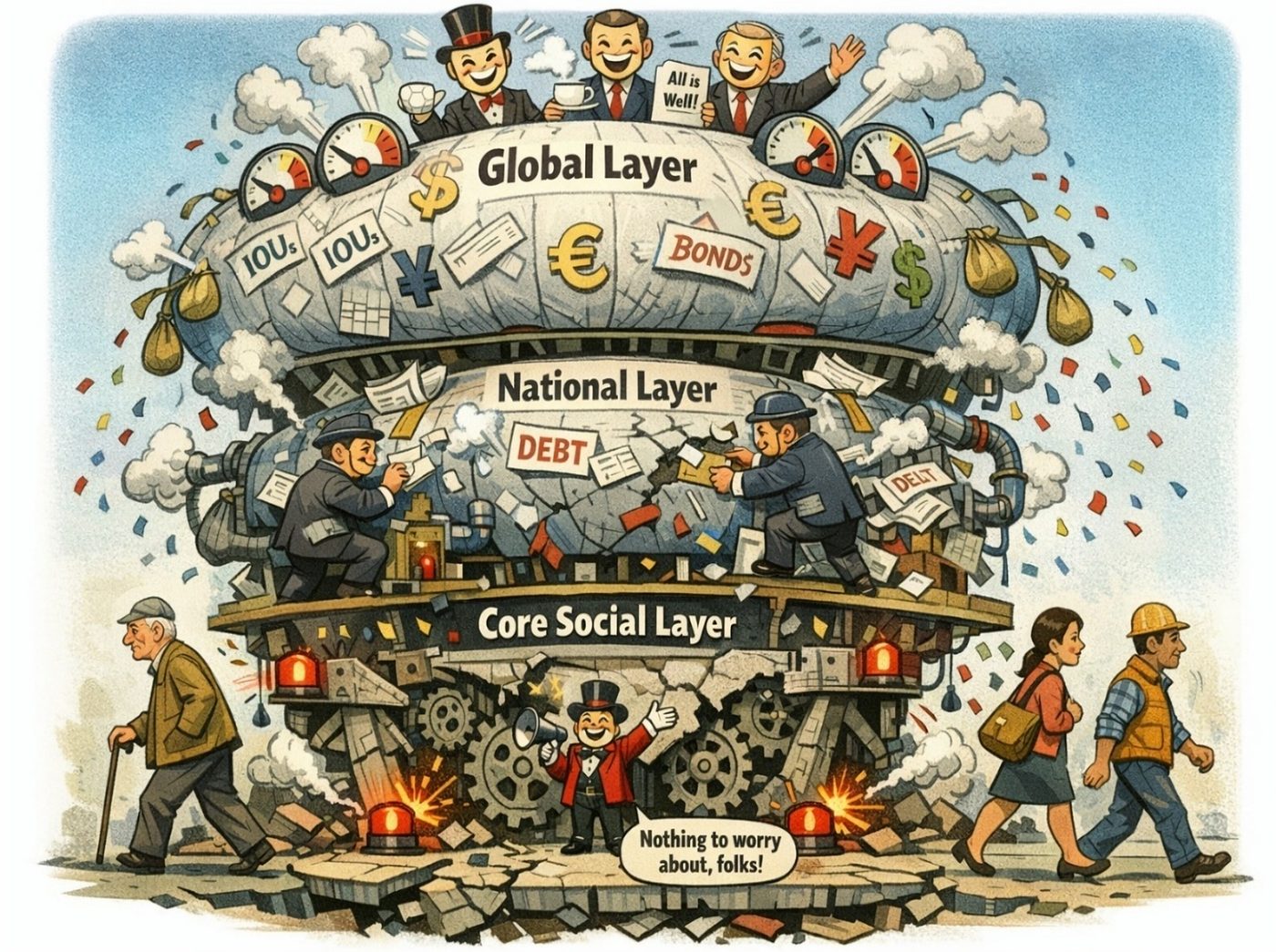
The Lender-of-last-resort consensus system is facing an unprecedented extinction threat for the first time since the advent of fixed settlement systems. The global layer is already over 80 years old, which means that its prime age as a dominant model is over. One may assume that there might be a contender for the status of next global reserve currency but the predominant actors in the second layer i.e. the nations are themselves passing through a strange crisis.
1.6.1 History does not repeat but it rhymes definitely
This crisis is quite analogous to the 16th and 17th century when nation-states as modern sovereign entities gained a clear status. There was a strange cartographic limitation in the previous periods. Map-making as a scientific technology got its recognition via triangulation and precise scale. Before that, people identified their sovereigns with allegiances. Though it was not a bad system but in hotly contested zones of authority, this led to fuzzy borders. Before that, it was almost impossible to figure out where the boundaries start or end. The thirty-year war (1618-1648) among European states could not be stopped because of a technology gap. Treaty of Westphalia (1648) made this science a shared truth among all. What was only an imagination of sovereign borders, Cartography made it a reality. Now, every border was a zero-sum line. On a piece of map, you are either outside or inside. There is nothing in-between. The tired and deeply injured states realized that mathematical certainty was a far better choice than fighting over micro plots of land.
1.6.2 Future is already here but still fuzzy
The 21st century is facing a similar problem of fuzzy borders. Human behaviour has shifted from physical permissions to digital permissions. Whether it is payments, identities, asset registrations, transfers, ticketing, entry and exit points, all have now a digital footprint. It means that network boundaries are now more important than national boundaries. Facebook, Twitter (now X), Instagram, Gmail, WhatsApp, Telegram, ChatGPT are virtual nations in a world of nearly 200 physical nations. Who controls the citizens of these virtual nations/networks? The owner platform or the government of a respective citizen’s nation? There are approximately five billion smartphone owners in the world who use these networks daily (no, every hour). For any nation to remain relevant at global or national level, it must become a big network. For example, India has UPI (Unified Payment Interface) that handles over 20 billion transactions per month. China has WeChat and Alipay that handle a similar scale. Ironically, the user data handled by Google, Meta Inc, Netflix, Microsoft, Open AI and Amazon is in no way less than that of national players. This makes the case for the second layer of LOLR quite problematic. This is a hotly contested zone. Corporate networks are global and irreplaceable while national networks are strong but not scalable. LOLR is in a serious jeopardy as it cannot repeat the historical grammar of repeating itself at national and international layers. There is a big vacuum at both design and implementation level.
1.6.3 Crypto has made the strongest claim to inheriting future
The last and the core layer of LOLR is that of man-woman social contract. The decline of TFR across the world, declining rate of marriages, rise of singlehood and unintended childlessness among women, population decline in many developed countries, rising youth unemployment at the global scale and many other factors are indicating the eventual obsolescence of marriage. It means that LOLR as a composite design template is no longer workable. What will replace this? Nobody knows the answer but that is the space of 21st century praxis. Crypto is ideally suited to perform in this new paradigm.
When Bitcoin emerged as a popular currency, it was a clear indication of the future path. National and global layers were stuck while Bitcoin chose a direction that was of the least friction. It unleashed a force like what Cartography did in the 17th century. It offered mathematical precision via game theory and cryptography, a thermodynamic basis of creating new currency units and total political neutrality. From a peer-to-peer perspective, this was the most realistic choice. What Bitcoin started, Ethereum multiplied the same with a huge factor. Nation-states had circular economy, blockchains also had the same. Nation-states imposed high cost of trust via taxation and debasement while blockchains were behaving like the proto versions of network states with low-cost trust architecture. Nation-states could not be scaled but blockchains were planetary by default. For the first time in history, human dependency over LOLR has been replaced partially at least if not fully. Compare the 15 years of crypto (2011-2026) with the last 5,000 years of LOLR. It is a job of nearly 200 generations done in less than one generation. Whatever be the pitfalls of crypto, this scale is astoundingly good.
1.7.0 Marriage choices of a crypto billionaire friend
A reader may feel as to why I am bringing man-woman relationship inside crypto as some may find it quite far-fetched or even totally unrelated. I don’t deny their scepticism but let me share something very odd that I came to know during my last Dubai trip. I have a friend who stays in Dubai Marina in a penthouse. He is in crypto since 2011. He has a few thousand BTC; made a lot of money from early Ethereum ICO; had quite a few successful exits. He lives the most luxurious life in Dubai. I used to consider his career a sort of blue-chip one from a crypto standpoint, but he had a strange mistrust for women and no desire for kids. He had a long-time girlfriend in his early career but once he emigrated to Dubai, the relationship broke. After that, he had a series of short-term relationships. When he turned 45, something changed in him. He decided to marry but of course, with a protection plan wrapped in a pre-nuptial contract. He hired the best of Dubai matchmakers and shared two pre-nuptial conditions: -
- The woman can command a severity allowance of $100 million only if she has at least two kids with him plus a commitment of $2 million per year till both the kids are 18.
- She must cook food for him twice daily with only a single day off per week.
Both the conditions were a bit upsetting. A matchmaker asked why he is making marrying him a difficult choice for others. He answered that he wanted a wife for homely values. If she could not give him good food and kids, there was no point in marriage. The matchmakers reached out to a lot of women but once they got to know of the conditions, most of them withdrew. Then, one day, one woman agreed to marry the man but with her own two conditions: -
- While she cooks the meal, her husband should be present in the kitchen at least once in the day with two days off per week.
- While she will bear not just two but as many kids as possible, he won’t disturb her sleep ever. Her husband must assure that he would wake up whenever the baby cries at night.
My friend never responded back to the woman, and I could not ask him why. He is touching 50 and still unmarried. He is still a rich man but looking at his life, I must say that he is cash-rich but care-poor. Had crypto cracked the fundamental construct behind LOLR, this dichotomy would have been solved by now.
Notes
- Graphical Processing Unit
- Field Programmable Gate Array
- Application Specific Integrated Circuit
- Initial Coin Offering
- Initial Exchange Offering means that the ICO process is limited to the users of a particular exchange where mode of payment may be any coin chosen by the exchange and promoters.
- Initial DEX Offering where a coin is offered as a swap on a decentralized exchange where liquidity is provided by the project promoter or the platform founder.