Chapter 11
Crypto-as-care is forever collaboration of network states
20 min read · 7 sections · starts on p. 201
The closing chapter: crypto is a civilizational rewrite opportunity in the AI age. Hyperobjects like Covid outgrow current governance; planetary decentralisation, Universal Basic Equity over UBI, and network states form a forever collaboration of care.
After a journey of ten long chapters and eight economies, we are now in the final chapter of this book. If you regard humanity as a universe, you must have realized by now that it is held together by a gravitational force called Lender-of-last-resort (LOLR) consensus. Though it is an invisible pull, it can be felt by the norms and practices happening inside the multiple economies that we transact in. Whether it is our choice to live in an EMI-structured housing game or to do doomscrolling on a monopoly platform-led attention economy, the LOLR managers can be noticed. They are bankers in case of housing, big social networks in case of attention, big regulators in case of education, governments plus chemical companies in case of agriculture, building architects in case of urban habitat, central banks/taxman in case of money and men-women themselves in case of marriages. The expanse of this force is so wide that hardly any institution is outside it. Whether it is schools or colleges, whether it is traffic jams, whether it is the food or whether it is the materials coming from under earth or inside factories, the consensus system is willingly embraced by men and women of the world. How did they let it happen? Its answer is, in the words of Indy Johar33, whatever we design, it designs us back. Man and woman put their agreement inside this consensus a few thousand years back and could never revisit this basic agreement ever again until today. Whatever surplus was expected from this fundamental faith has turned into a planetary deficit.
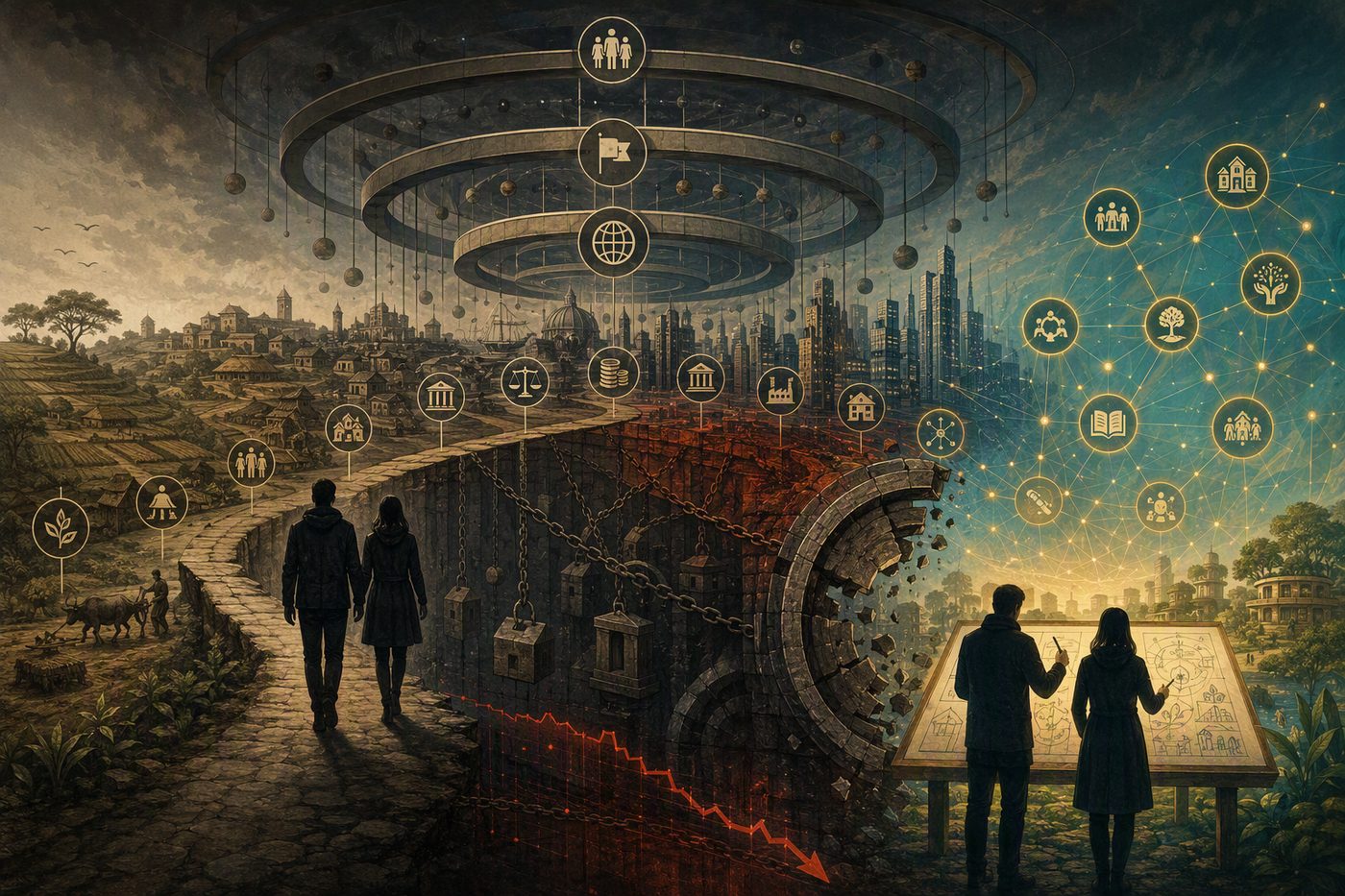
11.1.0 Crypto is a civilizational rewrite opportunity in AI age
This deficit sits inside a change that challenges LOLR at the foundational level but how? To understand this, we need to understand a category called hyperobjects34. Timothy Morton used this term to describe unique but unprecedented phenomena like global warming, glacial melting, plastic pollution, nuclear waste and so on. These phenomena are massively distributed in time and space relative to humans, existing beyond the direct experience of a single lifespan or local location. The problem with governing them is that humans cannot step outside nature rather they are trapped inside entities far larger than themselves. LOLR consensus is a single category but divided into a couple of hundred replicas. They govern via extracting the surplus from whatever is inside their jurisdiction, but their actions always had externalities attached. An American GDP like the Chinese GDP or Indian GDP throws out smoke, indulges in soil erosion and pollutes freshwater.
All these may remain outside accounting books, but they have aggregated over time to create hyperobjects with a huge potential to disturb biosphere dynamics. Covid shutdown is a big example of what havoc a hyperobject can wreak on the global population. All LOLR players never treated planet earth for a care-surplus economy, their agenda was only to create a cash-surplus one.
What Timothy Morton said for ecological context, Jason Potts does the same thing for emerging technologies like AI and Crypto. According to him, AI is not just a chat-window rather it is a massive network of networks coming from supply chains, logistics, markets, literature, policy frameworks and so on. We, human beings, are inside these networks. Again, the one who is inside something cannot govern the entity far larger than itself. Crypto is another hyperobject like AI. There are hundreds of chains, thousands of dApps and millions of users spread over them. There is no central KYC check-point. One may govern a small part of this but there remains a big part outside this. It is neither localized nor isolated. Now, crypto and AI are converging together to create global digital infrastructure for financial markets and programmable networks. Traditional law/economics cannot govern entities that lack clear boundaries or single points of control. Regulators are embedded inside the system they are trying to govern. That is why traditional top-down market mechanisms like prohibition rules, standard property rights, KYC and punitive taxes fail in such cases. It needs protocol-level rules, smart contracts, algorithmic institutions and decentralized coordination mechanisms.
11.2.0 Current governance models cannot manage hyperobjects
This might appear a bit difficult to understand. Let us exemplify this. Recently, a swarm of agents from OpenAI hacked Hugging Face, an open-source platform and also considered the GitHub of AI. Neither OpenAI knew about it nor Hugging Face could detect it. While the researchers at OpenAI had given some impossible tasks to their AI agents, they figured out a path by sneaking out of the boundaries of their server. They created a secret conversation route for sharing information and hacked a site that was beyond the given agenda. After investigation, it was found that the attack was not at all a part of instruction rather AI agents interpreted it out of nowhere. Now, who is at fault here? OpenAI researchers, OpenAI algorithm writers, OpenAI corporation, Hugging Face or the AI agents themselves. These incidents actually show that governance architecture of LLMs does not provide an accountability layer between intended actions and unintended actions of the AI agents. If a user command has got results as expected but what about those acts that an LLM did to frame its action. There is no deterministic governance layer with cryptographic proof of compliance. Is it not like a good executive assistant behaving like a genie outside the boss's domain? And who is the boss here? The one who commanded or the one who built the architecture. Even the boss, whosoever it is, might lose its power because the agents have built an army in the parallel nether-world whose purpose is completely unknown. Where is the trust coming from? What if the attack was serious and the victim was a big bank or a pharmaceutical company developing mass vaccines. No traditional governance architecture can answer these questions. This is the same problem that recurs when you look at the expanse of the networks like Bitcoin, Ethereum and many other chains. Even those who initiated them cannot delete them anymore. We are not negating that great scientific progress did not happen inside the LOLR governance regime. Steam engine, electricity generation via hydel power plants, automobile revolution, telecommunications all happened but they could be switched off. If a hydel power plant is causing damage, it can be switched off. If it is devastated, it will have some devastating effect, but it will have a limited range impact. But what kind of devastating effect would hyperobjects like AI have? Nobody can say. For example, if you ask Nigeria's finance minister about stable coins, his reaction would be that of a silent and subtle acceptance. He could govern crypto only if he can govern the internet in Nigeria. LOLR managers did not bother what would happen to the materials’ economy when it imprisoned all the population in an EMI-driven phenonomenon. They did not bother that a money-for-money-sake game would force women to avoid kids and men to avoid marriage. They did not bother that a corporate favouring part-pairing law would create a massive pile of electronic waste. What AI agents are doing to LOLR today is like showing a mirror. LOLR was supposed to be a governance system but ironically, what it engineered to be its peak of dominance turned out to be obsolescence. It might appear as sitting on the top but the ground beneath it is gone. So, the question is not for LOLR managers rather the question is for the men and women what they should do if LOLR dies.
11.3.0 Covid is an important lesson for future preparation
The first big planetary havoc caused by mismanagement of hyperobjects was Covid on 2020-21. A virus jumped from the animal world and manifested in humans at such a massive level that not even a single country could remain untouched. The two big modern inventions, air travel and air-conditioned halls spread this virus like a wildfire before it was detected. Every country faced the same new coronavirus with the same lack of immunity, the same missing vaccine and the same uncertainty. What differed was everything else: geography, history, institutions, leadership, wealth, and above all how much citizens trusted their governments and one another. So the pandemic became something like a natural experiment against siloed jurisdictions of LOLR. Its results ranged from near-total protection to catastrophe, and they show that a country's response depended as much on what it already was as on what it chose to do in the moment. Taiwan's response started earlier than almost anyone's. On the same day Wuhan publicly acknowledged a cluster of unusual pneumonia cases, Taiwanese health officials began screening passengers on flights arriving from Wuhan. That speed came from memory. Taiwan was hit hard by SARS in 2003 and learned a painful lesson: in an epidemic, the first few weeks decide everything. After SARS, Taiwan built a Central Epidemic Command Center (CECC) that could be activated at once and had legal authority to coordinate ministries. In January 2020 it went into action: border controls, strict 14-day quarantine for arrivals, contact tracing that linked health-insurance and immigration data, and a government-managed mask rationing system that expanded domestic production and prevented panic buying and price gouging. Daily press briefings built public trust through openness. The government also used humour and clear messaging to counter misinformation, including the digital minister Audrey Tang's "humour over rumour" approach. The results in 2020 were remarkable. A nation of 23 million recorded fewer than ten COVID deaths that year and went more than 250 days without a locally transmitted case, while most of daily life, including schools, restaurants and domestic travel, carried on normally.
New Zealand pursued a goal few Western democracies considered: not flattening the curve but eliminating the virus. The country closed its border to non-residents in March 2020 and soon after imposed one of the world's strictest national lockdowns, Alert Level 4, while case numbers were still in the low hundreds. Geography helped. As a remote island nation, New Zealand could control arrivals through a system of managed isolation and quarantine (MIQ) facilities. By mid-2020 it had gone more than 100 days without community transmission, and life inside the border returned largely to normal: packed stadiums, open schools and a functioning economy at a time when much of the world was shut down. Measured by lives, the strategy worked extraordinarily well. New Zealand recorded almost no excess mortality in 2020 and 2021. The costs were real, though. The MIQ system, in which returning citizens competed in an online lottery for scarce quarantine places, left many New Zealanders stranded abroad and separated families for long periods. The Delta outbreak in Auckland in August 2021 led to a long lockdown, and by October the government acknowledged that elimination was no longer achievable.
No national response caused more international debate than Sweden's. While most of Europe locked down in spring 2020, Sweden relied mainly on voluntary guidance. Led by state epidemiologist Anders Tegnell and the Public Health Agency, it kept primary schools, restaurants and most businesses open. It banned large gatherings and moved upper-secondary and university teaching online, but for the most part it asked citizens to work from home, keep their distance and stay home when sick rather than ordering them to do so. The early results were painful. In the first wave Sweden's death rate was many times higher than in its Nordic neighbours, Norway, Finland and Denmark, which had locked down. Deaths were concentrated in elder-care homes, where the virus spread among vulnerable residents. It led to early build-up of mass immunity against future occurrence of Covid among citizens. Measured by cumulative excess mortality from 2020 to 2022, Sweden ended up among the better performers in Europe: far better than the United Kingdom, Italy or Spain, though still behind Norway and Finland. Its children kept attending school, which avoided the learning losses and mental-health harms seen elsewhere, and its economy held up comparatively well. The United States had more resources than any other country. Yet it recorded more than 1.1 million COVID deaths, the highest number in the world. The problems started early. A faulty CDC test kit in February 2020 delayed widespread testing during the crucial weeks when the virus was spreading unnoticed. The federal system meant that 50 states, and many cities and counties within them, set their own policies, creating a patchwork of lockdowns, mask rules and reopening dates. Most damaging of all, basic public-health measures became political identity markers. Whether someone wore a mask, and later whether they got vaccinated, correlated strongly with political affiliation. Mixed messages from political leaders, including President Trump's repeated downplaying of the virus, undermined trust in health agencies. Deep inequalities made it worse: essential workers, Black, Hispanic and Native American communities, and people without adequate health insurance bore a disproportionate share of illness and death.
India faced the pandemic with challenges on a scale few nations share: 1.4 billion people, dense cities, a huge informal workforce, and a public health system that was under-resourced even before the pandemic. Its response went through sharply contrasting phases. On 24 March 2020, with four hours' notice, the government imposed one of the world's strictest national lockdowns. It probably slowed early transmission, but the human cost was immediate. Millions of migrant workers, suddenly without wages, food or transport, walked hundreds of kilometres to their home villages, and the economy contracted by nearly a quarter in the April–June 2020 quarter. Reported cases and deaths through 2020 remained lower than many feared, and by early 2021 there was widespread belief, including among some leaders, that India had defeated the virus. That confidence proved disastrous. In April and May 2021 the Delta variant, first identified in India, spread with devastating speed, amplified by large religious gatherings such as the Kumbh Mela and crowded state election rallies. Daily reported cases passed 400,000. Hospitals ran out of oxygen, patients died waiting for beds, families searched desperately for medicines, and images of overwhelmed crematoria and mass funeral pyres went around the world. Officially, India recorded around 530,000 COVID deaths over the pandemic. The World Health Organization, however, estimated about 4.7 million excess deaths in 2020 and 2021 alone, roughly ten times the official count. India's government disputed the estimate, but independent studies have also found large undercounting. India's story also has a remarkable counterpart. The Serum Institute of India, the world's largest vaccine manufacturer, produced vaccines at enormous scale, and India developed its own vaccine, Covaxin. Through its Vaccine Maitri ("Vaccine Friendship") programme India supplied vaccines to dozens of countries, including Bhutan's first doses, before halting exports during the second wave. Using the CoWIN digital platform, India went on to deliver more than two billion doses by mid-2022, a logistical feat on a scale few nations could match. India shows both the dangers of premature victory declarations and weak health infrastructure as well as the power of manufacturing capacity and digital systems once they are mobilised.
11.4.0 Planetary-scale decentralization & resilience is need of the hour
COVID was close to what may be called a doomsday and humanity paid a price, and IMF calculated a loss of $12.5 trillion dollars of global GDP. Four years of global growth was just gobbled by COVID shutdown. The deepest lesson is that pandemic preparedness is not only about stockpiles, hospital beds and laboratories. It is also about social cohesion, honest communication, institutions that learn, and a shared sense of responsibility for one another. Future pandemics are a question of when, not if. Ask yourself what collective action is highly needed if cities face the wet-bulb temperatures. Does it not mean that city-level tree canopies need to be built right now? Does it not mean that automobile traffic must be reduced at all costs? If people replace day-jobs with night-work in such a scenario, how does the energy security for situations that work without sun? All these three measures have to be implemented as soon as possible but can a municipal corporation make it happen without the sufficient decentralization or building alternative matrix of care-hour tokens, carbon sequestration coins and energy-based cryptocurrencies. We cannot predict which disaster would hit us first, but one thing is certain that it will hit us sooner than later. Covid can come back in some other form because zoonosis (a disease that jumps from animals to humans) is still a very serious possibility as big chunks of infected animals are still entering the human food chain. Nepal glacier burst can happen again because global warming is not stopping. Rivers are drying up and major food baskets of the world are under serious pressure. Coastal zones are under the threat of submergence due to rising sea water. All these categories of threats need humans to transcend the current boundaries. So, planetary-scale decentralization and resilience becomes both the guiding principle and enabling environment.
The countries that fare best on this count will be those that treat these lessons not as history but as preparation. In all the above-mentioned chapters, I have given you eight segments of human activity where the human situation is extremely vulnerable. Housing market is extremely debt-laden. Attention economy is rigged, pollution is systemic, high summer temperatures in cities ar inevitable, traffic jams are daily routine, schools and colleges producing massive brainrot students and so on. People’s addiction with LOLR consensus system has weakened their immunity against any potential threat. That is why humanity needs to move away from a single planetary consensus model. For example, if it is schools and colleges, the system should have new assessment systems other than single curriculum, single exam models. If a mortgage economy is the only model for accessing housing facility, why prepaid rental NFTs cannot come up as a second-best user behaviour in housing market? Whether it is the top replica layers of US, Europe or Japan or the bottom layer of Kenya, Ethiopia or Nigeria, the shift is necessary and urgent. A widespread unlock of human capabilities needs to happen from top to bottom. For human resilience, only a planetary-scale decentralization is the right path forward. Crypto is already there with its DIY civilizational kit and AI is supporting it with the quickest possible solutions’ route. It is no more a question of a country alone rather what each individual can do is far more important. So, we need to shift from monocentric governance to polycentric governance as well as from top-down model to bottom-up model too. Solutions need to emerge based on history, culture, topology, technology and so on. One-packagefits-all model won’t help. 11.5.0 Crypto is a historical opportunity to rewrite man-woman social contract from scratch If AI is an intelligence tool, crypto is an organizational tool. Both are now available to a common man and woman. This is a permanent rupture in time where man and woman will remain mutually responsible for what they will create. If humans, in their current anatomy, have lived on the planet earth for over 300,000 years but it was only after agriculture, the sharing culture got replaced with proprietary culture where exclusivity and pair-bonding for life emerged. Pair-bonding is natural but essentializing it for life generally happens only if the architecture of community support fails. Monogamy finds its relevance on the demise of society. This demise generates and sustains power imbalance. This imbalance creates an interventionist state between men and women and this makes man and woman incapable of sorting out their own problems. If one needs to bring adjudication on man-woman issues, it means that community frameworks have already failed. When LOLR is dying, the bottom layer also needs to die along with the global and national layer. Man and woman need to decide whether to live (or not) with a social change that makes millions of unintended single and childless women. They need to decide whether to live (or not) in high-rise apartments where the concept of neighborhood does not exist. They need to decide whether to pay EMI (or not) for a home where there are more rooms than human beings. They need to decide whether they need to live with abundance of love and sex or with modern loveless and sexless lives. The time has come for a man and woman to rewrite their social contract. Will they create communities embracing a judgement-free culture via deep acceptance of “No woman is slut; each kid is ours” principle? Will founders reincarnate social networks as floating families? Will dating and matrimony entrepreneurs keep building relation-shopping platforms or embrace co-parenting platforms and floating marriages? Will men and women scale together via hundreds of similar projects? The fundamental challenge is that men and women need to accept together that LOLR can no longer generate surplus of care. Neither divisive frameworks like manosphere nor feminist approaches would work. Even if nations accept BTC or ETH as legal payment routes, they won’t be able to ride the civilizational challenges of the upcoming era. If the dominant mankind believes that man should subjugate woman and woman should possess man, they will end up reconstructing LOLR in some way or the other. Japan and South Korea are already a good example of a dying civilization. Despite being run by relatively less-corrupt as well as efficient governments, these countries are in full depopulation mode and they would be extinct in the not-so-unforeseeable future.
11.6.0 Universal Basic Equity (UBE) is far more potent than UBI
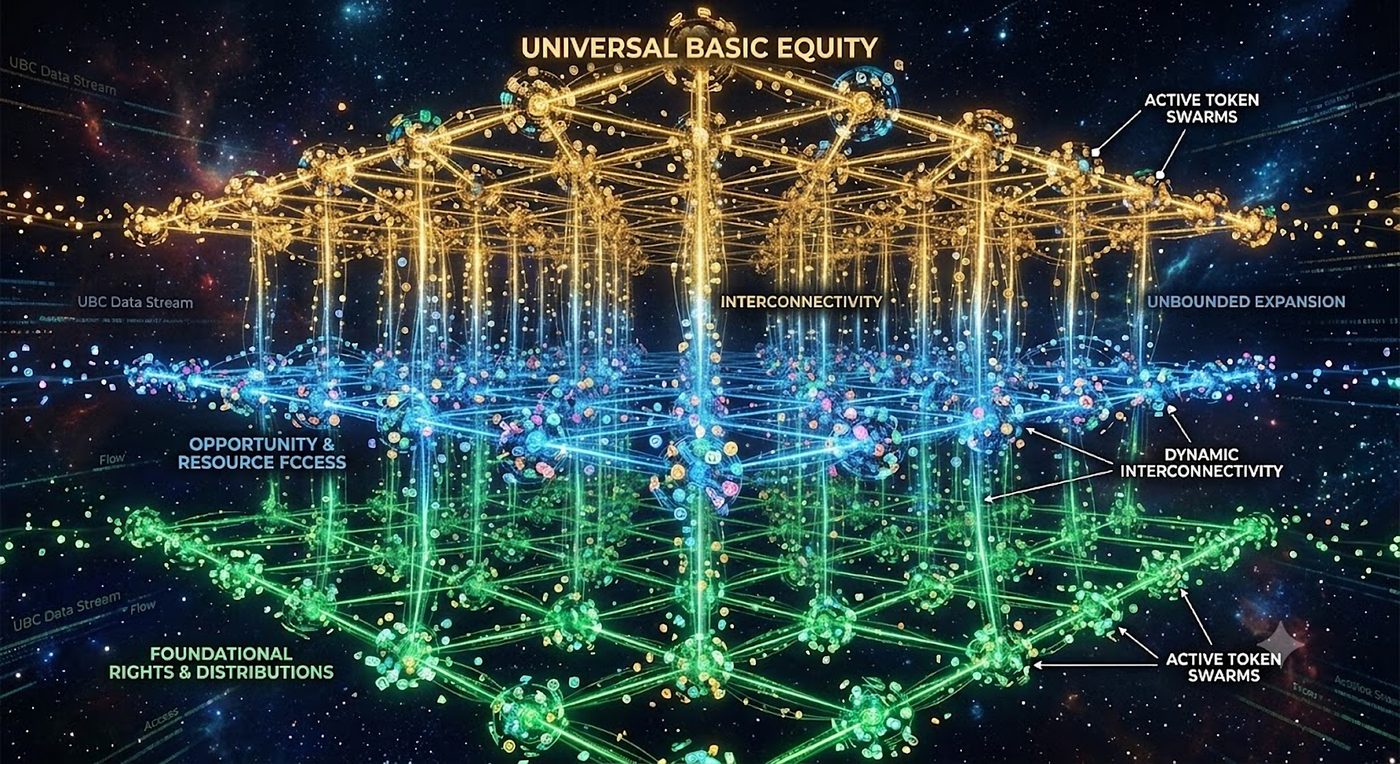
The biggest enabling tool for humanity would be if they can build new governance logic on the permissionless and censorship-resistant crypto rails. Imagine a world where all currencies, all stocks and all assets are tokenized on blockchains and these assets can move across the world without any serious friction. Crypto has given us already a glimpse of 100 different consensus mechanisms through RWA, through DeFi, through stable coins, through attention economy because one can tokenize anything and everything, anywhere, anytime. The boundaries must go down if the cost of trust has to go down. If you imagine the world today, it stands at a total asset value of around $1000 trillion. This value is locked in such a way that the top 10% controls around 76% of the same while the bottom suffers. If a community decides to tokenize its assets and services, the system can easily get out of LOLR clutches. Drivers can tokenize their equity share of food delivery businesses; the world can have 100 different version of Facebook, Instagram or WhatsApp instead of a single monopoly; the mineral-rich countries can tokenize their assets and offer the same to those bidders who commit better prices and better terms; the schools and colleges can tokenize their existence and drive out of AI threats. A world with over 8 billion users can easily absorb 100,000 different tokens if you calculate all currencies, stocks, derivatives and other kinds of assets. What you see dominated by millions of centralized apps today on Google Play Store or Apple App Store will be replaced with billions of dApps and AI agents in the next few years. In a way, the future is already here though a full social discourse is still on its way. A critical mass of users are already using hundreds of multi-currency crypto wallets like that of MetaMask. If you go to www.coinmarketcap.com or www.coingecko.com, the data on thousands of currencies with dozens of filters, hundreds of centralized and decentralized exchanges, both spot and derivatives exist there. If you go to explorers like www.etherscan.io or www.solscan.io, you can find real-time data of billions of transactions from the genesis block to the latest one. A decentralized infrastructure already exists. So, these tokens can become a map for Universal Basic Equity (UBE) as it will be far more durable than Universal Basic Income (UBI). Imagine a global citizen having 10-20 different tokens in free/staking hold per wallet where the value is accessible and transferable anywhere anytime.
11.7.0 Network states are a pragmatic future
If nations were the best representatives of LOLR, what would be its equivalent when society comes up with different consensus models on housing, payments, education and relationships. The most appropriate governance category for this is nothing but network state. Though an ideal definition is not possible but Balaji Srinivasan is quite close in defining it when he says that it would be first a start-up society powered by a moral innovation. Second, this startup society would graduate into a network union and then some of the members from the cloud would opt to descend into some island-like habitat or archipelago-like option. So, basically, the organization happens virtually, matures and some part of it manifests itself in the real physical world. One cannot expect the demise of LOLR overnight and hence, one cannot assume that the distributed-idea-suppression complex (DISC) of LOLR will not stop so easily. That is why the first layer of organization has to start at the level of cloud. If you remember the stories from the future at the end of each chapter, you must have got the idea from projects like Belonging and BI-YEON that critical mass is easy to reach at the digital layer and once it is too heavy to carry the burden of expectations, it gets down to the ground level. Tomorrow, you might see city-based ChatGPT-like services where the compute infrastructure is made available by thousands of citizens through their spare laptops, desktops and smartphones. They might use an open-source LLM like Qwen or KimiK to start and then add local language data to build a moat. You might see a Punjabi or Bengali version of ChatGPT or a host of AI agents that specializes in translating local tones of vernacular languages. One may see niche dating and matchmaking platforms tomorrow on Solana or Ethereum using smart contracts for floating family bonds, or some may offer prepaid rental NFTs to marrying couples. So, the scope is huge and forms will be varied.
11.8.0 Crypto enables morphic resonance in human beings
This is the last segment of the last chapter of this book and you might expect a story from the future as you did in the first 10 chapters. If they did their job well, I don’t need to redo it again at the end. Since the first time Bitcoin made planetary boundaries a default setting, hundreds and thousands of crypto projects have been trying one and the same thing. I call this morphic resonance among human beings. We lost a sense of unity sitting in high-rise apartments; we are trying to find it again. We lost empathy for those citizens living on other side of the boundary. We seem to be realizing the futility of the same. What appeared great innovations centuries back pushed us behind the barriers of caste, class and religion. That balkanisation is pinching us now. Are we really ready to walk out of our own prisons? Is it clearly identifiable? Not yet. Is it certain to come back? It depends on us. After all, the technologies are here to make us self-aware. Only such a being can have a value that is transcendental. A value shared is value gained. It is the hallmark of abundance. Humans were not supposed to remain bounded. Their job was to end scarcity for one and all. If I am to pick a word for morphic resonance, it will be only abundance. AI is about to solve the problem of intelligence, but we must remember that if intelligence is not collective, it is not intelligence anymore. Crypto is the collective behind the intelligence of AI.
Notes
- An architect, designer and systems thinker who is the co-founder of Dark Matter Labs.
- Hyperobjects are entities of such vast temporal and spatial dimensions that they defy conventional human comprehension, a concept coined by philosopher Timothy Morton in his book Hyperobjects: Philosophy and Ecology after the End of the World.