Chapter 10 · Governance
Trust-less protocols of governance
31 min read · 9 sections · starts on p. 183
Legal tender was designed for a physical economy, not a network one. On-chain sovereign currencies backed by gold, land or data/compute, and municipal care-hour tokens, are proposed as the network avatar of the nation.
In the last week of July 2026, there appeared a YouTube interview31 of Elon Musk with the editor-in-chief of the Economist, Zanny Minton Beddoes. Like many of Musk’s interactions, it was also a widely seen video but it carried one unique element that stayed in many minds. While answering a question about the future, he declared that “money won’t matter in 2036”. The Economist editor was a bit flabbergasted at this and asked for clarification from him. Elon Musk answered, “People need money for buying goods and services……. but by 2036, AI and Robotics will produce such an immense supply of goods and services that any human being cannot consume…………. What do you need money for?” The editor was completely at a loss because in 2026, money was immensely critical. For her, to make a conceptual jump from dominant monetary status in 2026 to a redundant one in 2036 was too difficult. This bridge 2026-36 is a big elephant in the room. Despite a believable prediction of money’s demise in ten years, it is beyond comprehension how it would happen. It may look like a very rosy prediction but there is a dark fact hidden inside it. It also predicts that money-as-we-see today will die in the coming few years. So, one half of the story is that of a burning bridge and the second half belongs to a resurrecting bridge. If the second half is mystical, the first half is horrifying too.
10.1.0 Money’s future is both mystical and horrifying
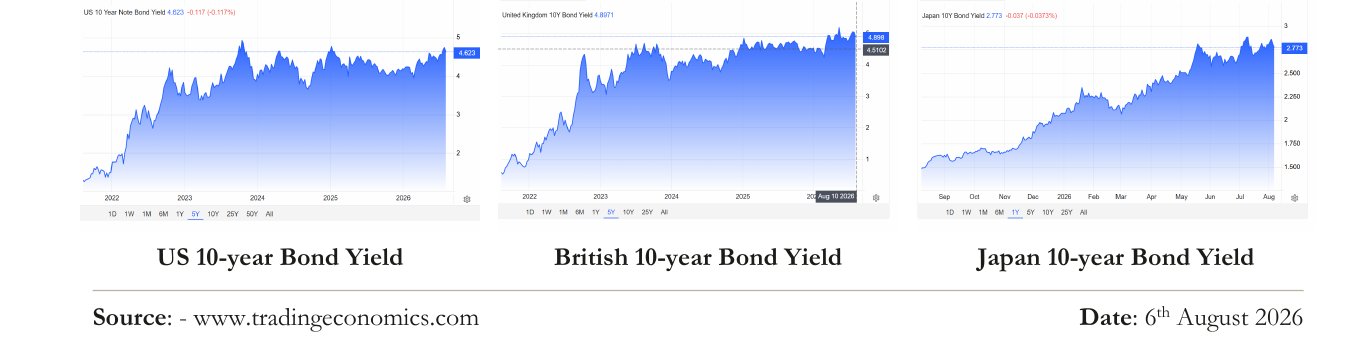
The mystique around money does not exist without its own horrors. So, there are three segments of this story. The first is the one that tells the demise of money; the second is the one that links a dying past with an emerging future and third is the one that shows the true picture of money’s future. If you look at the modern period, LOLR solved the scarcity of capital magically. People needed capital for their shipping expeditions across seven seas. Governments needed capital for building long distance railways, telecommunications infrastructure, large insurance corporations, global supply chains and so on. The consensus system behind lender-of-last-resort built joint stock corporations, fractional reserve banking, global bond markets to solve the scarcity of capital. AI infrastructure like data centres, nano-meter range computing chip-making fabs, big energy grids and talent all came together to build the pinnacle of LOLR achievements. Nation-states, the biggest drivers of LOLR, became very big lenders as well as big borrowers in such a uniquely managed way that everybody could borrow and borrow almost indefinitely. From governments to households and from households to corporations, everybody borrowed but the productivity of debt diminished faster. The situation has reached a point where new loans are being taken only for paying back old loans. Jeff Booth is not misplaced when he says that $1 of GDP growth happened with $4 of debt creation in his book.32 The problem was well established by the 2008 crisis, but LOLR never stopped pulling out rabbit after rabbit from its own hat. AI is the latest one, but it seems to be the last one too. A debt-sponsored abundance will be a fake one because it destroys more capital instead of creating one. Now, the borrowing limits are exhausted. For an overview, just look at the following table of three big nations as well as three big borrowers of the world. See what has happened to their borrowing cost. It shows that borrowing cost has gone up nearly four times for the USA, Japan and Britain. Things are not much different for the rest of world. Now, here comes AI that breaks the spine of LOLR. If citizens are paying their taxes to the governments, EMIs to their banks and daily lives to the corporations, there should have been no point of concern. But AI started damaging the white-collar employees first. A software project that needed 100 employees for 100 days could be done by 10 employees in 10 days and even less. If AI succeeds, it is a suicide for LOLR. If employees are without jobs, it means that governments are without taxes and banks are without their EMIs. Any further money-printing would only aggravate the scenario. Now, let us come back to what Elon Musk said. He did not mention clearly that money-as-we-seenow will die. Yes, it would have been a catastrophic statement on his part, but he did mention a bright future. So, how do you jump from this era of crisis when lenders can't lend, and borrowers can't borrow to an era where we shift from the deficit of today to the surplus of tomorrow?
10.1.1 Money consensus needs an upgrade
The first thing that one must acknowledge is that LOLR cannot keep lending anymore; its golden era is over. It cannot create surplus anymore. The obvious ramification of this realization is to stop lending further, but the problem is that the entire global economy is addicted to money. Its liquid flow act as the fuel of household consumption as well as welfare economics of the governments. Liquidity stops and everything else stops simultaneously too. The value of currencies would not fall rather it would crash if this happened. Liquidity prospered under the solid assurance of tax-paying and debt-repaying employees. Before that, liquidity thrived under the solid anchoring of gold. If both are gone permanently, the liquidity itself would also perish. So, the fundamental realisation here is that money is both solid and liquid at the same time. Solid introduces restraint while liquid enhances productivity. Both properties should work in sync. The simplistic way of understanding solid property of money is if we issue gold backed money as it was during the majority of LOLR regimes in the pre-1971 era but physical-ness is not the only virtue of solid money.
10.2.0 Legal tender was designed for a physical not a network economy
The 20th century model of fiat money was relevant for establishing a monetary standard and economies of scale in a world where a single player could pool in the transaction costs of a physically dispersed system. Though it did solve the problem of standardization yet it had one flaw and that was how to reach the last mile customer. That is why fractional reserve banking was created as the second layer over central banking to manage the liquidity needs of the people. The problem here is that the system is fragmented between central bank and commercial banks. The central bank is a true public goods manager as it is an entity with fiduciary responsibility to each currency user, but commercial banks are less-than-full public goods. They are corporations, both private and public ones subservient to the primacy of shareholders’ interests. If a central bank changes its reference rates, the commercial banks don’t transfer it to the public in an equally transparent and equally fast manner. This model took shape inside a historical context when fiat currency was the only player-in-the-nation, and it delegated a part of its power to commercial banks. However today, a central bank can reach out to each citizen via a simple digital application. Its dependence on commercial banks is no longer necessary. So, the solid and liquid properties of money need to be relocated into a system that is better than what exists today.
The better version of this is to build an on-chain restraint model where the issuance is locked the way it is done in Bitcoin and Ethereum. Bitcoin locks it via keeping the maximum supply at 21 million tokens while Ethereum maintains the solid nature of money via pretty low inflation coupled with transaction fee burn model. Both result in nearly the same thing. If Bitcoin is locked at 21 million tokens, Ethereum is locked around 122 million tokens. The better part here is that these systems not only offer macro lock but also micro restraints. Bitcoin offers halving of block reward every four years. It started with 50-coin reward per block in 2009 but today, it kept on going down from 50 to 25, from 25 to 12.5, from 12.5 to 6.25 and now it stands at 3.125 per ten minutes of coin issuance. Similarly, the current supply of 122,087,478.83 ETH (as on 28th September 2026) is managed in a low inflation range by a mix of staking rewards and transaction fee burn. This is unlike a central banking model where the actual money supply is revealed by the central bank only and there is no seriously reliable way of double-checking the amount. For example, how many currency denominations in how much amount is a tricky thing because there is a huge time lag between the money printcum-distribution point and money returning to banks when they get soiled or replaced. Plus money distribution is disproportionately spread across the physical supply and bank money. An approximate range for both is 5-15% issued by central bank while 85-95% is issued by the commercial banks. That is why on-chain metrics of money supply are way more tangible and solid that a centralized intermediary model. A blockchain offers better balance of both liquid and solid properties of money.
The only way for restoring trust in money is finding a way out to stop the rise of debt culture. The lender and borrower needs to be put into restraints that are visible both at micro and macro level whether that entity is the central bank itself or a corporation or a single individual. That means the maintenance of solid and liquid properties of money at all the levels all the time. This needs a fundamental upgrade of human consensus around money and hence around all those institutions like direct and indirect taxes, public finance and securities regulation. Basically, this portion is meant for statesmanship particularly for those who are interested in the art of monetary statecraft. For those who want to save their nation from the last-stage problems of LOLR, this part of the chapter is quite critical.
10.3.0 On-chain Sovereign Currency (OCSC) is network avatar of nation
I must remind my readers that nations are not supposed to remain wedded with LOLR. A consensus system that is in terminal decline will take a nation down along with it. If a country had adopted central bank model of fiat currency around a century ago, it should not remain fixated on the same system. A century ago, the system was decentralized and disconnected. For making it connected, it had to be centralized but today, a system can remain decentralized but connected also. Onchain Sovereign currency (OCSC) framework is such an idea for changed times. Basically, it means that a country should have not one but two legal tenders. The legacy fiat currency should keep on working as off-chain currency while a new onchain token should be launched under a protocol sanctioned by the constitution of the country. I am not talking of CBDC here because a central bank digital currency recreates LOLR in digital mode. Banks are already doing that. I am talking about something different. This is a new currency but an on-chain one. It is about shifting the centre of governance from the central bank to a publicly managed voting system under the new protocol to be managed by the combined layers of central, state and local governments.
10.3.1 Gold-backed currencies
Just imagine that OCSC takes the form of a gold-backed currency. If it is India, let us call it the Indian Gold Dollar (IGD). India has nearly 30,000 tons of gold sitting in the houses and temples. If you calculate the current value at rate of $133,832 per kg, it comes down to around $4 trillion. If the nation decides to tokenize this gold, the best way is to build a network of local custodians that are available via bank branches within a short distance of everybody’s home. All the bank branches with locker facilities can start work towards this with immediate effect. Even the gold finance companies can be upgraded to gold banks provided they move from interest-based mechanism to holding fee-based mechanism. The physical infrastructure is already there. What is needed is to fix a price anchor. Let us assume a scenario for India. If this price is fixed at Rs.150,000 per 10gm/tola, it comes down to Rs.15 per mg of gold. The bank will issue an on-chain custody certificate that will show the weight and purity of gold. While the name and address of the depositor should be kept secret, the weight and purity should be made public. Based upon this, the holder can be made eligible to withdraw up to 100% of the anchor value, of course, in two or three tranches. It means that for pure gold worth 400 gm, the depositor has the provision of turning this gold into liquid money. Let us assume that a holder monetizes 50% of the gold. It would mean half of 40x150,000=6,000,000 and that means 200k IGD is worth Rs. 3,000,000.
This is a self-motivated money creation by the holder of the asset. It would mean that citizens are now free from reckless money-printing and long-term inflation. Now, you may ask why a government would allow such a thing as it gets no benefit by sacrificing its money-printing powers. No, I am not in favour of a weak government. What I propose instead is a standard 3% money-printing fee per year. For a value of IGD 3,000,000, it comes down to 90,000 IGD per year. It can easily be distributed into central, state and local government layers. On a potential value of $4 trillion, it comes down to $120 billion money-creation fee revenue for the government. The other doubt would be what about the direct and indirect tax treatment of IGD. To encourage holders for using IGD, all the holders can be exempted from all direct and indirect taxes on IGD, but they have to pay a transaction tax of 1% on all the transactions. On an annual transaction volume of $20 trillion, it comes down to $200 billion. If you add money-creation fee and transaction fee, an OCSC based on gold can easily collect over $300 billion worth of tax plus fee. If people opt for IGD, the tax revenue loss coming from INR will be automatically compensated by the new revenue pipelines and that too with minimal tax collection paraphernalia. The total tax base of the country is around $415 billion in the year 2025-26. For those who might propose a threat from foreign players, the system can be confined only to the Indians. All the permissioned public keys linked to Indian citizens alone can use this and nobody else can use this currency of IGD. Till the people are monetizing their gold and using their new IGD assets, the governments from central to local levels will keep on receiving their revenue share automatically. It means that the money-governance protocol has delegated power of money creation to the citizens on the one hand but also automated the tax collection of the entire thing. The idea here is to eliminate the arbitrariness in the system and stop the misuse of money. If a holder is not paying money creation fee or paying back one’s IGD, the gold will remain locked inside the vault until then. So, it is a system that will never create non-performing assets. Beyond a reasonable time of delay or in case of death of the holder, the government can dilute a part or full of these holdings and handover the rest to the nominees. For those who want to convert to INR at the fixed rate of Rs.15 to 1 IGD, they can easily do so with the help of cryptocurrency exchanges that are already plenty in the country. They can easily work as crypto payment banks for handling the mass volume flowing from INR to IGD and vice-versa.
10.3.2 Land-backed currencies
If you can create a gold bank, why can't you create a land custodian in every city and every district of a nation? Let us think in terms of creating a land-backed dollar and for ease, let us call it the Indian Land Dollar (ILD). Every piece of land has a paper registration deed that can be easily converted into an NFT. Each land parcel is already having a revenue circle rate. So, both the price and verification models for land monetization already exist in the country. If the system of clear land titles is put in place and price feeds of each land parcel are maintained seriously, the system can easily govern the new model of money creation backed by the land value. For example, a rough estimated value of India’s farmland is around $4-5 trillion (Rs.350-450 lakh crore) and that of urban land is around $8-12 trillion. Though it is not an official estimate, the figures should be tentatively close. The World Bank’s wealth data figures are not very far from these estimates. The irony behind the Indian farm story is that farmers are asset-rich but cash-poor and the banking system has not been able to take the banking credit facilities to rural households. If clean land titles are available on-chain along with price feed, the system can easily generate the basic credit worthiness of a farmer. If the protocol decides to put a limit of 50% monetization of the market value, we are looking at a huge unlock of the new credit facility.
Now, put the same conditions of money creation fee of 3% per year and 1% transaction fee along with complete exemption of direct and indirect taxes. The system can easily generate alternative revenue to the tune of over $500 billion each year. All the state governments can come together under a protocol layer initiated by the central government where the custody layers are managed by local governments. The Bihar government can unlock huge liquidity within its own state; so do Jharkhand, Chhattisgarh, Madhya Pradesh, Maharashtra and so on. Will the governments be richer or poorer after this? You know the answer. The real problem is that the Indian nation is locked inside LOLR while the new world order asks for a protocol led governance and multi-currency world without renouncing monetary sovereignty. The only thing to be sacrificed is the arbitrary world of centralized intermediaries. Why should banks dominate the money creation and distribution when it can be transferred to the last mile users via blockchains. You don't need a bank branch any longer. Blockchain is the back end, and the application is the front end. Why to have a 20,000 staff member RBI? This job can be done by a 20-member startup sponsored by Indian government or any state government. If India could move away from BSNL, a legacy telecom monopoly to a mass-friendly telecom infrastructure managed by a handful of private companies, the crypto moment would take it one step further. The public can create money on its own within certain rules and tax collection is automatically happening without no need for centralized supervision. To make it friendly to global citizens, this can be made fully accessible to anybody inside or outside the nation.
Just imagine what would happen if people could buy land with zero friction in Kapurthala, Punjab or Jhunjhunu, Rajasthan by paying in ILD from any part of the world. Of course, the government has to make a serious implementation of on-chain guarantees in the legal courts also. Instead of issuing a stablecoin, ILD can fulfil the same role without any serious government paraphernalia. Blockchains are already here, tokenization tools are available here, talent is available in bulk but the only thing that lacks is the will-power from the side of the government. INR exchanges with Indian gold dollar (IGD) and Indian land dollar(ILD) can easily be handled by cryptocurrency exchanges. They can easily operate as a bridge between the two. Not just that, crypto startups can build DeFi applications on IGD and ILD. Just observe two systems working simultaneously inside a nation. Banks of the legacy era keep charging interest on the loans while OCSC charges no interest payment. Yes, it will have some cost, but it would be far lower than the combined weight of inflation, interest, taxes, surcharges etc prevalent in the fiat currency system. There is no limit on human imagination and in the world of AI agents, both these forms of OCSC can easily work with machine readable chain rules. If the government limits the fresh debt creation inside the legacy tender of INR, the system will easily ensure the stability of value regime across the on-chain and off-chain legal tenders of the nation.
10.3.3 Data/Compute backed currencies
As far as the Indian Gold Dollar (IGD) and Indian Land Dollar (ILD) are concerned, someone can criticize that these new forms of government-controlled cryptocurrencies will benefit only those who have gold or their own land. It won’t help the GenZ or millennials as these age segments would not become big beneficiaries of these new forms of money. Though this is not a right critique, yet it has some elements of truth. The way young Indians have undergone huge debt, things are fast reaching a level where they might have exhausted their own gold or even land too. A mid-2026 survey of bank lending in India puts bank credit at Rs.215 lakh crores or Rs.215 trillion. Only 20% is used by the industry, small share goes to agriculture & services while the big chunk is used by the household category whether it is for home loans, gold loans, personal loans, credit card outstanding. Credit bureau CRIF High Mark counts 170 trillion rupees of retail loans. This state of household debt is close to nearly 50% of the GDP though it is still lower than what is the state of affairs in rich countries. In the meanwhile, the delinquency rate is increasing and there seems no big reason to believe that it would stop ever. It means that ILD or IGD, if delayed by the government, may bring positive results quite late. At such a juncture, the governments may be forced to undergo Universal Basic Income (UBI) to handle public poverty. This would become double whammy for the central banks as they would not be able to handle resulting problems like fiscal deficit, declining rupee-dollar exchange ratio and a potential sovereign debt crisis. Though UBI is not an unwarranted solution, LOLR is too weak to administer such a cure to its citizenry.
If the situation arrives at such a juncture, the best possible way out is Indian Data Dollar (IDD), a tokenized version of telecom data that we consume each minute every day. Let us assume a median base of 1 billion Indian users in the next 10 years with each user consuming 1GB daily. It means a monthly consumption of 30GB & annual consumption of 365GB. Over 10 years, the total data consumption would be 3650 GB per user. For 1 billion users, it comes down to 3,650 GB or 3.65 trillion GB of data. Let us create 3.65 trillion tokens pegging @ INR 10 = 1 GB. Don’t forget that the USD: YUAN peg was used as a great monetary tool by China for building its export-led economy 20 years back. Let us call this pegged token Indian Data Dollar (IDD). It virtually means INR 36.5 trillion worth of new money over next 10 years. An amount equivalent to INR 36.5 trillion may create serious prejudices in certain minds. That is why it is important to clarify that this is not easy money created by the Parliament of India for reckless spending. Before anybody mistakes this number, we need to remind that the current money supply (M3) in India is nearly INR 330 trillion. In 2010, it was only INR 50 trillion and it was INR 9.9 trillion in 1999. India is a large nation with increasing money supply. India has witnessed nearly 15-17% growth in money supply for the last 30 years or so. It is a developing country with increasing needs. If you add INR 36.5 trillion to the current monetary base (Mo), INR 47 trillion worth of currency supply with public today, it comes down to INR 83.5 trillion. Over a period of ten years, this comes down to a CAGR of around 6%, that is less than half of the same. It is also not very high with respect to consumer price inflation. Secondly, all this new money (IDD 3.65 trillion or INR 36.5 trillion) is neither M0 nor M3 in the traditional sense of the term. RBI does a regular job of issuing fresh currency into the public and bank lending creates a fresh money supply too in the economy. It is the combined impact of these two actions that affect the money circulation. The idea here is to not get caught in the technical definitions of money supply and create the following three pools for distribution with dedicated shares for each:
- Universal Basic Income (UBI) Pool with an allocation of 26%
- Telecom Pool with an allocation of 40% for all the telecom players
- Currency Reserve Fund @34% to be used over next 10 years gradually
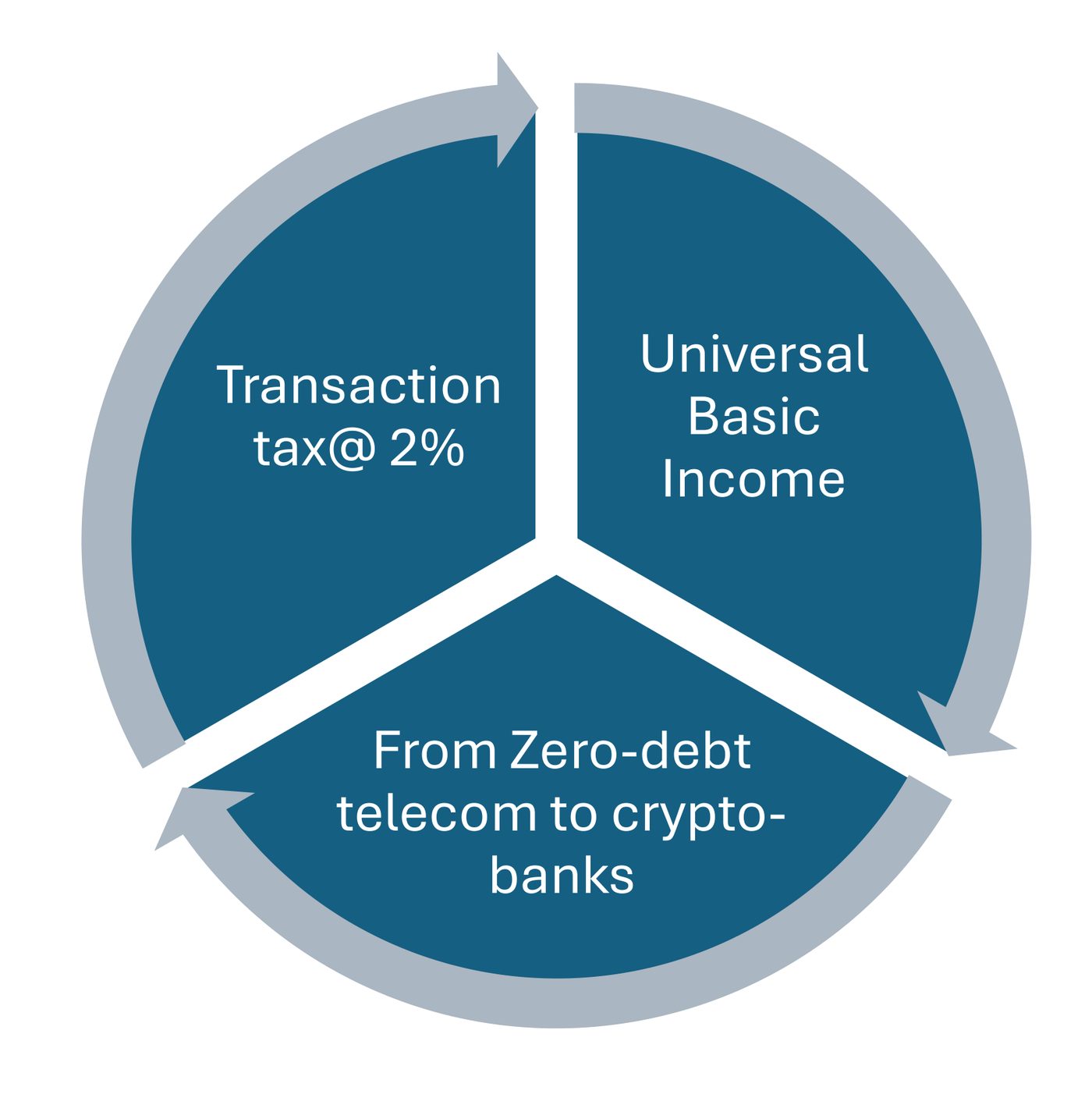
The telecom sector pays GST on telecom services @18% as well as annualized gross revenue (AGR) share of telecoms is 8% in lieu of spectrum fees. This makes 26% net outgo from the fees received by the telecom players from Indians. This is the amount which is collected from the people and paid back to the people in the form of public expenditure by the government. What is proposed here is that 26% of the IDD supply should be distributed as advance income support to 1 billion data users of India and they should not be charged GST on their telecom bills as well as given 8% deduction on the bill in lieu of AGR exemption for the next 10 years. This is public money which is being given to the public and they are being assured that they will not have to pay it to telecom players in any form. 26% of 3.65 trillion tokens come to the UBI Pool of IDD 949 billion or INR 9.49 trillion. If you calculate this money at a larger scale, it comes down to 2.70% share of GDP at current rates. It can be distributed to 1 billion data users of India in 10 equal monthly installments of INR 949 each. In a family of four, it comes down to nearly INR 38,000/- in less than a year. If we make IDD payable for telecom billing, e-commerce portals & all PoS terminals pan-India, it will generate a huge uptick in Indian GDP. One person’s expenditure is someone’s income. Being digital, this UBI would create a high money velocity that can be even 10x of the initial amount given.
Since the idea is total tokenization of the telecom sector, it also means that equity of telecom companies would also be priced in IDD. That is where 40% of token supply will be made to the telecom company shareholders & debtors. This amount is not fresh money in M0 sense of the term rather it is exchange of their current holdings. Now, once the equity holders convert their equity into the new IDD token, they have two options. They can maintain their liquidity in IDD or they can convert it back to a security token. It means that all telecom companies will be asked to convert themselves into a blockchain-friendly governance system where equities should convert into security tokens issued by the respective companies like Airtel, Reliance JIO, Vodafone-Idea and BSNL/MTNL. This is also applicable to all the debt-holders of these companies. Most of the promoters hold the majority equity and prefer to take debt against equity. This creates a tendency to keep a company under loads of debt. Telecom players hold a massive debt to the tune of nearly INR 5.9 trillion. This debt is held against some sort of pledged equity. The telecom players would convert themselves into a zero-debt status by offloading their equity. A phased equity-to-token conversion should happen as per this distribution plan. First priority is to make the telecom sector into a zero-debt sector. Somebody may argue that telecom companies will object to this transition. Yes, it may happen but there is a hidden incentive for all the telecom players. If the telecom companies fulfill two conditions of distributing UBI to the users and converting themselves into zero-debt organizations, the second priority is to rechristen them as “IDD Banks”, a new banking category. IDD banks would be full reserve banks unlike the fractional reserve lending system of traditional banks. IDD banks would be token-based borderless networks by default. The objective is to generate sufficient demand for IDD at the financial front and stakeholders that there is zero friction at the implementation level.
UBI Pool takes 26% and Telecom Pool takes 40%. What is left is 34% of the IDD tokens. This is called the Reserve Pool. The sole objective of the Reserve Pool is to be the long tail of IDD money supply. It means that the best option is to release it in a gradual fashion by dividing it into 100 tranches across 120 months excluding the first 20 months needed for UBI and preparation of the telecom sector. In this period, Parliament can upgrade the laws, and the executive branch can shift to this new dual legal tender system. As far as the bridge between INR and IDD is concerned, RBI can take over this role and as far as project execution is concerned, a joint custodianship between TRAI and NPCI can pull off this job as they understand both the telecom sector and payments industry. Users can buy these tokens from the custodian with a maximum limit imposed per person so that IDD hoarding does not happen. This distribution of 3.65 trillion IDD tokens can be formalized via a constitutional bill passed by both the houses of the parliament. This will defend against any technological risks. Since the law is encoded, it can be used to do course correction if anything goes wrong. What is being proposed here is not a mandatory requirement. Rather, the purpose here is to keep monetary imagination intact. No problem is big enough. Crypto is a DIY kit for civilizational re-design whether it is for individuals or governments. If OCSC framework is regularized, all the cryptocurrencies can be made fully convertible with all the forms of OCSC too. On-chain governance can happen only on a chain. The fiat currency regulators are off-chain. Within the current model, they cannot administer crypto but if they reincarnate themselves via OCSC, the game is wide open. Defi apps can easily work over ILD, IGD or IDD. The tokenization of B2C platforms can be easily done in this new framework. One might see Zomato coin or Swiggy Coin in those scenarios too.
10.3.4 Care-hour tokens
If central government can create an IDD and state governments can create ILD, the municipal corporations can also monetize a regime as it is a deeply decentralized and local affair. This is what I will call small but critical human activities like cooking, baby care, old age care, housekeeping, teaching or training young kids and so on. A corporation can easily calculate the imbalance between those who need it and those who can provide it. A local platform approach can easily solve it where demand and supply of care hours can be tokenized and they can be used for quick and short-term payments like grocery bills, school fee, electricity bills, local travel and so on. These care-hour tokens need not have a permanent supply. They can have a monthly or yearly cycle where supply is matched with demand and nothing excess should exist in the market. If it does, it should be burnt. If all the issuance and burn schedule is managed on-chain, corporation accountability can also be ensured. I won’t call these tokens to be as big in economic size as IDD or ILD or IDD but their role will be local and supplementary. In cases where huge unemployment exists, it can even become critical for preventing deep vulnerability among populations also.
When I began this chapter about Elon Musk speaking about the future of money, you must have realized now that we shall be in the world of hyper-barter era and no more in the fiat currency era. Things would be more peer to peer and instant. Ledgers and wallets would sync in a simple UI/UX and AI agents would make it trustworthy and simple. It does not mean that governments would die. Rather, it means that governance will be reinvented on-chain. Yes, Musk is right that money will evaporate but it should be mentioned here that Crypto-as-care would replace what would be left by the demise of LOLR.
10.4.0 Dream 2048: 1000 Schools with multiple intelligences model in Bangalore
On Sankranti morning in the year 2048, eleven-year-old Tanvi Gowda walked into the thousandth school. It didn't look like a school. It had no bell and no rows of desks. Where a principal's office would be, there was a banyan tree with a ring of stone seats around it. Tanvi carried a small cloth bag with three things in it: a clay pot she had fired herself, a song she had written in Kannada and set to a raga, and a hand-drawn map of the rainwater channels in her ward. These were her kala offerings, her proof of learning. Her grandmother had once memorised the periodic table and forgotten it by thirty. Tanvi would never have to. Nobody here asked her to be good at everything. They asked her to discover what she was already good at, and then to grow it.
The story of how Bangalore got here begins twenty years earlier, in a crowded co-working space above a darshini in HSR Layout. For years, the world was still arguing about whether blockchains were useful. Bangalore had stopped arguing and started building. A special exemption was given to all the web3 firms to operate without fear in the city by the IT minister of the state. It began small. All big IT firms had shifted to making the city fab hub in the post-AI world. Most of the engineering colleges of the city shifted to hands-on assessment model. The top VCs of the city shifted to small cheques in a big way. Instead of writing a $10 million cheque, they settled on a $10k-100k range and it worked very well. For all those founders who wanted to try out a new idea, they could get both funds and facilities in the city. 80% of the night patrolling was done by home-built robots in the city. A city ward used a public ledger to track every rupee spent on a lake clean-up, and people could watch the money move on their phones. A cooperative of silk weavers in Ramanagara sold directly to buyers in Milan using smart contracts that paid out the moment the goods cleared customs. The Karnataka land records office piloted on-chain land titles, and within a year a quarter of the farmers who had never had a bank loan got one. The world of blockchain had embraced formal specification in a big way and accidentally, the city had a big chunk of experts who knew formal languages like Haskell, Lean, Tau Alpha and so on. The world noticed. By 2030, Bangalore had a nickname in the global tech press: the Prototype Capital of Web3. Protocols were written in San Francisco and funded in Singapore, but they were tested in Bangalore, because Bangalore had everything at once: world-class engineers, a chaotic real economy, and millions of people with real problems.
Among the builders were three friends.
Meera Rao had built a privacy protocol that let people prove things about themselves without revealing their data. Farhan Siddiqui ran a lending platform that gave loans to street vendors. Arjun Nair, the quiet one, made tools that let groups vote on how to spend shared money. By 2031, all three were rich on paper. None of them were happy. Three things happened, one after another. In a dry summer of 2032, the rains failed twice in a row. Borewells across the city ran dry, and water tankers became the most powerful business in Bangalore. Meera spent three weeks queuing for water with her domestic help's family in Bommanahalli and realised that none of her protocols could make it rain. AI didn't take jobs in one dramatic wave. It hollowed them out, year by year. By 2033, half the junior coders, content writers and call-centre staff in the city had been let go. What shocked people wasn't the unemployment. It was that a generation of young adults had been trained for exactly the tasks machines now did best. They had topped every exam and had no idea what else they were good at. At fourteen, Farhan’s son stopped speaking at school. Doctors, counsellors and tutors all found nothing wrong. In the end, it was an old Yakshagana teacher from Udupi, a family friend, who got him talking again, by teaching him to drum. Farhan watched his son beat the chande for hours, lit up in a way no report card had ever shown. That night he called Meera and Arjun.
"We've been building rails for money," he said. "What if we built rails for talent instead?" The three friends didn't shut their companies. They changed what they were for. Meera's privacy protocol became a way for children to hold their own learning records: a lifelong portfolio of skills, owned by the child, not by any school or board. Farhan's lending platform became prepaid Vidya Bonds, where citizens could fund a neighbourhood school and receive returns measured in outcomes, not money. Arjun's voting tools let parents, teachers and students run each school together as a shared community.
Other founders followed. By 2036, Bangalore had a second nickname. People had started calling the city's builders social founders, and the word "startup" had begun to sound old-fashioned. But they still didn't know what to teach. The answer came from two directions at once. The first was Western and modern. Harvard psychologist Howard Gardner had argued back in 1983 that intelligence isn't one thing but many: linguistic, logical, musical, bodily, spatial, naturalist, interpersonal and intrapersonal. The theory was famous, but almost no school system had been rebuilt around it.
The second was Indian and ancient. Meera's grandmother, a Sanskrit scholar in Mysuru, handed her a yellowed book one evening. It listed the chatushashti kalas, the sixty-four arts that a well-educated person was once expected to explore. The list was astonishing in its range: singing and instrumental music, dance, painting, architecture, carpentry, gardening and the science of plants, testing metals and gems, riddles and word puzzles, the languages of different regions, making mechanical devices, even music played on water. Meera laid Gardner's eight intelligences next to the sixty-four kalas. They fit together almost perfectly. "We don't need to invent a new curriculum," Meera said at the first design gathering in 2039. "We need to remember an old one, and give it modern tools."
| Intelligence | Kalas | |
|---|---|---|
| 1 | Linguistic | Completing verses (kavya-samasya-purana), regional languages (desha-bhasha-vijnana), reading aloud (pustaka-vachana) |
| 2 | Logical | Riddles (prahelika), mechanical devices (yantra-matrika), testing metals (dhatuvada) |
| 3 | Musical | Singing (gita), instruments (vadya), water music (udaka-vadya) |
| 4 | Bodily | Dance (nritya), physical training (vyayamiki) |
| 5 | Spatial | Painting (alekhya), architecture (vastu-vidya), carpentry (taksha-karma) |
| 6 | Naturalist | Plant science and gardening (vrikshayurveda) |
| 7 | Interpersonal | Stagecraft and costume (nepathya-prayoga), conduct and etiquette (vainayiki) |
| 8 | Intrapersonal | Dhyana (meditation) and self-inquiry from the philosophical schools, atmavidya |
The model that emerged was simple:
- Every child explores all eight intelligences in the early years, through the kalas, not textbooks.
- By age ten, each child finds 2 or 3 "home" kalas where they come alive, and goes deep. Mathematics, science and languages are taught through those kalas: geometry through architecture, chemistry through dyeing and metals, biology through the school's own farm.
- Every school is a guru-shala, a space where master artisans, musicians, farmers and craftspeople teach alongside trained teachers and are paid as equals.
- Every child's growth is recorded in their own learning portfolio, a living record of what they have made, performed, grown and built. There are no ranks, only stories of progress.
- Every school is run as a shared community by its parents, teachers and older students, with every rupee visible on a public ledger.
The first ten schools opened in 2040, in a converted tech park in Whitefield, a heritage bungalow in Basavanagudi, a government school in Hebbal that volunteered, and seven more. The results were slow, then sudden. By 2043, a boy from the Hebbal school, a would-be dropout whose home kala was taksha-karma, designed a low-cost rainwater filter using local wood and clay. It was installed in four hundred homes. After that, the model spread by copying, not by decree. Neighbourhoods competed to open their own schools. Vidya Bonds were oversubscribed within hours. Retired engineers became teachers of yantra-matrika. Farmers from Kolar and Chikkaballapur, the ones who had once struggled to get bank credit, now taught vrikshayurveda three days a week and earned more from teaching than from their harvest. Rural children came into the city schools, and city children went out to the rural ones. The old divide between village and city learning began, at last, to close. By 2046 there were 600 schools. By the end of 2047 there were 999. On Sankranti 2048, the thousandth school opened in Koramangala, and Tanvi Gowda walked in with her clay pot, her raga and her water map.
Meera, Farhan and Arjun were there, grey-haired now, sitting quietly on the stone seats under the banyan tree. Nobody made speeches. A group of children performed udaka-vadya, music played on bowls of water, the sixty-fourth kala that everyone had forgotten. Farhan's son, now thirty and a master drummer, led the rhythm. Meera leaned over to Arjun and whispered:
"Twenty years ago, we wanted to be the prototype capital of the world's money." Arjun smiled.
"And we became the prototype capital of the world's children."
Notes
- https://www.youtube.com/watch?v=XuoqKYxDHVc&t=131s
- Jeff Booth, The Price of Tomorrow: Why Deflation is the Key to an Abundant Future (Stanley Press, 2020).