Chapter 2
Geopolitics, AI & Corporate Collapse destroying LOLR
39 min read · 16 sections · starts on p. 43
After 1971 the LOLR lost its restraint and grew old as a debt pyramid. Geoeconomics, stablecoins replaying the "Dollar Milkshake", the AI lay-off trap and tokenization are now eating its weaker replicas. The chapter ends with a call to rewrite the man-woman social contract and a Dream of South Korea reversing population decline by 2056.
Lender-of-last-resort knew throughout history that a king would pay the price with his throne if his people lost trust in the currency issued by him. The regime change ensured the reincarnation of the system from scratch. Debt jubilee and cleaning the slate coincided with rise of a new regime. However, after 1971 gold de-pegging, something strange happened. Nobody needed to pay the price. We do not have kings anymore. We have political parties who are given a mandate to rule for a fixed duration of 4-5 years. These parties have hierarchical layers of authority from legislature to executive where decision-making remains quite diffused and hence, far removed from immediate implications of their actions. Electoral democracies keep postponing the cost of bad mistakes by LOLR managers while monarchies did not have a similar sweet spot. That is why LOLR behaves like a drunk giant today. Let us look at it from an inter-generational perspective. Though this is a rare perspective, yet it unveils a far deeper reality of a fumbling foundation.
2.1.0 LOLR gets old and decrepit naturally
When my grandfather was in his prime, he was the Chief Accountant of a firm in the 1950s. At the age 40, he used to earn Rs. 50 as his monthly salary and he had seven kids, four sons & three daughters. He did own nearly 800 gm of gold but did not own any physical property. He was not rich but relatively a comfortable middle-class person. He married off all his sons and daughters relatively well. His entire family stayed in a single 700 sq. feet home that was double-storeyed. When my father was 40, he used to earn Rs.500 as monthly salary and had four kids, three sons and a daughter. He had nearly 400 gm of gold but did not own any home. He married his kids off in similar status households. He was middle class but slightly less well-off than his father. When I turned 40, I used to earn Rs. 50,000 and had only one kid. My family gold came down to less than 100 gm, and I owned a small home but on a 20-year mortgage loan. I was a salaried man and my wife also worked. Despite owning a home, our household tensions were recurring. If the salary were delayed any month, arranging the housing EMI used to be a big tension. In all possible definitions, I was still middle class. At this rate, I used to fear what if my son follows the similar trajectory. He might be earning Rs. 500,000 at the age 40 with a wife but no kid.
The first time this reality dawned upon me, the money transformed into a completely different system. Across three generations of my family, our income increased 1000 times, but our relative status always remained middle class. We used to have barely enough to stay afloat but never owned serious assets to achieve what may be called escape velocity. We were a talented bunch, hard-working, legally compliant, tax-paying citizens throughout but somehow, we were never rich. Figures were bulging in our balance-sheets but there was no substantive change in our family status. We knew inflation but we never noticed that we were living in a long-term inflationary economy. We moved from a small town to a bigger city, but money dependence kept on rising generation after generation. What used to be done with community support was being done more and more with money transactions.
I wondered whether the same was happening to other families. OMG! Things were almost similar for over 99% of the country. Not just that, things were exactly similar for working families across the world. There was something common across the world as far as money was concerned. The common factor was LOLR, lender-of-last-resort consensus that defined all of us. It seemed like we were all in a common prison with invisible walls. Instead of locking our body, it had bound our behaviour. We were acting free, but the path dependency was a far bigger demon. That is why money is gravitational and hence, existential.
2.1.1 LOLR consensus with strong to poor replicas
LOLR constitutes the basis of every nation-state; be it the USA or Bangladesh. LOLR system is as good a consensus category as shared consensus or its technical equivalent, Byzantine Fault Tolerance is. It is like a proof-of-work consensus system used by both Bitcoin and Litecoin. Despite being in the same category, the substantive difference is huge. It would be ridiculous to assume that the decline of LOLR means the same thing for the USA as well as for Nigeria. The British Pound lost the global reserve currency status in 1945, but it is still a strong currency and considered among the top ones in the world. LOLR dies but not as a category in one go. That is why death of LOLR replicas is different from the death of LOLR. Its weaknesses appear at the bottom and travel to the top. America is at the top. Japan, Germany, Europe, Switzerland, they are the next best. Then there is a third layer of developing countries like India, Malaysia, Sri Lanka and then there is a fourth layer of least developed countries like Ethiopia, Sudan, Niger and others. Mistakes are done by all, but the bottom players pay a higher cost in a shorter duration.
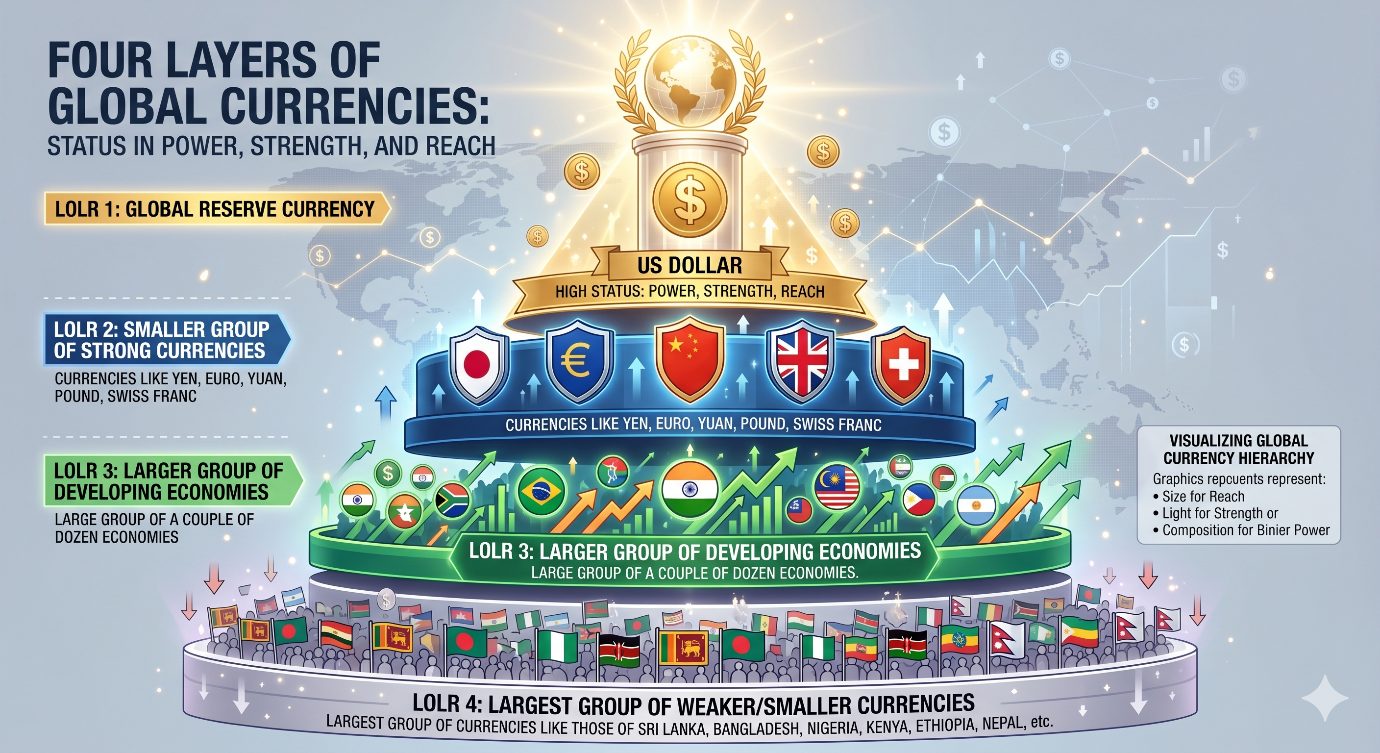
Last two decades have been pretty bad for LOLR consensus system as it has faced many challenges. It is still intact but getting diluted internally. If the 2008 financial crisis brought the too-big-to-fail banks on the verge of bankruptcy, they were bailed out by inflating the national balance-sheets. If the defence budget was to be increased and the current revenue was not enough, the rulers decided to inflate the LOLR system they thrived upon. If Covid shutdown happened and people had no money to spend, the choice was obvious, inflate the LOLR. The paradox is that whenever a crisis happened, LOLR managers resorted to borrowing more. Few noticed when LOLR became “unaccountability machine”9 The irony is that it is a single reality but with multiple manifestations. If I want to see what would happen to my kid, I can see that in South Korea where the total fertility rate (TFR) per woman is 0.7 far below than 2.1, the natural rate for maintaining population. Things are so bad that the population has started declining and the country is expected to lose half of the population by the end of century. The other potential simulations of my own land’s future might be in Argentina or Brazil where inflation rates have only remained high. It may even look like that of Nigeria where monetary management is in doldrums. So, these are all symptoms of an old and decaying lender of last resort. One may say that LOLR is a completely autodestruct mode but with varying degree of senescence. So, one may say (pun intended), the future is already here but evenly distributed.
2.2.0 Real Geopolitics is geoeconomics now
When you look at the state of crypto adoption in a country like Nigeria, you don’t see the excellence of their policy makers rather you see the alternative picture coming out of the death of LOLR. Nearly 22 to 28 million Nigerians hold or use cryptocurrency. It makes nearly 10-12% of the population but nearly one-third of the adult ones. The annual flow of on-chain transactions in Nigeria is over $90 billion and over 85% of the transactions are retail-driven. The Nigerian government tried its best to prevent its public from using crypto, but the central bank of Nigeria was too incapable to offer a safe and better alternative. Here comes a unique fact. Over 40% of the crypto transactions are in USD stablecoins, USDT or USDC and this share is only increasing.
What does this mean?
A stronger replica of LOLR is replacing a weaker one by using crypto rails. A large chunk of Nigerians are using crypto not because they love crypto; they use crypto because the legacy monetary system did not work. There are more than 100 countries in the least developed or weakly developing nations that are in a similar bracket. LOLR system is quite weak there. It is either dysfunctional or helpless against crypto adoption. So, people don’t need a regulatory infrastructure to use crypto wallets, rather they are pushed into newer alternatives due to existential reasons. The old consensus has lost its gravitational pull there and a new system is emerging there. Does it mean that this trend will move from the bottom fourth layer to the third layer of developing countries; then, to the second one of OECD nations and finally to the top, the USA?
The answer is political not ethical.
USA, the topmost LOLR player tried its defensive strategies against cryptocurrencies for nearly 15 years but finally realized something very strange. Bitcoin had created a new P2P space that made digital cash transfer possible across the world. This space was unique. It was mutual as well as universal at the same time. It gave freedom without an extractive architecture. LOLR had been a dominant reality for long, but it was never truly P2P. It was global but never worked like instant cash settlement. It was always under institutional control but never censorship-resistant. LOLR was an all-inclusive power phenomenon, but Bitcoin exposed its lack of innovation. The USA played a long-stalling game against Bitcoin for several years, but it was a strange beast with thousand heads. You cut one, ten or even hundreds, it would not die. Soon, it enabled the rise of other cryptocurrencies, and the prominent one was Ethereum that led to thousands of more currencies. America realized the futility of fighting an enemy that was self-multiplicative. It chose finally to participate in the space as an active player rather than restricting the game from outside. As a monetary strategy, it was a sound choice. If you cannot stop your defeat, you can delay it. There are only two ways to do that.
- To kill your enemy, simulate it.
- If there are many challengers to the empire, ensure that none of them reach higher enough to achieve that status.
Stablecoins offered both options to the USA. Tether (USDT) was the first such eye-opener for playing this new great game. By tokenizing the USD, stablecoins behaved like the dollar but inside a space that was purely crypto. Now, a stablecoin is P2P, global and real-time cash settlement instrument. The second advantage was gaining network effects. America realized that stablecoin space was a virgin territory. It could gain massive power in crypto over all countries that will join the stablecoin one day.
2.2.1 Stablecoins and replay of “Dollar Milkshake Theory”
America started slowly on stablecoins but soon noticed a big gap. Though there were thousands of crypto currencies, they needed a market pair for trading. If both sides of a pair are volatile, the swap will not work for long. People preferred USDT as one side of the trade. This was a strategic entry point for serious scale. Tether was such a massive success that its trading volume reached an average of $5 trillion per month in June 2026. Though it was a crypto token, it was created inside a regulatory arbitrage. One could create only as much stablecoins in 1:1 proportion as in bank deposits or government securities. This meant that regulatory supervision as well as leeway was always needed.
The moment one stablecoin seemed to succeed, the US government encouraged the adoption of similar stablecoin projects. The success continued to expand and finally, the government institutionalized this in the GENIUS ACT. It was a full-fledged regulatory framework for all those companies who wanted to issue USD-backed stablecoins. Even more regulatory support structure is following after this. Clarity Act is only going to strengthen the crypto permissiveness in the mainstream. The daily, weekly and monthly trading volume of stablecoins is growing so fast that it might rival the Eurodollar markets one day. American dollar remained a reserve currency because foreign banks used US bonds as a collateral to create ledger entries in $. This was a system that was not run by the US government but instead directly benefitted it. The size of Eurodollar market is in trillions but of late, central banks are reducing their exposure to long-term US bonds and increasing their gold reserves. What America seemed to be losing at Eurodollar front is turning into a gain on the USD stablecoin front. This is way easier for the USA to achieve because no other country is even thinking about a strategic game around crypto. So, it is a massive return of “Dollar Milkshake Theory”. Global monetary flows are like a big milkshake where every nation needs US dollars for trade, investments and debt. Despite being a hugely trade deficit nation, it could attract global capital, maintain zero interest rate policy and sabotage any currency from being a competitor. Stablecoins ensure a new direction of continuing the same dominance for some more decades. It is American statecraft using blockchains to its unique advantage.
2.2.2 Non-US LOLR players miles behind in stablecoin & crypto regulation
One quite perplexing thing is that no non-US LOLR replica is playing the same game in crypto like that of its top player. What America did with Bitcoin ETFs, Ethereum ETFs, GENIUS ACT and CLARITY ACT (yet to be done), nobody else has moved at a similar speed. The way US government has been able to build a strategic direction inside a politically neutral zone of blockchains, nobody has come close. China shut out crypto completely. This is understandable as they did the same with other IT giants for the last two decades. They have been able to maintain a political firewall against any kind of value extraction from non-Chinese players. However, no other nation in second, third and fourth layers of LOLR replicas has been able to build a regulatory roadmap. Most of them are quite restrictive against stablecoins and all other coins too. If there are a few isolated cases, they belong to small nations like Singapore, UAE, El Salvador, Marshall Islands and some other tax havens. To be more precise, crypto is yet to become a tool of statecraft in many countries other than America. A large chunk of the global public is using USDT, USDC as well as holding hundreds of cryptocurrencies outside America. In certain countries like South Korea, Japan, India, Nigeria and ASEAN nations, the level of adoption is reasonably high, but their governments have yet not come up with regulatory innovation derived from crypto. Why did this not happen? I don’t have a true answer but if I hazard a guess, it is the same thing I mentioned earlier. LOLR is a gravitational force and hence turns into an existential reality. Weaker countries still look at the USA as an irreplaceable hegemon due to LOLR inertia. Secondly, few political parties can see beyond 4-5 years in a democratic set-up, and they are yet to turn focus on GenZ as a voter class. Since the political weight of this voter category is too less to be noticed at a macro level. Crypto being a GenZ aspiration is still on the back burner yet.
2.3.0 LOLR accepted AI 100x faster than crypto in adoption
If you look at the last four decades from the lens of hyper-novelty, AI should be ranked at the peak since internet. If internet was a general-purpose technology, AI has proved to be a general-dimensional technology. It has squeezed time and space so fast that it has crossed over a billion active users in the last three years. Since an active base of digitally native population already existed, the AI hyperscalers like OpenAI, Anthropic, Google, xAI and others have been able to break all the speed records. Just ChatGPT has a billion monthly active users. Thanks to this trend, Elon Musk has unleashed insane plans of building data centres in space with his venture SpaceX and has also become the first trillionaire of the world after its IPO. What could have happened with crypto adoption, did occur finally but with AI? What was friction in case of crypto turned into a big rat race for governments in case of AI. One big reason may be the centralized nature of AI companies. If governments cannot control them, they can certainly manoeuvre them to their own benefit. Recursive self-improvement nature of the big LLMs has made AI too dangerous to ignore. If one does not find an opportunity in this space, it can turn into a threat also. The global realpolitik is such that one LOLR player would like to get ahead of the other LOLR player. AI fits into this game very well.
2.3.1 “AI lay-off trap” is a suicide for weaker LOLR replicas10
In March 2026, two scholars Brett Hemenway Falk and Gerry Tsoukalas came out with a paper “AI lay-off trap” that pointed out something critical. “If AI displaces human workers faster than the economy can reabsorb them, it risks eroding the very consumer demand firms depend on. ………... In ……… economy, each firm captures the full cost saving from automation but bears only a fraction of the demand loss it creates in the product market; the rest falls on rivals. This demand externality traps rational firms in an automation arms race, displacing workers well beyond what is collectively optimal. The resulting loss harms both workers and firm owners.” For clarity, assume that a country’s economy is made up of 10 companies. Their workers are also their consumers. If company 1 decides to increase its profits by AI-driven employee lay-offs, it gains hugely in profits but loses small in terms of reduced consumer demand. If company 2 does the same, the profit gain will be less, and loss of consumer demand will be higher. If company 3 does the same and company 4 goes on like this, the case for AI lay-offs will attract a negative equilibrium. A worker laid off by Oracle will not pay for Netflix, will not buy a new car from Tesla, will not borrow for a home loan from Morgan Stanley and so on. So, if you go beyond a point, it is not increasing the net income of the economy. AI is killing white collar jobs first. These are the people who have the highest purchasing power in any society. These are the people who invest in stocks, buy real estate, take home loans as well as consumer loans. These are the people who buy high value goods. For example, 90% of income tax in India is contributed by only 10 million people. White-collar employees make a big chunk of this. If they lose job, the government loses the tax revenue. Not only that, the indirect taxes coming from this segment would also go down. On the one hand, demand goes down due to low consumption, and tax revenue goes down due to low collection. What will happen to huge pile of debt arrears if the citizens could not afford to pay back? How much money will be printed by their central banks? How many bad loans will be written off by the banks? If tax revenue declines, will they be able to prevent the depreciation of their exchange value in the global markets? It may not be remote to imagine here that AI might turn a fiat currency system into a debt junkyard in certain extreme cases.
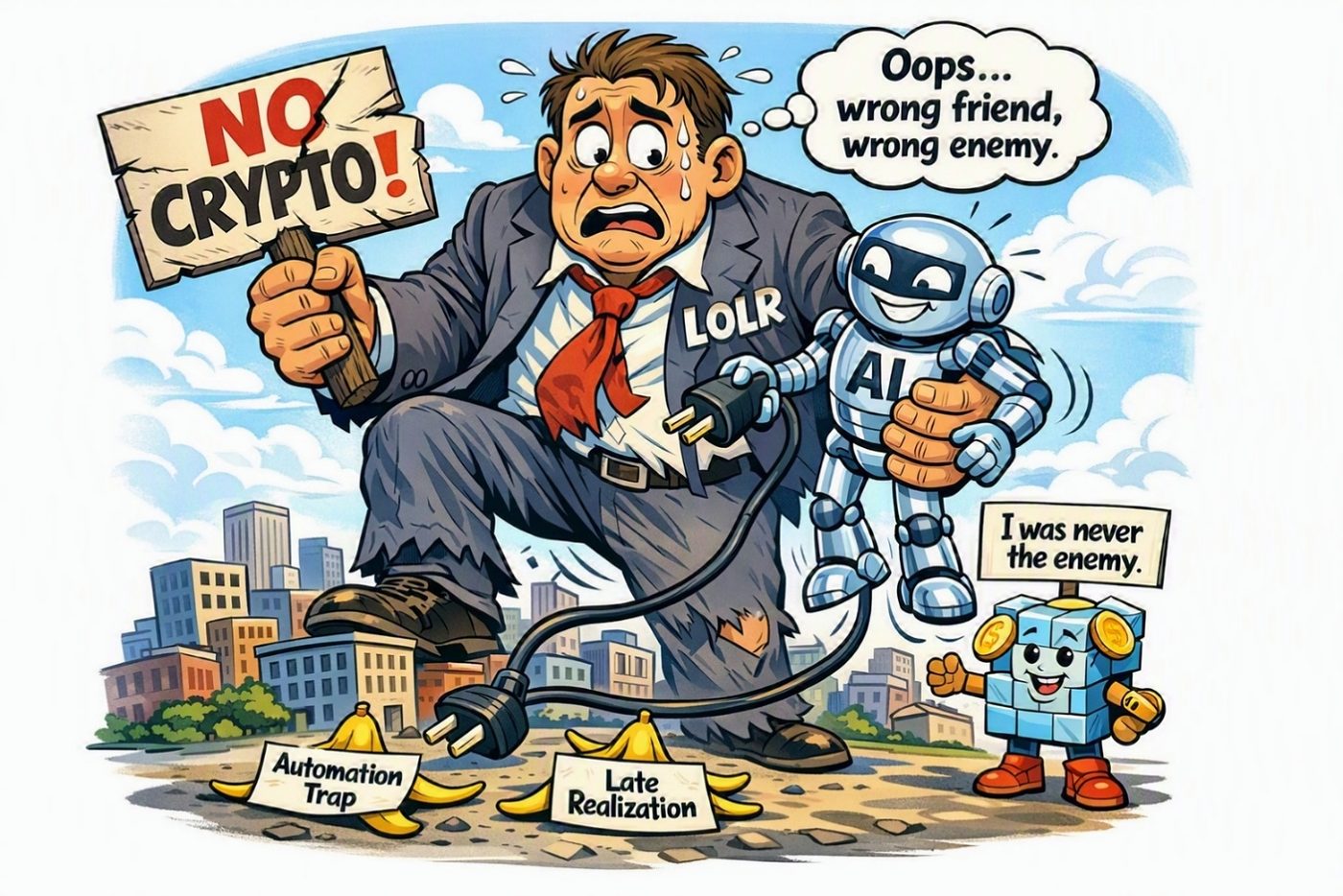
Now, assume this scenario for the third as well as the bottom layer replicas of LOLR. Their economy and tax base will suffer the deepest cut due to AI. Since this will have second and third order effects, the actual impact will be like death by thousand cuts. If AI as a technology is neutral, its adoption curve will have a very uneven impact on different countries. It is like a fight between a giant and a pygmy. Now, ask yourself whether these governments will keep resisting decentralized crypto. Will they opt for dollar stablecoin or Bitcoin/Ethereum? Will they allow their citizens to adopt commodity/utility backed currencies like gold-backed altcoins, KWH-based currencies, data/compute-backed altcoins or keep pushing their population into blind obedience of dollar imperialism? It looks like a choice but the road towards decentralization is never a straight one. For such countries, the crypto may or may not be a positive choice but remaining stuck with LOLR is definitely going to have negative repercussions, even life-threatening too.
2.3.2 Nearly impossible to compete with America and China on AI front
Since the launch of ChatGPT in November 2022, the true competition on AI front is between America and China only. If America is leading with the world’s most powerful generative AI platforms like Claude by Anthropic, ChatGPT by OpenAI, Gemini by Google and Grok by SpaceX/xAI, the counter challenge is being run in China by DeepSeek, Qwen, GLM V2 and a couple of more LLMs. Even if there is a gap in capabilities, it is not more than 3-6 months. However, it is not just the question of having the most powerful LLM. The real question is having an LLM that is good enough at affordable prices. On the Robotics and automation front, China is way ahead of the USA. A large number of Chinese factories like those by BYD and Xiaomi work 24x7 without any worker in the loop. The cheapest robot worth $5,900 by a Chinese company is already available. From a competitive perspective, even Europe, Japan, Australia and other countries are far from these two giants. Yes, Taiwan and South Korea are exceptions because of unique fab manufacturing excellence, but they are not at all serious geopolitical players seeking to compete with the rest of world. For smaller and weaker countries, AI has become like an unavoidable trap. They cannot stop their citizens and companies from using AI platforms from either the USA or China, but the eventual damage will be contained in their respective countries while gains will be exported to the top giants. The labor share of GDP or labor income share has already gone down over the last four decades due to technology, but AI might push certain sectors off the cliff. India may lose its BPO edge in IT services where wage %age is multiple times higher than that in agriculture. The entire thing can become dark comedy for weaker and developing LOLR replicas. They just simulated the global operating system without any serious homegrown sustainable alternative. At least 100-150 nations are expected to bear the brunt of demand destruction related to AI and hence, economic damage and maybe sovereign currency crises eventually in the next 5-10 years. If they can become neither America nor China, what options are they left with? Will they opt for decentralized computing infrastructure? Will they nationalize AI into a universal basic service with a new coin?
This is a great moment of speculative surprise. What if the open weight models from Chinese LLM like Kimi K3 or GLM V2 or Qwen 3 might enable late entrants to cope up with AI race much faster than expected. What if Bangladesh, Peru, Vietnam, Malaysia, Indonesia or some less known country may find Universal AI Services for all citizens by building a virtuous circular loop with a tokenbased inventive model. What China did with state capitalism might be repeated with a token-based institutional crypto-economics blessed by a developing country. If we ask what the probability of something like this happening in the next 12 months is, it might be less than 1% but if we ask for the same probability over next 36 months, it will definitely rise to over 10% and if the timeline is 60 months, the probability will jump over 50% definitely. The weaker nations are being forced to embrace a future that is definitely unforeseen. It is a great bet but also a risky one too. It seems that embracing crypto is far more politically neutral than signing up with either the USA or China. They have more chances of learning ropes from the big game. India might build a great health domain AI services economy and become the biggest attractor of medical tourism by 2034. Kenya might produce the greatest Coffee bean farms with AI in 2036. Bangladesh might come up with BANG token to deliver local language delivery of AI services free of cost to all the citizens based upon simple audio commands by 2030. What if we get a crypto version of Non-Aligned Movement in the next five years? What was unreal in the 1950s and 1960s in the era of cold war, might make a comeback again? History may not repeat but it may rhyme again.
2.4.0 Tokenization is a far bigger tsunami than past stock boom era
Every fiat currency gets its true power from citizens’ capability and desire to pay tax. If both are going down, the tax revenue would also go down. It means that budget deficit, fiscal and revenue deficits are rising also. To offset losses, if government increases income tax, people will resort to tax evasion. Using USDT is one such exit route. It means that we are reaching a kind of a point where crypto is getting adopted not because of geopolitics but due to desperate financial repression of an old LOLR. It is also being pushed by the rise of AI as corporates cut employee strength. The third important thing is the easy over-the-top access of crypto. We may question the ethics of crypto adoption, but one thing is certain. Tokenization as a trend is on a higher adoption curve. A momentum is building that scholars call institutional acceleration11. Currencies are getting tokenized, assets are being tokenized, utilities and commodities are on the same trajectory. It is like an ice ball going down the hill. There is a parallel in history when things changed very dramatically. To answer this, let us go 500 years back.
2.4.1 Token is a better functional unit over equity
A Joint stock corporation is a group business activity where you pull in capital to create a business venture where the ownership is distributed among not only 10, 20 or 100 rather among thousands or even millions of people. This foundational entity was not there 500 years back. But something unique happened that was unique in the history of accounting then. It was the double entry bookkeeping system. It was the first ever accounting mechanism which ensured the transparency of income and expenditure records. How does it work? A single ledger page is divided into two segments. One segment is used for filing the debit entries and the other segment for credit entries. All the entries are summed up at the bottom. The next page starts from the bottom entry of the previous page both for credit and debit. It means that throughout the ledger if you do a single change, it will steamroll into lots of changes in the rest of ledger and it will need some sort of overwriting. If you place accounting book in public, any third-party observer can verify the truthfulness of the financial report. But this was a direct outcome only; something else happened that was totally unintended. A few people realized that this is not just an accounting innovation. It is a business innovation. For example, one person is running a business. He sells something for $1 million and generates $800,000 as a profit. Now, this is a huge profit. Another person reaches out to him and offers to buy a 10% share of the business for $1 million. Five centuries back, this offer was not technically possible because there was no tool for organizational finance. How to split a business in micro shares? If that was somehow done, how to ensure the exit of the investor? Joint Stock Corporation made it possible by doing two things. Make a company with ownership divisible into small units of equity and make those units tradable. This could be made trustworthy if the double entry balance-sheets of the business are placed before the public as a mandatory requirement. Since paper books are impossible to cook without getting detected, this became a defining practice for public limited companies. Now, you could have a company with 1 million, 10 million or even a billion shares where an equity unit or share could start with a base value and gain market value over time. A trading platform for these shares helped discover the price and this led to origin of modern stock exchanges. People could pool in capital by distributing the risk. The East India Company, that colonized 100 plus countries and had a market cap equivalent to $5 trillion in terms of current valuation, was actually a public limited company or what you call a Joint Stock Corporation.
Bitcoin is not a corporation, but it does what a corporation does. It does a business function. It moves value from point A to point B. It is a non-corporate form of a payment bank. Now the point here is what Bitcoin as an organization is? Does it carry ROI like that of a stock instrument? There is no equity-issuer corporation behind this, but it behaves like stock. If all the people are buying bitcoin, they are basically sponsoring the miners, exchanges and Bitcoin development. So, they are investing into the system in a way. You may not call it an equity instrument, but Bitcoin is not different from equity too.
It has all the functions but in a decentralized form. One can be a Bitcoin miner as well as a long-term holder. Let's go to Ethereum. On Ethereum, you can deploy hundreds and thousands of decentralized applications, and you can create 100s and 1000s of tokens. So, on Ethereum, you can create a large number of decentralized networks. What is a token if it is not an equity? So, we can say that a community decides its functionalities. The point I'm trying to reach is that a joint stock company was a kind of agreement between investors and promoters. But it was not an agreement between promoters and customers/users of the platform/ product. So, a distinction between a user and investor is impossible now. From a network standpoint, an equity law cannot bound this since you are contributing to the network as an investor, as a user or as a reputation builder. Whether you pay in cash or kind, you are aiming to be a beneficiary at the end. When VCs entered the crypto ecosystem, they were not fully aware of the fundamental shift. Their ignorance was treating tokens on the lines of equity. Subconsciously, they were LOLR stakeholders. What was supposed to be done by a community, they tried to do that by planting centralized stakeholders in a decentralized ecosystem. The root crypto innovation was to move out of controlled LOLR design and hand it over to the community. All systems were supposed to be zerodebt community ledgers. If the token is dead, the ledger is futile. It was not an inter-generational prison game working via central banks. There was no ultimate entity other than the community itself. It was never going to be LOLR. It was a flat playing field for all the participants. If any party prioritizes its interest, it might disturb the equilibrium and kill the system eventually. That is what happened with the majority of ICOs. Early investors or VCs tried to grab the lion’s share of early profits. In a way, every coin became a meme coin. Crypto was never an investor game rather it was value-sharing mechanism over time. People negated this basic principle and ended up burning their own hands. The tokenization as a system survives but old LOLR practices are flying over a new system trying to snub it.
2.4.2 Tokens are far more compatible with AI than past institutions
The world of LOLR is geographically managed, KYC-controlled, non-transparent and anti-permissionless but AI has created hyper-objects in the form of AI agents. They are untethered. Blockchains are also hyper-objects as they can exist without any government licensing systems. The speed at which a human being can generate an AI agent and number of AI agents one parent agent can create is literally infinite. Their number of transactions can be in millions, and value of each transaction can be pretty small. A bank is not configured to handle such a unique combination. The additional problem is that banks don’t provide transparent data to the agents whereas on blockchains, one can see the metadata of all the transactions. This allows configuration of transaction values for future purposes. Data has a cascading effect when agents are involved. When access to the depth and range of data is allowed via open blockchains, the use of AI can be enhanced with far more reliability and certainty. All data logs can be tracked on blockchain whereas legacy banks won’t be able to provide such nuanced data access. Agentic payments have already made big progress on stablecoin front and same is expected to progress to agentic commerce in near future. This means that if AI agentic use is to have a bright future, it will rest upon the blockchain rails only.
2.5.0 American networks will eat up weaker LOLR replicas
LOLR is only getting weaker whether it is AI or blockchain. How can a frog-inwell compete with sharks and whales of an ocean? The limits of LOLR are seriously exposed. It cannot remain the universal medium of value creation anymore. Corporate squeeze has only heightened it further. So, the only option left for humanity is to build better value creation and value sharing mechanisms. Tokenization is the future in this scenario. America has realized it far more than anyone else. What a counter-intuitive brainchild of history! It is perplexing that a country that opposed Bitcoin and wider crypto tooth and nail, has led in assimilation of crypto assets in its mainstream financial culture. Bitcoin ETFs and Ethereum ETFs are now quite popular on Wall Street. Many listed companies are holding crypto assets in their treasury, and their reporting mechanisms are robust. Genius Act has already built entire regulation around companies issuing stablecoins and the upcoming Clarity Act (expected to be passed by Senate in 2026) will add far more bandwidth on the taxonomy of cryptocurrencies. America has positioned itself as the major beneficiary of the crypto bull wave as and when it happens. Other countries have neither stable-coin regime nor altcoin regulatory mechanism. It means that the layer four and layer three LOLR replicas are going to be not only left behind but also potentially sabotaged by new-age crypto finance. They have laid themselves bare in front of a borderless currency regime that works like an OTT layer of open finance. One might see ChatGPT coming up with its own coin in the post-Clarity regime. One can even visualize top US stocks like those of Apple Inc and Alphabet getting tokenized and easily accessible to all those with stablecoins. Crypto was supposed to kill the fiat currency, but a clever global reserve currency player could reverse the game and use the same to reinvent itself with a new global financial architecture. The global public can move into this without any serious friction even if its respective national regulators are against the use of crypto. Imagine Bangladesh, Sri Lanka, Nigeria, Peru, Kenya and similar weaker/ developing countries. They may see an internal bloodless coup where people move their cash into $ stablecoins. America is a big beneficiary of this potential currency war. For example, Argentina has already sacrificed its monetary sovereignty before the USA. Venezuela is in a similar situation. This trend might see only 20-30 odd fiat currencies in the next 10 years instead of 200 national currencies as they are today. It might mean that bottom layers of LOLR get wiped out but the top layers remain intact for a far longer time. This is nothing but laying the bottom 90% of global population bare and helpless.
2.6.0 LOLR gives Hopium not hope for bottom 90% in the age of AI
Let us visualize the collapse of bottom layers of LOLR replicas for the common masses. This has been in secular decline over the last few decades, but something is far stranger than this. When something starts going wrong, people tend to find an alternative. For example, if a political party is seen as inefficient or corrupt, the electorate chooses to install a new government. If you look at Argentina, Sri Lanka, Bangladesh, Nepal over the last few years, there have been slightly radical leaders and parties coming to power. Balen Shah, a 35-year-old rapper-cum-engineer, is an unexpected Prime Minister of Nepal. Javier Milei, a TV news star economist, was a blatant impossibility in the electoral history of Argentina. Sri Lanka and Bangladesh saw public-led coups that kicked out existing regimes. An election comes up like a popular Netflix web-series, stays high in public imagination for a few weeks and then, everything goes back to normal. The currency remains as weak as it was; the inflation story does not change much; external debt situation is delicate again; youth unemployment is rising and among educated ones, it is skyrocketing; men and women are running away from marriage and kids and so on. What to talk about the last two years, the fundamental reality has only been worsening over the last two decades and even more. Real wage rates have been going down over the last four decades, fertility rates are collapsing, upward mobility options are slowing, and the trend never reverses. Any leader who comes up with a fresh agenda seems to follow the same path what the ones before him/her did. Every element of hope turns out to be fake. Every job promise turns into a lie. Every new business startup faces more and more regulatory friction or capital scarcity. With emergence of AI, the last bastions of regulatory autonomy in developing countries are also dwindling. The export sectors are weakening. Highly promising tech sector, digital marketing, accounting, education and other knowledge-based sectors are getting marginalized with lower revenue and less pay. What appeared as hope turns out to be its opiate version. So, it is hopium not hope. The reason is again gravitational and hence existential. Few members of the public can see the operating system of LOLR; few can create a better alternative of money; few can design better law; few can design better economics; few can design better economics; few can design better economics; few can design better economy; few can change the public education system. LOLR is still there. It is weak but it is like buggy code that lets its users strand half-way.
2.7.0 Crypto failed at realizing “Ownership is personal, value is ecological” truth
Where do we stand now? LOLR is down but not yet out, Crypto is at the door but not yet fully in. Crypto is being used as an anti-thesis to counter the gravitational pull of LOLR. The real game is to build people-friendly systems where rent extraction is minimal. That is where crypto has not yet been able to replace the legacy systems. Sadly, this realization is missing among crypto audience. Nobody can deny that Bitcoin was such a sleeper hit that LOLR players could not comprehend it. It could not be killed but it could be deflected. From its original use as P2P e-cash, it was converted into digital gold. The early BTC buyers got such huge appreciation gains that they could hardly think of the fundamental game design. Bitcoin as a massive alternative asset class was accepted but as a payment network, it was largely unsuccessful. Crypto OGs became Bitcoin maximalists, but they failed to distinguish between Bitcoin as a network and BTC as a token. One could hedge oneself against fiat currency inflation with Bitcoin but what about hedge against social and economic war. Altcoins lost the narrative too. What appeared a massive individual gain for a select few investors, remained a big loss for large entrants. Now, we have a couple of hundred million disillusioned crypto users, a huge new-age decentralization infrastructure and thousands of new-age entrepreneurs.
Ask yourself what went wrong. Don’t give an industry perspective, don’t give a political commentary, don’t look at the markets at all. Just go back to your home and see what problems you are facing. Did crypto ever touch this domain? Look at your family, your wife, your kids, your mother, your sister, your brother or anyone inside your loved-ones. Are they happier than they were? Are you really able to solve basic questions of life? Let me give you a few examples as follows:-
- Will my wife love to cook dinner today?
- Will my 33-year-old sister stop being a single woman anytime soon?
- Should we relocate to our hometown or continue to stay in the metropolitan city?
- Can we, as a couple, plan for another kid this year?
- Are we able to decide whether our kid should be homeschooled or not?
- Can we remove smartphone addiction from my two-year old kid?
- Should I ask my wife to start a side hustle as my job is at risk due to AI?
- Should I ask my brother to drop out of college rather than pursue an MBA with a 15-year education loan?
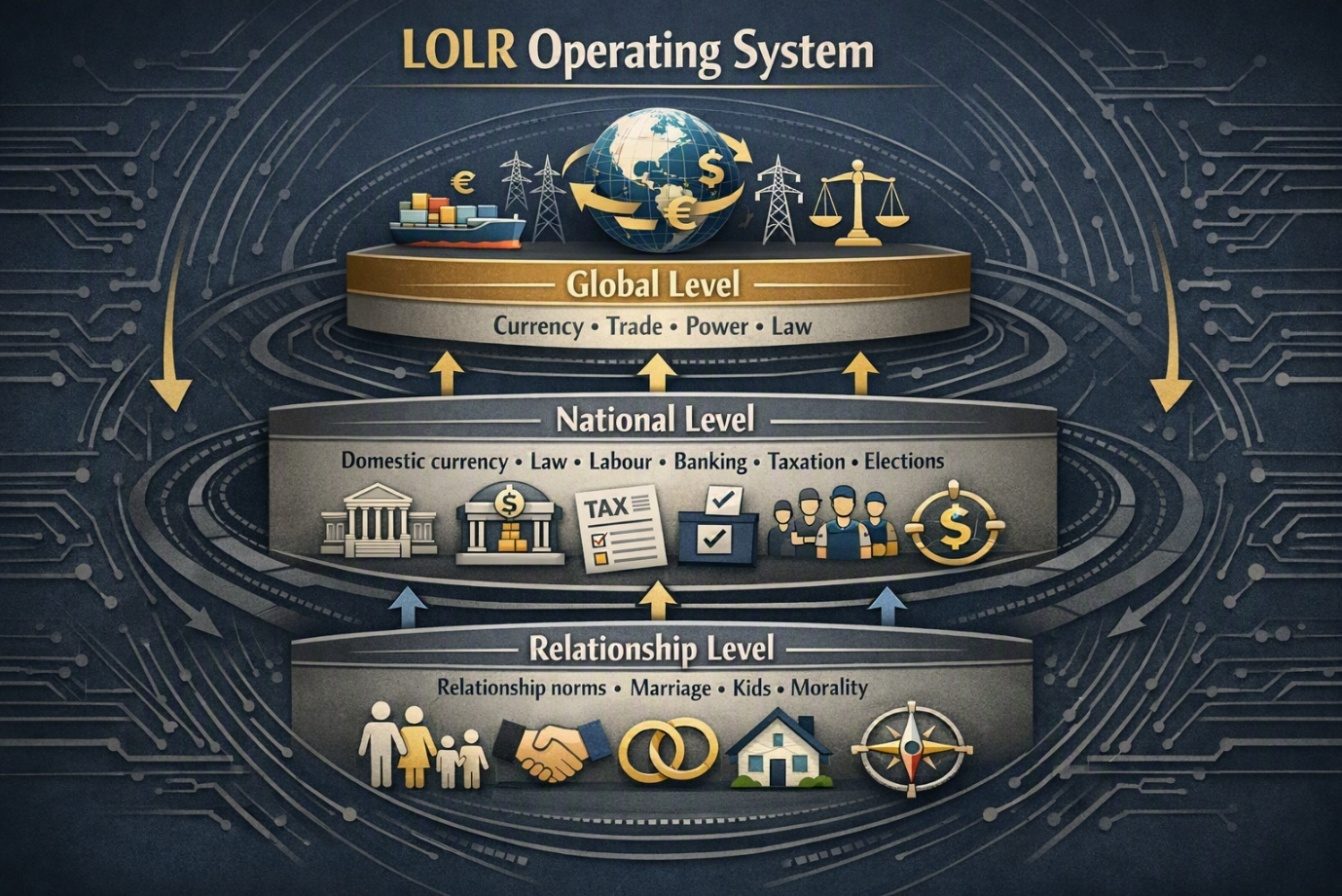
50 years back, these questions would not have carried any burden but today, they carry Himalayan weight. Did crypto ever help us solve even a single question out of the above. That is why we need to focus on those things that we have always tried to unsee. These are the questions that sit at the third and the bottom layer of LOLR.
Let us slow down a bit and ask why such simple human choices have become so difficult. Why is our agency in matters of household weakening day after day? The answer is that our governments sneaked into our lives so silently and pervasively that we almost failed to notice. Buying a home was also a home mortgage solution. Going to college/university was a decision that was made inside a regulator-controlled universe of entrance examinations. Getting married in a world where the cost of divorce is very high is not a decision that you can make easily. LOLR was working at the base layer controlling decisions like education, marriage, careers and so on. I wish to bring back the memories of those times where these decisions were taken by the people themselves without any fear or coercion.
2.8.0 Rewrite man-woman social contract and rebuild crypto-as-care
We, human beings, are a unique species in terms of care. We spend around a couple of decades to train our kids to be ready for adult lives. This means that men and women have to work together during this period to create a healthy future. Marriage is basically a decision to create surplus of care. If you look at the root origin of this term, it comes from “matrimony” that literally means “mothermaking”. So, it has nothing to do with nuclear family or feminism. The most critical question is how a society deals with the question of care. Marriage, Motherhood, pregnancy, female health, child-birth, ante-natal plus post-natal care, living space for old and young, kids’ education inside and outside schools, use of technology inside homes all are the questions that are part of this universe. In the last two generations/last five decades, these questions were decided by a consensus in front of whom we were helpless. This is the true helplessness that lender-of-lastresort keeps us locked in. Since the day it went restraint-free post-1971, the value paradigm shifted to money-for-sake-of-money. Marriage needed a house, a house needed a bank loan, a bank needed convergence of investment and retail banking, this convergence needed financialization of everything and that needed spread of LOLR mandate in all sectors of human life.
I hope that you must have come to believe now that LOLR has a third layer no matter how invisible it might appear to you. This is the layer of relationships. That is where man-woman social contract is critical. You may ask men and women whether they are bound to follow a contract that is controlled by lending mechanics. You should ask a woman whether her motherhood should be decided by the availability of a rich husband or a care-rich community. Can you imagine the future of a society where a majority of fertile men and women remain single and childless? When crypto came into this world, it was supposed to be the beginning of a taboo-free culture where you could chart out your own path. Women were supposed to play a big part in this new consciousness but nothing of that sort happened. Crypto conferences were always boys’ clubs. Whatever space was given to women was more of a PR stunt.
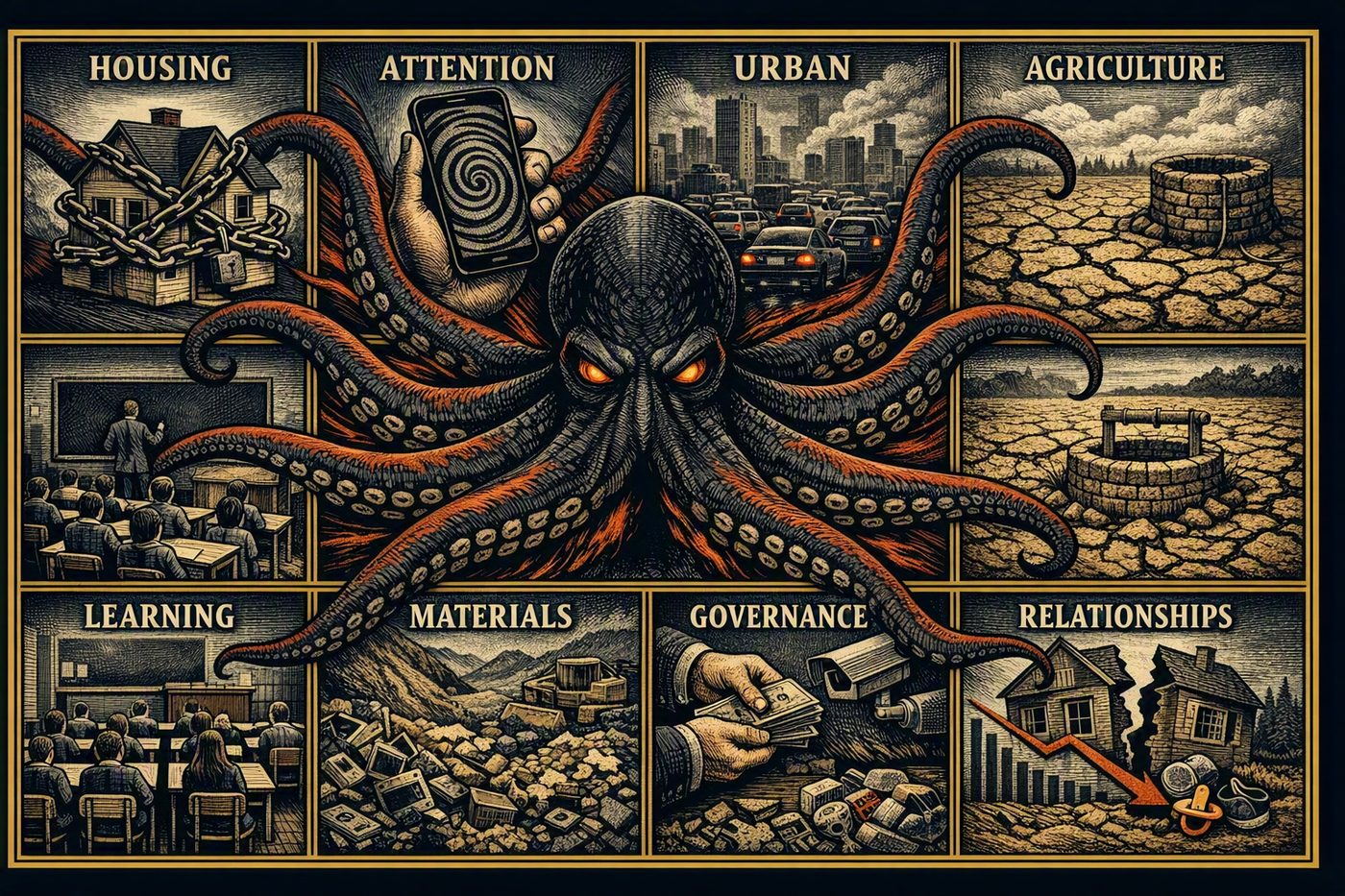
The questions of care and the ones relevant for women are not two different buckets. Trust is, of course, a property of decentralization but more than that, trust is relational. Women know that a kid takes two decades of care and it needs a foundational understanding of change. Crypto never came close. Today, if men cannot take care of a family on a single salary, why marry then? Why to have kids then? Deciding against marriage and kids is basically a defiance against LOLR. Though it is suicidal also, yet it is a defiance. If the present cannot be made truly alive, let the future be dead. LOLR knew about this but could not address the root causes. After all, it is a moneylender view of the world. Kids are a cost; lesser kids mean lesser cost. Women were unhappy but instead of giving them a care-surplus environment, they were showered with more rights against men. One can take big alimony from husband during a divorce, but it made marriage a far thorny institution that it was. It was a strange paradox that a society where marriage was turning difficult, the laws against sex work were also turning stricter. Soliciting for sex is a criminal offence. Something that a man and woman can give to each other free of cost anywhere anytime is a rare treat to be governed by the mechanics of LOLR stakeholders. Sex outside marriage is a controlled affair, and marriage is already a controlled phenomenon. It is not just a monopoly of money rather it is also a monopoly of morality. Crypto did try to replace money but failed to create its own definition of morality. That is why crypto should have focussed far more seriously on the question of value. It was not a balance-sheet question even if it was decentralized. It was a ledger-transcendent question. If the value of a single BTC can go from zero to over $100,000, it is because there are some believers who won’t sell Bitcoin at any price. The real value of Bitcoin comes from its censorship-resistant nature. One could see the same with Ethereum. If you could create a permissionless dApp on a blockchain, the real value comes from the freedom. Why did crypto fail to carve out multiple definitions of value? Even if it did, it failed to sustain the movement. The reason was the total negation of the third layer of LOLR and that was space of man-woman social contract. It was the mother of all values. That is why Crypto-as-Care remained a missed agenda. The best way forward is to know that one that was missed was not forgotten. Within care economy, there are thousands of options available. These options are spread primarily in the eight domains; Housing Economy, Attention Economy, Urban habitat, Agriculture, Learning, Materials, Governance and Relationship Economy. The value is distributed across all of them. LOLR gravity sucked all vitality from these economies. It is time to replace the business models and carve out new product designs in these economies to figure out a new surplus of care. Not only you and your family but to make sure that all remain healthy and safe. Be it global warming, be it plastic pollution, be it depopulation; all these concerns are not for aliens. Crypto does have a role to play here. Crypto can become collective consciousness only if it takes its mandate inside the core efficiency of LOLR. If it is housing mortgage for LOLR, try a better model with NFTs. If it is doomscrolling for LOLR, build a reputation based social networks using attestation vouchers on blockchains. If it is multi-party system for LOLR, it should be DAO-based real-time governance voting for the crypto world. And a lot can follow. The question is whether we are ready for it.
Men and women together need to answer that. Marriage may appear to create a civil and economic union between a man and woman but today, it has to become a civilizational deadlock. They need to redefine the true conditions of “mothermaking”. If matrimony is healed, marriage is also fine then. If nation-state is a circular economy for men and women, crypto can reproduce the same with multiple innovative options. Airdrops for pregnant women, token rewards for committed couples, yield share for foster parents, tokenization of community kitchens, care hours can become currency of local municipalities, and many more interesting ideas are possible. So, the point here is that you should go back to money-as-cash, money-as-capital, money-as-logic and money-as-intimacy all in a shared consensus box and propose it as a governance template for humanity. It will be easily able to replace the lender of last resort consensus system. Without creating its full replacement, we can never beat it. It is time for crypto entrepreneurs to remove this flaw.
2.9.0 Dream 2056: South Korea reverses its population decline
Something happened in the year 2026 in Seoul. A dating network BI-YEON was launched by a 32-year-old single mom. Ironically, this dating app never supported marriage. Its tagline was “Marriage is injurious to health”. In a country where the majority of women were participating in the 4B movement (No dating, no marriage, no sex, no kids), the dating app got immediate attention. Instead of marriage, it asked a couple to participate in duration-based staking commitments, and the stake was in the network currency called GAXI. The platform did a zero premine like that of Bitcoin and offered free GAXIs to only those users who diligently went through the sign-up form. Users needed tokens primarily for staking commitments. The idea was loved by young men and women a lot. The founder of the platform was inspired from her own life. She followed up with a very radical idea called YEOSIN meant for single women lining up on the platform. She opened a unique window “Marry God but love everyone”. It meant that any woman who decided to get married to the network deity will get tokens for likes she generated on her posts and profile. In a way, the network unleashed female independence. Now, a woman did not need to depend on an earning husband. She could love anyone. Suddenly, the women got so enamoured of the platform that nearly 80% of all the GenZ and millennial women were on the platform in South Korea. Since the GAXI token was in short supply, its price shot up and the women getting tokens via likes got damn big incentives. Some of them started earning far better than those on OnlyFans. It was no more a side hustle. Public attention became their bread and butter. Soon, the dating network was expanded to ASEAN countries due to similar cultural sensibilities. In a very short period, the social network’s value went to over $80 billion. The platform had 140,000 dating clubs in the first five years with millions of active members. The trend of a new model of community-powered dating went up so fast that over 2 million women submitted their oaths by marrying the network deity in the first year of the feature launch. The founder woman went one step ahead and announced whosoever wants to be a single mother would be supported by prepaid rental homes and lifelong employment via community businesses. Women just pounced upon this idea. They preferred a foster father over a legal one. More women started choosing this trend and dating club members supported this. Within the first decade, the platform could support half a million single mothers. Women shifted from fixed to floating marriages. People shifted from fixed to floating families. The only source of population growth was coming from the women opting for this new model. The new kids were having a universal father, a couple of foster fathers and a big neighbourhood to support and care for. The whole thing turned into such a smooth sociological phenomenon that more women preferred having kids even if they were not married. By the year 2038, the total fertility ratio went up from 0.7 to 1.1. The South Korean government was quite piqued at this trend. They had been trying all kinds of schemes to promote motherhood among young women but had failed for years. Now, something was working on its own. They first kept silent and then, started supporting. By the year 2038, they declared the platform token as the second legal tender of the country and gave complete tax immunity to below 40-year-old women if they were holding or earning their income in the platform token. The trend went on and on. By the year 2045, the TFR went up from 1.1 to 1.7 and further up to 2.1 by the year 2053. By the year 2056, the demographics department announced that South Korea had not only normalized its birth rate but had also reversed its population decline.
Notes
- A famous book by Dan Davies where he shows how large organizations keep making decisions repeatedly that often turn out to be irrational or faulty or working against the exact goals they were designed for. Big orgs distribute responsibility in such a way that nobody feels accountable for the macro implications of one’s actions.
- Hemenway Falk, Brett and Tsoukalas, Gerry, The AI Layoff Trap (March 02, 2026). The Wharton School Research Paper, Available at SSRN: https://ssrn.com/abstract=6448898 or http://dx.doi.org/10.2139/ssrn.6448898
- Allen DWE, Berg C, Potts J. Institutional Acceleration: The Consequences of Technological Change in a Digital Economy. Cambridge University Press; 2025.