Chapter 3 · Housing
Rent the future, don’t mortgage it
34 min read · 11 sections · starts on p. 67
Ghost cities, 25-year EMIs and prices that never fall: real estate is LOLR's strongest gravitational field. The alternative is to rent the future rather than mortgage it, with prepaid rental rights as NFTs, banks becoming housing-as-a-service platforms, and on-chain auctions for work-in-progress projects.
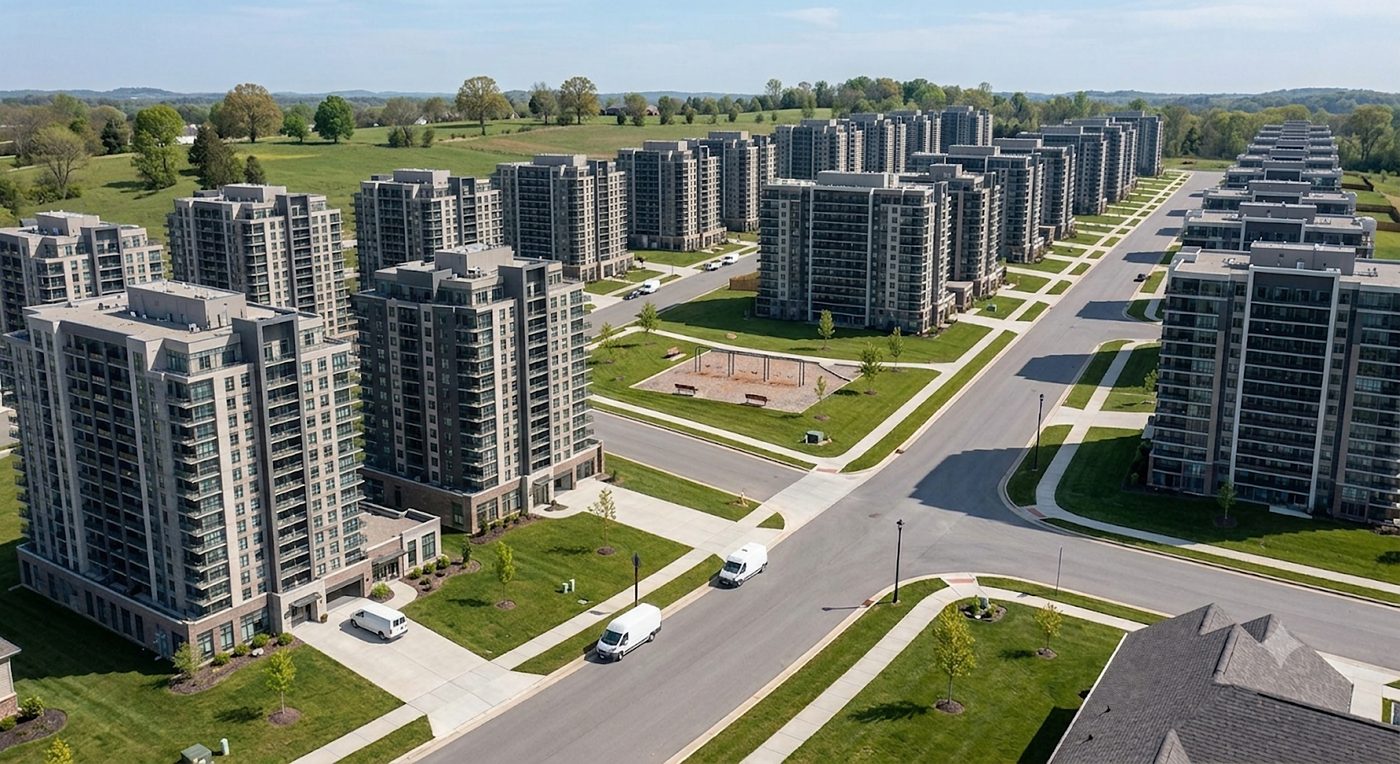
During my recent trip to Malaysia, an embarrassing incident happened to me. My cab driver was taking me from Singapore to Malaysia. He asked me to choose between a high and a low traffic option. I chose low traffic and got lost in my own thoughts. I failed to notice that the distance had shifted from 8km to 38 km. After nearly 20 minutes or so, I noticed hundreds of buildings with empty flats on both sides of the road. It was a different route from what I expected but the mistake was made. I decided just to pass time glancing outside my car window. There were rows of high-rise apartments one after the other during the entire distance. It was weird to see fully polished buildings but without any sign of occupying residents. Who was paying for these mega housing sprees? The answer was not local, but it was global.
3.1.0 Ghost cities as shameless representation of LOLR
Over the last three decades, the global real estate and urban planning landscape has been marked by a hyper-ambitious trend: building massive, master-planned "smart cities" or "financial hubs" entirely from scratch. Driven by cheap credit, speculative investment, and political hubris, these megaprojects promised to be the tech-driven, sustainable utopias of the 21st century. Instead, they collapsed under the weight of poor execution, economic reality, and severe lack of organic community. To understand this, let us have a look at a strange phenomenon called Ghost Cities with few examples mentioned below: - A. Forest City (Johor Bahru, Malaysia) in 2016 This is a $100 billion dollar township built within 2km distance from Singapore. The two countries are just separated by the Strait of Johor. Its promoter was Country Garden, the famous Chinese real estate giant that succumbed to bankruptcy recently. Its luxury apartments were planned for nearly a million residents with high purchasing power. A big chunk of the flats was bought by wealthy Chinese. Today, it is largely a ghost city with occupancy rate of less than 8%. The dream was that all those high-end professionals who could not afford a property in Singapore, could buy it in Forest City at a stone’s throw away from Singapore. But a series of accidents post-covid and rising mistrust between Malaysian and Chinese governments could not turn it into mini-Dubai. Immigration policies, special economic zone status and tax exemptions were not managed accordingly to turn this city into a big magnet. Today, rows of empty towers stand starkly silent against the coastline. Malls, shops and restaurants are there but a very few customers trickle into them daily. You can feel quite often that the number of workers is more than the customers.
B. Lavasa (Maharashtra, India) launched in 2000 It was a well-planned hill station just two hours away from Bombay, the financial capital of India. Nestled in the Western Ghats, it was designed like an Italian coastal village with lakeside escapes. But it got caught in the political slugfest between rival political parties. Multiple accusations like environmental violations, land acquisition laws’ violations kept on aggregating along with a massive debt on the project. The project founder was related with some big political leader of Maharashtra. So, despite being the right intent and investment, the project could not handle the setbacks. Today, it is strewn with unfinished roads, failing municipal services, rotting concrete walls and an uncertain future. A very small chunk far lesser than intended one, is living there with no hope of an emerging city. C. Yujiapu Financial District (Tianjin, China) launched in 2009 Like many big-promise projects, this was supposed to be the wall street equivalent of China. With a towering skyline, high-speed rail terminal, it was designed for a million workers of a new-age financial city. However, it could not create sufficient attraction in public mind to shift from Shanghai or Beijing as it was quite distant from these two major centres. If you look at it today, it is a fully-furnished city, but the population is very thin. Office towers sit hollow and silent. While it was supposed to be a densely populated financial district, it has become only a tourist destination for short visits.
D. Burj Al Babas (Mudurnu, Turkey) launched in 2014 This was supposed to be a hyper-specific luxury resort village comprising a few hundred villas. It was made specifically for wealthy Gulf tourists, but the Turkish economy did not perform well. Inflation rates soared, oil prices crashed and foreign buyers pulled out. The promoter company went bankrupt before they could complete the project. Today, it is an ugly site of half-finished castles standing in tight rows across a valley with zero population and decaying surroundings. E. Kilamba New City (Luanda, Angola) launched in 2008 Chinese state-owned enterprise sponsored this city in exchange for the oil of this African country. With a goal of addressing the housing deficit in Luanda, it was made to house over half a million residents. To complete surprise, it turned out to be a construction far costly than this poor country could afford. The average price of a single house was put above $100,000. Angolans could not afford such high costs. They did not have any vibrant mortgage banking system for the right support. For a number of years, the city remained virtually empty but with government subsidies and steep price correction, some life has come to this not-so-new city but still, vast spaces are vacant.
3.1.1 Ghost cities thrive inside a hidden and misleading regulatory language
Modern ghost cities almost always suffer from "Top-Down Planning Syndrome." Urban planners treat cities like engineering blueprints rather than living ecosystems. Without structural affordability, jobs, or community networks, they remain monuments of speculative investment rather than places to live. Let us ask how many Ghost cities there are in China. Pinpointing an exact number is notoriously difficult because "ghost city" is a media term rather than an official administrative classification. However, urban planning researchers, geographic data analysts, and economic reports generally estimate that there are around 50 major underoccupied developments or municipalities across China that fit this description. Local governments rarely publish low-occupancy data, researchers have had to get creative. One of the most famous estimates came from data compiled via the State Grid Corporation of China. They tracked how many residential units had zero electricity consumption for six consecutive months. That metric suggested there are roughly 50 to 65 million empty apartments across the country—enough vacant housing to hold the entire population of France. They Aren't "Ghost Cities"— They Are "Unborn Cities".
Because these cities are built on a 20-to-30-year planning horizon, several of the most "infamous" ghost cities from the 2000s and 2010s may no longer be considered ghosts at all. Once the government hooks up high-speed rail lines, relocates top-tier public schools, and moves municipal headquarters to the area, people follow. Pudong (Shanghai) is one such example. In the 1990s, it was widely mocked as a massive, empty white elephant. Today, it is one of the most vital, densely populated financial districts on the planet. However, the demographic state of China clearly shows very little probability of such recurring success stories. While the larger, major "tier-1 and tier-2" experimental cities eventually find their footing, the real "perma-ghosts" are emerging in tier-3 and tier-4 areas (smaller, remote regional cities). Local officials built massive suburban high-rise grids to artificially inflate local GDP, but because China’s overall population is declining and young workers are migrating exclusively to major tech hubs, these lower-tier properties may truly remain empty forever.
Even if some cities may gain somewhat normalcy, the most important question is the actual occupancy rate. This figure should be the most difficult to trace in the public data in any country. I have travelled to over a couple of dozen cities in the last two decades and I cannot deny that I rarely see new-age apartment complexes with high occupancy ratio. Not only cities like Bengaluru, Pune, Hyderabad, New Delhi, Singapore, Malaysia, Dubai, Abu Dhabhi, Chennai, Kolkata but also smaller towns like Nashik (Maharashtra, India), Noida (Uttar Pradesh, India), Amritsar (Punjab, India) show a similar trend of buildings with an occupancy rate of 10-30%. This is not a one-time figure; rather I have been observing something like this for over a decade. When a developer launches a property, it shows a pre-booked status, but when on-ground reality is observed, the real inhabitants never come to settle in those buildings. When you go inside such locations, there is a strange kind of loneliness among people whosoever is visible. They are both terrified as well as welcoming towards a stranger. If it is potentially a new owner coming to inhabit the space, they appear happy but if it is not, their eyes show a non-invitation as if they are feeling embarrassed with living like prisoners on this stranded piece of land.
3.1.2 Why do real estate prices rarely go down?
It is a strange paradox that real estate prices rarely go down despite global headwinds, ghost cities, AI layoffs and so on. The homeowner may be able to sell property at less profit, but it is rare to see someone selling at a huge discount. It is understandable why an owner would sell at a loss, but the problem is even more complicated. Even if one wants to, it would be extremely difficult to sell below a certain price. The first hurdle is to prepay one’s own principal to arrange a smooth sale to the next owner. Without the bank’s permission, it is not possible. Why would a bank allow a property to be sold at a price that is less than its original one? It will hurt its asset portfolio. They lend at a mark-to-market rate. If a property is worth $500,000, the bank might lend up to 80-90% of the market value but if the market value is accepted to be falling, the bank won’t allow such a reality to settle. Banks ride on great market fictions; they cannot showcase a negative future. An owner owns the property physically, but the legal claim is permissible only if the bank releases the property. If there is a default in EMIs, the bank will reclaim the property and auction it but won’t devalue the property outrightly. The real price of a property may decline but the nominal prices rarely decline. Even if there is oversupply of housing in a market, the prices don’t fall below a certain bracket. The other reason is the local government. Local governments generally have a policy of circle rate. Circle rate basically means that you cannot sell a property or buy a property below a certain price, a sort of minimal standard price. This is done to discourage the evasion of stamp duty which is 5 to 10% depending upon your location. If the circle rate is jacked up year after year and you want to sell, you cannot offload below a certain price floor. If there is no buyer at that price, how will you exit the market? The savage part is that the circle rate goes up but rarely goes down. So, homeowners may be millionaires on paper, but they cannot realize the value without the blessing of the system.
This creates serious financing anomalies and perversion of real estate market itself. If you want to see a glimpse of the future, India is a great example of that. The whole housing finance has moved from affordable to luxury housing in the last decade. Affordable housing means the price is below Rs.5 million. If only upper middle class or rich people can buy, the bank credit would go to them only. Media coverage is available to only those properties that are above Rs. 10 million. Though the demand for affordable homes should be big in a developing country like India, the NPAs for this segment have remained high due to K-shaped economic growth. Over 80% loans are given to luxury houses and if you ask what the percentage is being given to affordable housing then it is less than 20%. All big real estate developers have abdicated their responsibility from this segment because it is no more profitable to serve the middle-class segment. When you see such a phenomenon, the LOLR stakeholders present a weak wicket, but it does not mean an imminent death of the sector or the business model. A long-term trend takes its time to manifest its debilitating implications. The powerful players don’t exit a market just because the market is behaving unprofitably. Housing markets are deeply embedded social structures. There are multiple levers in this market like interest rates, financing duration, public demand and so on.
3.1.3 Real Estate is the biggest gravitational field of LOLR
As we get into the heart of the matter, we can see two obvious things. First, the problem is very deep. Secondly, it is very seriously spread across almost all the countries. In such a reality, figuring out solutions is not easy. A simplistic startup-like approach won’t help because the creators of the problem don’t even bother to recognize the existence of the problem. So, this kind of blind approach towards crypto startups is not going to work. Crypto entrepreneurs would have to do original thinking to highlight whatever they do is not just for money. It must be aligned with emerging social design of the future.
For that, they need to understand how a lender of last sort has created such a serious vertical and horizontal spread. You'll be surprised to know the global size of real estate industry or real estate as a sector is over $300 trillion. It includes all privately owned commercial and residential buildings. Only America has 140 million homes. Against a population of 340 million, they have a house for basically 2.3 persons each. China has around 600 million houses. The global number may land up anywhere between 2 to 2.5 billion housing units. If one builds a mortgage culture over such a vast base, it means that citizens would be under debt for generations. A citizen under debt is very easy to control because the leverage can be tightened/loosened by a few things like home loan interest rates, tax exemptions for mortgage buyers, allowing multiple home mortgages and so on.
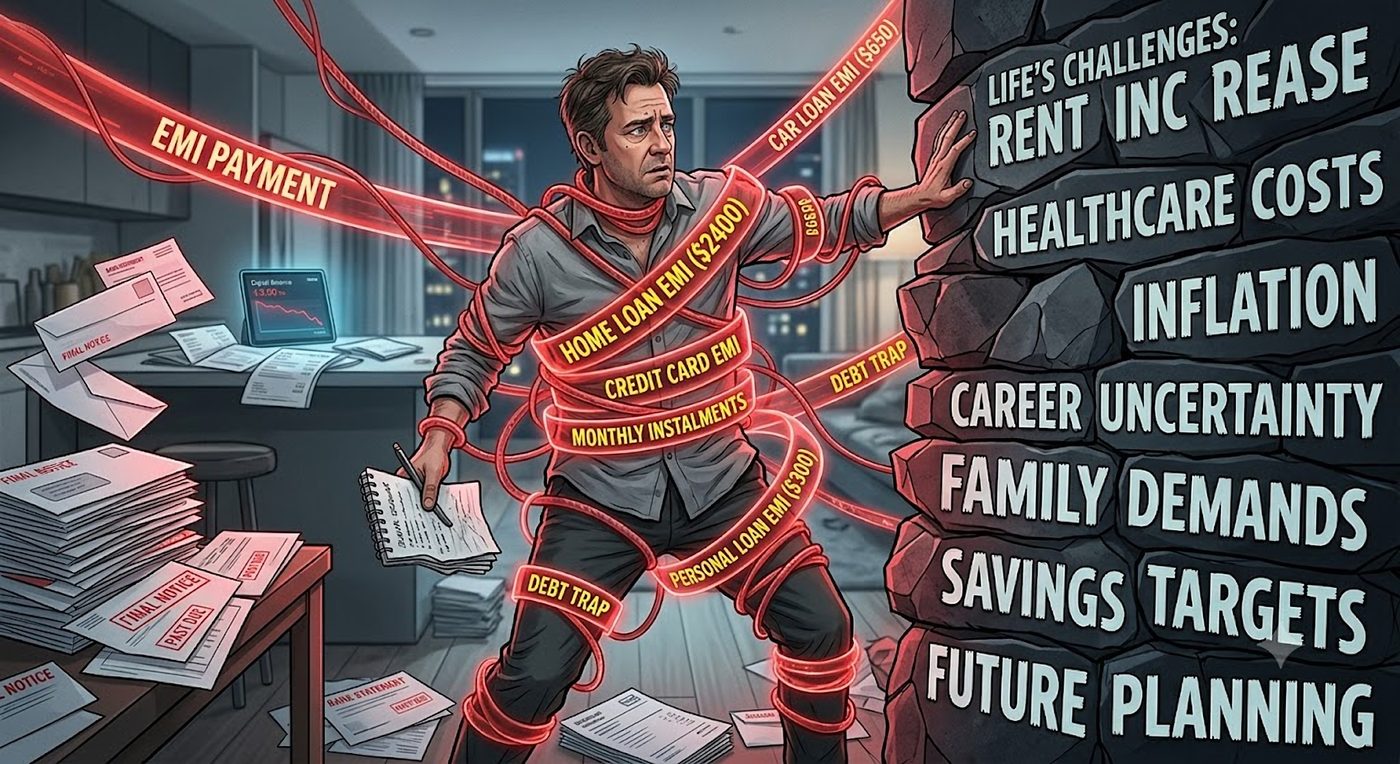
When a citizen pays EMIs month after month for years, it throws a counter-intuitive design bug. Is this situation not far from socialist housing era? A landlord is an owner only if the full loan amount is paid back. Till then, he/she is a slave. If property rights are curtailed by limited duration lease model (as it exists in Singapore), the ownership is made extinct further. If food was licensed in socialism, credit cards are multiplied in capitalism. If public transport helped users commute in socialism, EMI-based cars made transport possible in capitalism. The government paid for your education in socialism, but you pay for your education via EMI-based loans for 15 years in capitalism. If tax rates were high in socialism, the EMI and tax portion of one’s monthly income is in the range of 60-80%. Whether it is socialism or capitalism, the governments find a way of intervening with life of their citizens. The reason is not the ideology rather it is the core design template of humanity. It is both gravitational and existential. It is lender-of-last-resort. You go North; you go South, you will find LOLR. You go into developed countries or developing countries, you will find LOLR. Socialism is LOLR and ironically, capitalism has also become LOLR. If you look at couple of generations, the difference is merely ornamental. It is a game of deception.
3.2.0 EMI culture is coming to halt at a generational level
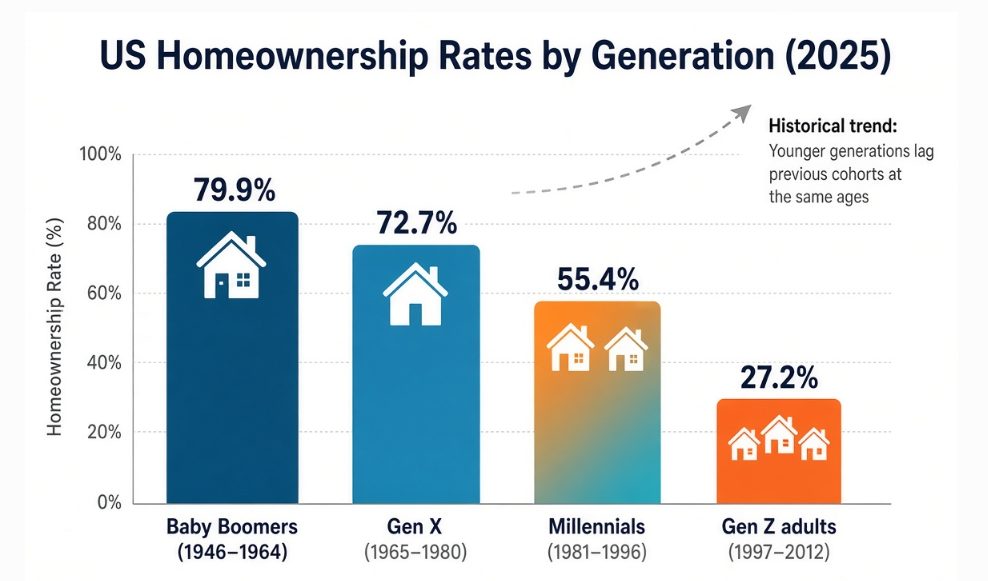
Now the question is whether housing economy keeps on pulling upcoming generations the way they did with the last three. The answer is not a comforting one for LOLR stakeholders. All the circumstances, like rising population, rising purchasing power, affordable housing, low interest rates and low inflation, that are a prerequisite for housing demand have completely gone contrary. Compare a couple of today with the one from 60s and 70s. That was an era when one man could earn for the entire family and could easily afford EMIs within one salary. A couple used to believe in the institution of marriage and raising a family for life. The economy was booming, incomes were rising and banks did not have the problem of bad loans. Compare the same with what is the scenario today. Marriage is being delayed or avoided. If some are married, they avoid kids and even if they have kids, they tend to have none or as little as possible. Buying a home would require at least two earning members, that means both wife and husband. The relative demand for housing is in active decline. If you look at Figure 3.3, you will have a fairly good idea how the ownership pattern has decelerated radically in the USA.
| Nation | Affordable (3.0 & under) | Moderately unaffordable (3.1–4.0) | Seriously unaffordable (4.1–5.0) | Severely unaffordable (5.1–8.9) | Impossibly unaffordable (9.0 & over) | Total markets | Median multiple |
|---|---|---|---|---|---|---|---|
| Australia | 0 | 0 | 0 | 1 | 4 | 5 | 9.9 |
| Canada | 0 | 1 | 2 | 2 | 1 | 6 | 5.4 |
| Hong Kong | 0 | 0 | 0 | 0 | 1 | 1 | 14.1 |
| Ireland | 0 | 0 | 0 | 1 | 0 | 1 | 4.9 |
| New Zealand | 0 | 0 | 0 | 1 | 0 | 1 | 7.7 |
| Singapore | 0 | 0 | 1 | 0 | 0 | 1 | 4.3 |
| UK | 0 | 3 | 7 | 13 | 0 | 23 | 5.2 |
| USA | 0 | 15 | 20 | 18 | 5 | 58 | 4.5 |
| Total | 0 | 19 | 30 | 36 | 11 | 96 | 5.0 |
Source: Demographia International Housing Affordability, 2026 Edition, Centre for Demographics & Policy, Chapman University.
This pattern is not just for one country but fairly common across the world and rather much worse. When you look at all the countries and their ruling mindset, it is the same old past thinking that kids would get educated, would get jobs, would get married, raise a family and would buy a home. They refuse to acknowledge that education and jobs are being eaten up by AI; marriage is being gobbled up by rising cost of entering/exiting a marital bond; raising kids is a big burden for a nuclear family-cum-working parents that the entire story is a burn-out process. The third and the bottom layer of lender-of-last-resort is that of man-woman social contract. This contract is tearing apart all across the world. Men and women are preferring to remain single and childless. Dating apps like Tinder and Bumble are losing their subscribers plus revenue quarter after quarter and their market cap is around 80% down from all-time high. The number of educated but single women are rising fast. The average age of marriage has moved from mid-20s to early 30s. Some governments are turning desperate at this trend as it is not just negative demographics but might turn into a depopulation and eventually a civilizational crisis for them. For example, South Korean government is giving couples money to get married. For kids, it is giving ₩2 million12 for one kid to each couple and ₩3 million for two kids or twins. The problem is so severe that government is even giving money for dating expenses, engagement ceremony and honeymoon cost. Parental support and paternity leave are also being added into the package. The government is so serious that they have a dedicated ministry called the Ministry of Population Strategy and Planning. Since 2006, South Korea has conducted world’s costliest pro-natalist mission costing them ₩380trillion till date. It is not just a case of South Korea. Even Japan, Singapore, Hungary, Poland and Russia are running similar programs for couples. Despite all these big family programs, the success metrics are not encouraging yet. The family size is still shrinking. What worked wonders in case of Boomers and GenX is showing weak and even poor results in case of millennials and GenZ. And the biggest reason behind that is housing unaffordability. If you look all around the world, it presents a bleak picture as shown in Table 3.1. The apparatus LOLR stakeholders used to prop up housing economy was a mortgage-backed lending model. Banks are sitting on a big pile of debts and occupancy rates are still very low. Ghost cities are altogether another big problem. If the previous housing stock is not fully utilized yet, how can new demand be created?
3.2.1 Future of work is far more mobile than we can imagine
The edifice of mortgage economy was resurrected on the basis of corporate jobs where a professional was supposed to spend a good amount of his life from 25 to 60 years of age. The jobs could change but the corporate nature behind them was a stable factor. In a way, the rise of staff-led corporate growth was the inflation of borrower-led housing bubble. This bedrock of demand is getting squeezed particularly for the entry-level jobs. Though job cuts are still not widely prevalent, the reduced job hiring is a wide-open trend. The corporate managements are still figuring out what to do with AI. Recent US graduate (22-27 years) unemployment rose from 4.2 to 5.6% by March 2026. Youth unemployment in the UK rose from 14.2 to 16.4%; in Sweden, it rose to nearly 26%, and the trend is same in Canada. Big Indian IT services companies have already gone from net positive to net negative hiring in the last two years. There is serious pressure on billing structure as clients are asking for lower invoices as well as outcome-based pricing. The topline is either flat or declining. All such companies are seeing a steep fall in the market cap as most of their shares are down 50% from their all-time high. In a way, market has already given a verdict of their future. The way Claude and ChatGPT are reaching top-notch levels in 2026, the lay-off/reduced hiring both trends are expected to go worse. The pace at which AI is growing, it is definitely going to do one thing and that is security of a job. Once this bedrock of stability is gone, the demand for 25-year long mortgage will undergo a secular decline. What propped the last four decades of growth would go down with a downward job trend in coming decades. People would prefer rental accommodations because they can be managed with low visibility of future incomes. They would prefer to move frequently from city to city to maximize their earnings potential. In such a scenario, carrying a life-long debt burden would be a big no-no for the current generations. The future of work will be less based upon jobs and more based upon project outcomes. They will go for side hustles and will build not one but multiple income pipelines.
Now, the question is what will happen to the existing inventory of housing. How many Evergrande-like big real estate giants will fail before the governments wake up? How much fresh equity capital will be infused into public sector banks and how many bad debts will be written off? If banks cannot find easy buyers for their mortgage schemes, how will the banks save their asset values from going down? Will they go bankrupt? Will they seek bail-out facilities from the central bank? How will they reimagine their customers, business models and long-term sustainability?
3.3.0 Dear Bank, jump the cliff or become a prepaid rental housing NFT platform
If you summarize the implications of all above-mentioned phenomena like Ghost cities, rise of unaffordable housing, slow burn low-occupancy apartments and future of work, one thing is certain that LOLR can no longer keep on trusting the mortgage model as it has done in decades. The topology of population has undergone a serious shift. What to talk of buying, even renting is becoming unaffordable for a large number of GenZ as one-third of them have either gone back to parental homes due to joblessness or low paying capacity. This is called the boomerang generation. All those cultures with housing affordability problem have a special name for this sociological phenomenon. Japan calls it parasite singles; Italy calls it Bambocciani; Korea calls them Kangaroo tribe and in Germany and Austria, it is called Hotel Mama. What appeared to be a control game by LOLR has inversed into persistent under-cutting. If AI eats up white-collar jobs, it won’t be possible to absorb the massive bad debts. For a weaker LOLR, it would become a question of existence. At this juncture, the question arises whether it can seek redemption at all.
Before I answer this, I must remind you that the magnitude of this problem is damn big in terms of scale and value, but the real change is neither in dollars nor in numbers. The real change is phase-shift where populations are empowered not controlled. So, a solution should focus on the foundational layer. A lender-of-lastresort will have to decide whether it wants to keep lending into eventual bankruptcy or take a lateral route to safeguard the housing stock as well as the health of its population. Let us have a picture of that lateral thinking. Today, look at a big bank that has five million mortgages in its books. Its business model has been simple. Take the papers of ownership from the owner, hypothecate the asset to the bank and give a reasonable amount to the borrower to be repaid over a period of 20-30 years. If the market value of the asset is rising, it is a great business but if markets are declining and no long-term solution is forthcoming, there is a huge chance that this business model will fall back upon its own head. Now, those millions of mortgages are nothing but deadwood.
Now, look at the same problem from a different perspective. Right now, this housing stock is on the balance sheet with no visibility. If an item has gone into non-performing asset, you can auction it but if there is no demand or prices are very low, there won’t be any resolution of the problem. Even auctions can solve the problem only if they are small and do not affect the market. At this juncture, LOLR needs to ask itself whether it wants to empower its people or keep them locked into an obsolete model. I am offering a new picture for those who think of a bright future, and it is as follows: - Imagine a bank not as an invisible balance sheet that is ashamed of revealing its bad assets. Think of a bank like a housing platform like 99acres.com or Zillow where properties are listed but there is a big change. No property is being bought or sold but only the rental rights of the same are being transferred on the platform. So, it should be called a prepaid rental NFT platform like those of Opensea, Blur or MagicEden but it would work as Housing-as-a-service (HaaS) companies. It means that users are now buying the rights to rent a house for a fixed duration that may be one year or one month. But how will it work? The owner of the house will go to the banking platform that offers this facility. He or she will create a rental right that gives a clear mention of duration and price. Let us imagine that there is a property that fetches $3000 per month in a standard rental market. The owner offers two prepaid options to the buyers. Pay a full year amount in advance and get a 20% discount or pay a three-year rental amount in advance and get a 45% discount. What an owner gets is lumpsum liquidity that may be used to prepay the pending principal or some other loans. What a buyer gets is zero tension of recurring monthly payments. There is always an arbitrage opportunity between the buyer and the owner but ask yourself a question. Who has a deep insight into the financial situation of both parties. It is the bank because it is also the best data market for the housing sector.
Are you asking that a bank should behave like a broker platform or even a property management platform? Before I answer that, I have a counter-question. If mobility-as-a-service is possible, if software-as-a-service is possible, why is Housing-as-a-service (HaaS) not possible? A bank is the most suitable data marketplace to graduate into this role. Yes, it would need to assimilate some new verticals for efficient functioning, but it is entirely possible. Just revisit the history of the last four decades of banking. Could you have predicted in 1980 that banks would be selling insurance products, mutual funds and portfolio management services? If all this was possible earlier, nothing would be impossible for a bank today. Before you freak out, please wait for more information. If you ask what a borrower is paying to the bank and the answer would be that principal plus interest. We know that this is low-margin but a high-volume business. Now, you ask the same question: if banks are selling prepaid rental NFTs, what would be the sources of revenue? The first obvious answer is brokerage fee that can be in the range of 2-5% for different durations of prepaid rental NFTs but there would be additional revenue opportunities like providing the reputation management services to both the parties as it will be very critical. Land record managers may chip in with attestation services also. Since a bank sits on a big surface area and reputation data is shared between banks already, it would be far easier for them to implement such a service. A property can have different attraction points at different conditions. For example, a beachside villa worth over $1.5 million may not have a buyer but it might have a reasonable market if a prepaid rental NFT worth one year of utility rights is available at $80,000. A property may not appear attractive during one season but might have during the other season. For better price discovery, these platforms can add further things like market makers, upvote/downvote mechanism, insurance against property damage and so on. In an AI-driven job market, people would prefer to live in 30 homes over 30 years instead of living in the same home for similar period. If the reputation is portable or shared, shifting between cities would be far easier than it is today. Banks designed the financial infrastructure for good living conditions in the last decades; they can keep on doing the same but in a different avatar with different values. As far as tech infrastructure is concerned, we already have hundreds of public blockchains where such NFTs can be created. All the user-friendly services like gasless payments, account abstraction, multisig, social recovery etc. are already available for many such chains. If the LOLR prefers to do away with punishing crypto holders, they can pay for these prepaid rental NFTs via their crypto-currencies. It is not difficult to connect a blockchain address/public key to a permissioned KYC detail. Whitelisting can be easily managed without changing the decentralization feature of a blockchain. It means that LOLR can reincarnate as a public goods manager with high revenue visibility. If capital account convertibility is liberalized, the demand can be extended into foreign markets particularly for the tourism-friendly spots. In many cases, a-bank-as-a-NFT platform can outsmart many existing hotel booking platforms because a prepaid rental market would work exactly like one provided the duration of the rental NFTs is reduced for certain markets. In many cases, a prepaid rental NFT platform may even appear as a social network also. This transformation can enable a massive upsurge of network state entrepreneurs like that of Balaji Srinivasan who built his Network School in Johor Bahru, Malaysia just two km away from Singapore. A committed set of digital nomads can buy certain properties as a recurring attractor for building a mobile talent factory. These models may be leasing or sub-leasing models too where instead of a single flat, a bunch of properties are taken up for a smaller population from a few hundred to a few thousand.
You might think that banks will not jump on to blockchains as it would make them crypto players. The answer is that the LOLR stakeholders who hated Bitcoin for years finally concluded that the Bitcoin ETF is a far better way of engaging with a new asset market than abstaining. Today, even Ethereum ETFs are available and many similar services for other cryptocurrencies are in the pipeline. To be fair, crypto is a pipeline of innovation for banks and traditional financial institutions. Don’t forget that the current value of real estate is in the range of $300-500 trillion. A crypto-led solution would only serve this big market. The only condition is that LOLR stakeholders need to love crypto instead of hating it. Now, you may ask why the same cannot be done by banks without using blockchains or NFTs. The answer is that a new market needs not just innovation but also a fresh dose of transparency and freedom. Banks do not have a great history in all these three facets. They can gain all of them in one single shot if they use public blockchains as there is already a critical mass of crypto users who can jump in as the early customers of the new business model. It does not mean that adoption would be quick, but this would rise in similar fashion as the housing mortgage trend rose a few decades ago. Look at this problem from a recurring liquidity perspective. Housing is fundamentally a utility-led business but removing ownership hassles and long-term bondage can unlock this utility. The real game is changing the duration of ownership from a usage lens. A tenant owns a property for a fixed duration but within certain conditions. Even China and Singapore don’t give unlimited rights over property to their citizens. So, I am not suggesting something new. Rather, I am just trying to tone down the valuation story and bring forth the value story.
3.3.1 On-chain custodians and auction designs are faster to scale than offchain ones
It must be noted here that the prepaid rental NFT model for housing is a foundational choice, but its implementation is contingent on a few principles to be maintained by custodians. The data on the blockchain should reflect the on-ground reality exactly because chains can offer tamper-proof guarantees only after they are recorded on a distributed ledger. However, this needs data port from off-chain and even off-line source. This is a tricky trajectory and that is where the role of custodian becomes critical. Blockchains would remain the verification layer but the attestation from the custodian is where an on-chain record gets a full sanctity. The prepaid rental platforms can bring in reputation models and differential fees for localized land custodians. The first capture of land record has to be done diligently. A land registry is not just a data structure rather it is the state’s promise to intervene if the record and truth diverge. If the LOLR blesses the sanctity of this model, the indemnification clause against any poor record errors can also be introduced. The platform design would have many flavors from a big bank to a smaller bank, from one chain to another chain, from short-duration to long-duration NFTs, from high property management fee to low fee deductions, from low to high stamp duty fees and so on. However, there would be some common things here. Ownership will be a public record as well as a utilitarian right would also be a public one. Custodians would be maintaining transparency with on-chain transactions. All of them will provide some sort of key-loss safety provisions because these NFTs won’t be a bearer asset. Some sort of judicial or administrative rules will ensure the implementation of social recovery or multisig provisions. Even the buy/sell model might be different from platform to platform as there is a huge scope of adding unique auction models for NFTs. It may be an English auction (price rises until one bidder remains) or Dutch auction (price falls from a higher start until someone accepts). It may be a first-price sealed bid or even secondprice sealed bid too. The issue here is that different models may be suitable in different contexts. Blockchains are quite capable of implementing all the possible varieties of auction designs. When the entry barrier to such markets is done away by treating them on lines of crypto markets, this will create a massive restoration of value. This chapter started with sad details of capital destruction like those of Ghost cities or low occupancy housing apartments, but what is being discussed right now, is completely opposite. That is what crypto can do if done with the right intent and imagination.
3.3.2 Start with WIP project launches in a B2B2C model
One may ask what those sectors within housing are where these experiments can easily be carried out. The answer is the category of projects that are still a work-inprogress. A housing apartment complex can take any time from 3 to 5 years or even higher duration to complete. Imagine a project that was started in 2024 and will be delivered to the market in 2028. Now, this is a project that is half-built, banks already on-board and huge employment is involved in its construction. If the market sentiment goes negative due to AI-driven layoffs, the project would be dead much before it lands in 2028. This is a case where a developer is neither here nor there. If the long-term dynamics of the mortgage market are reversed, what are the options left for such a developer? It is a great predicament because the developer has also built the entire project by taking loans from the bank. Any delay in sales would have a debilitating impact on the project viability. How to sort this problem out? The answer is to launch prepaid rental NFTs of completed units where duration may vary from one year to five or seven years. Higher the duration, higher the discount of the rental unit. This would cushion a project against any adverse housing finance scenario. Secondly, users will be able to figure out the long-term value of a project during the rental phase. If this value holds, they can graduate into long-term duration rentals or even buy out the property. This model can work in B2B2C where first B is the developer, the second B is the bank/prepaid rental NFT platform and C is the customer. I am sure that you might be still worried about the paying capacity of users and would be still unconvinced about the viability of prepaid rental housing platforms. All answers cannot be administrative; some have to be sociological too. If the community decides to give a marrying couple a prepaid rental housing NFT as a gift, the game gets a new social anchor. Any matchmaking platform can come in-between to add the public acceptance of the project. What is being attempted here? One must understand that housing is not just a financial problem and hence, it is not just a problem for banks. Ultimately, it is a public goods problem. If a big chunk of housing sits vacant, it marks a failure of the underlying model. What is being proposed here is a foundational rewrite. It is a step in the right direction where the basic principle is that short-duration prepaid rental rights are a better model than ownership with long-term debt. It will fill all those vacant slots where buyers are not forthcoming due to higher prices or long-term debt. Once the apartment occupancy path is declogged, it will enable the economies of scale that will emerge once the people start engaging in more and more transactions.
3.4.0 Maturing of Housing-as-a-service economy with crypto payments for NFTs
A prepaid rental NFT won’t be a single and simplified market solution. One can tokenize a single residential unit for a single duration, a single unit for permanence, multiple units for multiple durations and a big residential unit for permanence also. Blockchain can provide one layer for permanent but fractional ownership but another layer for short duration but full unit ownership of a residential unit. In a way, this would be the true way of building housing markets where they will be liquid as well as solid at the same time. Housing-as-a-service economy is a wider paradigm that won’t have just one layer of prepaid rental NFTs. It would be supported by other blockchain applications relevant to real estate markets. One of such solutions will be those projects transformed into fractional ownership mode. It would be like turning a real estate project into a public limited company where all the rental and other incomes are distributed back to investors. However, this will be based upon semi-fungible or fungible tokens depending upon the context. There would be trading markets for such tokens as they would flow peer to peer as if they were equity instruments. This arrangement can go into both socialist and capitalist mode. A community can come together and can pre-fund a housing project like an old age home, a residential university or a big permaculture township. Another possible picture can also emerge where a few big VCs come together to fund a big casino resort, a cruise ship or a luxury hotel. These markets may end up fully open to all, selectively open to those with certain eligibility conditions or only open to a limited number of pre-selected members. The blockchains have sufficient space to accommodate the old and the new possibilities. Look at the scale and interoperability potential of these markets. Assume an AI agent buying a property for you in Singapore for your six-month stay via a prepaid rental NFT platform after paying with Bitcoin. It checks metadata of the property, aligns with past transactions, checks with custodian, checks the suitability of temperature and humidity conditions, observes the nearby restaurants and food delivery services. Once it is fully sure of being right, it makes the payment. At such a scale, any government that imposes too much friction would be bypassed by the AI agents. Abundance is a byproduct of mutually serving metadata environments. Only blockchains have the real capacity to ensure to work with AI at scale. Blockchains will provide the truth while AI will provide the intelligence.
3.5.0 Dream 2028: 74% of GDP in Nigeria comes from on-chain economies
Adaeze Nwankwo sells fabric in Balogun Market, Lagos. Her stall doesn't take cash anymore — hasn't for two years, not because she has anything against paper money, but because her rent is indexed to a stablecoin lease contract, and her customers, mostly other traders, pay through wallets that clear before she's finished wrapping the ankara. She still haggles the old way, loudly, with her hands. The blockchain just moved the plumbing underneath the argument. Her son works in what Lagosians now call "passport writing" — a trade that didn't exist when he was in secondary school. He's a certifier, one of thousands, whose job is to inspect goods — motorcycles, generators, second-hand phones — and attach legally binding claims about their condition to a digital token, backed by his own staked money. If he's wrong, he pays. If he's right, he earns a small cut every time that motorcycle changes hands for the rest of its working life. It's not a bank job. It's not a market-stall job. It's something the country built out of necessity somewhere in between.
Nigeria is like a clumsy kid who went to school but could never pass any exam. Its relationship with the lender-of-last-resort money system never settled. When the Nigerian central bank issued its currency Naira in 1973, it was pegged to British Pound at a ratio of 1:2, then lost the peg, pegged again to the USD and lost the peg again. The situation went so bad that the national currency nosedived from ₦170–199 per USD in 2014 to ₦1,500+ by early 2024. So, the people of Nigeria did not need to be convinced about crypto, they needed a clear regime. A quarter of adults were routing their savings and remittances through stablecoins in 2021. A unique contradiction was prevailing in the country with the banking system denying crypto while the population was locked in crypto. A government that began by hating crypto finally stopped doing so. Rather, it attempted to show its new-found love for crypto, but people were never bothered with government at all. In 2025, the Investments and Securities Act gave digital assets a legal home, classifying them as securities under the Securities and Exchange Commission rather than leaving them in the regulatory no-man's-land. This did not turn Nigeria into crypto startup capital. Hardly any worthwhile projects came out of this move. Though the government launched its own stablecoin, but its adoption remained very low. In July 2026, President Tinubu signed an executive order that simply opened the door to cross-border payments, remittances, trade settlements, all invited into regulated channels instead of being pushed into shadows. It was not the banking channels or government that made crypto adoption a success rather it was informal to formal bridging that proved extremely successful. Nigeria’s informal economy made of the market women, the okada riders, the roadside mechanics had been nearly invisible to GDP statisticians because cash leaves no trail. Wallets do. What was not noticed got into visibility zone by onchain transactions. They were already there but nobody had ever noticed. One day on 5th January 2029, there appeared a news item in CoinDesk magazine that was remarkably unbelievable for the world but very normal for the people of Nigeria. The magazine reported that the P2P trading volume of stablecoin in Nigeria had crossed $210 billion in 2028. The figure might appear very less, but economists immediately jumped at it. It was over 74% of the Nigerian GDP. No massive altcoin adoption, no big BTC holders, no taxonomy of cryptocurrencies, bad governance of crypto tools but despite all this, the country used only the digital cash version of crypto and that too with stablecoins. It was not due to efforts of any particular crypto company, but this was a shining example of what decentralized version of digital cash can actually accomplish in a poorly governed economy.
Notes
- ₩ is currency symbol for national currency, Won, of South Korea.