Chapter 4 · Attention
Attention Economy & its reincarnation in web3
40 min read · 16 sections · starts on p. 87
Social media went from empowerment to an impoverishment trap as platforms captured attention and gave nothing back. Web3 can reincarnate the attention economy through reputation layers, prediction markets, gaming, live broadcasting and tokenized ed-tech, once onboarding friction is solved.
I joined Facebook in 2009 and left it in 2024. Why am I stating a tragedy categorically right in the beginning? Why to share the news of a divorce before the marriage? Yes, it is a story of 15 years of hope turning into despair. Not only that, but it is also a story of despair turning into helplessness and finally, helplessness moving into a complete dejection.
4.1.0 From a great promise to an utter garbage
When I logged into Facebook in 2009, it was a historically unique space. One could talk to anybody across the world in real time. It used to be a great moment when somebody used to send a friend request to you or your friend request to somebody was accepted. That moment used to be exceptional if the friend was a person of great intellectual calibre or a well-known artist. In my first five years on Facebook, I built a pretty good list of nearly 2,000 friends. My focus was primarily indulging in intellectual deliberations with peers of my era. I used to avoid family members completely. I wanted to meet great scholars, artists, community builders through Facebook and not just in India but across the world. Nearly 40% of my Facebook friends were outside India. I had a well-spread friends’ list in terms of geography and disciplines. Being a college professor, it was important for me to figure out the fresh perspectives and emergent metaphors. Whether I was wrong or not was necessary but finding larger connections was far more critical to me. What could not be done in a physical setting was now possible in a virtual format. Facebook was an idea lab for me. I must have written hundreds of thousands of words on posts, comments and reply-threads. I was also a blogger during those days. So, getting a like or comment was a big thing for me. It was a huge validation when someone used to pay attention to your posts or replies. Being in deep dialogue with strangers was such an intimate experience that I could see the reverberations of a new planetary community beyond borders and biases. For nearly ten years from 2009 to 2018, I really enjoyed living on Facebook. In 2016, I made a blockchain-centric group called MoneyFrames that attracted big crypto minds into regular discussions. To my complete surprise, I saw DAO hack being reported in a few minutes in my FB group and Vitalik Buterin responding to the community members. It was such an intellectually vibrant era that I used to spend 4-5 hours daily on Facebook.
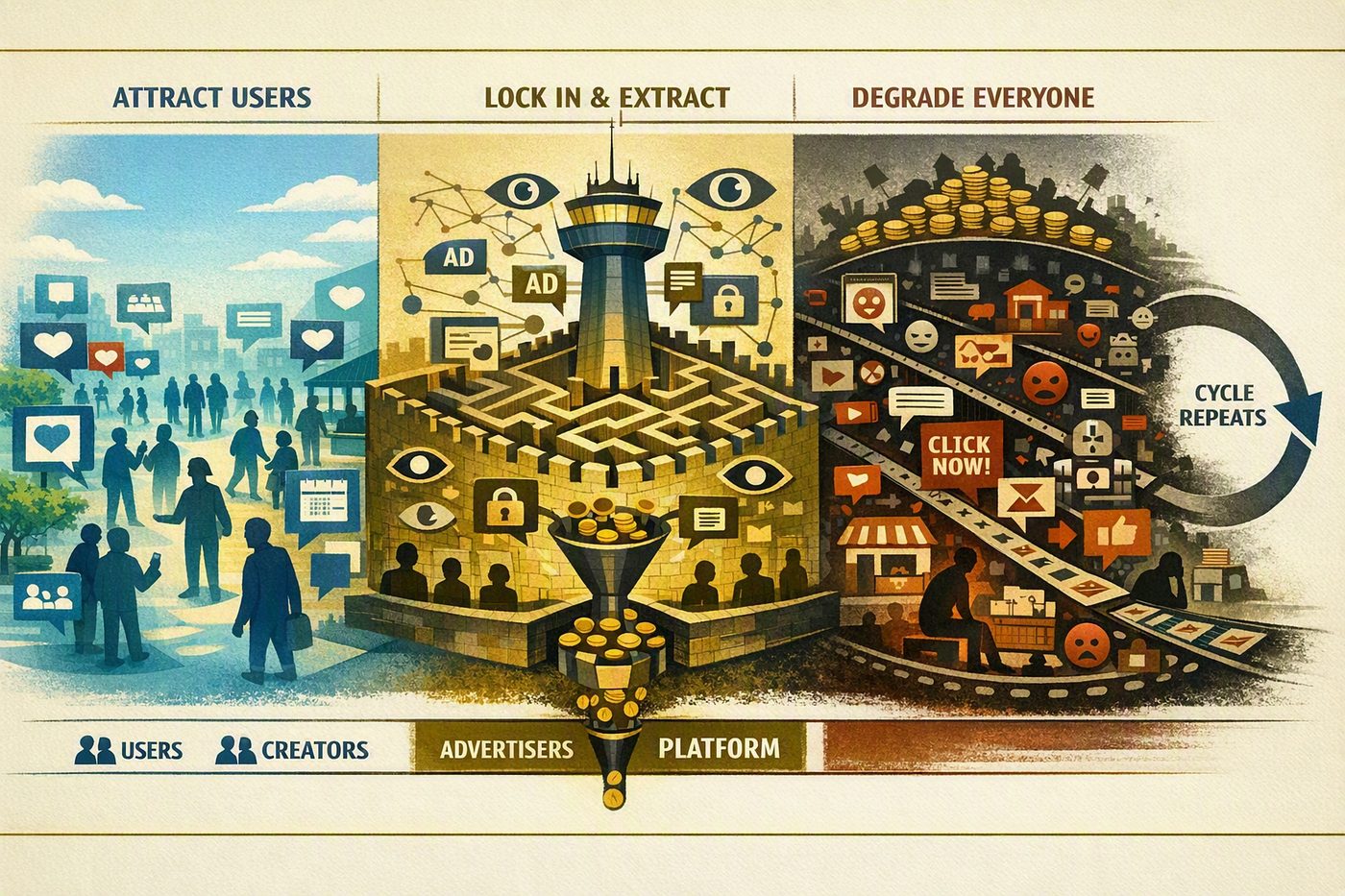
Around 2018-19, something started changing as my news feed was changing. The share of feed coming from friends was being replaced with more entertainment stuff and some advertisements. Earlier, it was not troubling but as things moved on, I realized that feed from certain friends was never coming to me even if they were very active on their timelines. To sort this out, I reduced a lot of friends from my list and kept only those who were active in terms of posts and comments. Even after that, my feed got deteriorated. I could not see even 200 friends appearing on my timeline even once in a month. What was an intellectual galaxy of 2000 friends turned into a thin stream with only occasional flow. Over time, the comments on my posts just vanished and then the likes also started evaporating. After a couple of years, I could not see even 20 friends on my timeline on a regular basis. Whatever was coming in my newsfeed was something I never asked for. Facebook was being made into an entertainment hub instead of an intellectual one for me. My daily time on Facebook went down from hours to less than 30 minutes. My list of friends was rich but still my news feed was poor in terms of ideas. It was not generating any echo for me. What started as a bulging river of ideas got reduced to a dry reality. I had created a proto-social world on Facebook, but it simply vanished from my timeline. My social graph was captured by an algorithm that I knew nothing about. I was still on Facebook but could not figure out why I was there. Chats with friends turned rare. What to talk of comments or a short reply, even likes became somewhat far and few. Waiting to see a post from a long-snatched friend from America or New Delhi or Goa was the only thing that kept me hinged on to the platform after 2022. Even this waiting turned out to be useless. Facebook never restored its promise. Each day spent on it kept sucking me into some sort of “enshittification”13 hole. The idea of leaving the platform started emerging inside me but I could not gather enough courage because the kind of friends I had, there was no hope of getting back to them outside Facebook. I must have tried twice or thrice deleting my account and reversing my decision shortly. How could you leave a 3 billion user platform that was larger than China and India combined? Whatever beautiful is possible in the world must come from the online activity happening inside Facebook! Still, there was some hope, but nothing seemed to be improving. What was social networking in the beginning was replaced with social media over time. What was highly interactive was now replaced with something where I was only a passive consumer. Later, the social media from friends was replaced with media from those who were not your friends. Then, it was just media and that too possibly from machines. Finally, one day in 2024, I just left Facebook permanently.
4.1.1 Facebook, X, Instagram & LinkedIn all went down same way same time
During my last days at Facebook, I started shifting to Twitter (now X) but it felt very different. It was more of a one-way traffic. The content was liked, people used to follow but the quality of comments was very low. If the comment was critical, people used to feel bad even if it was made with good intentions. Dialogue-generation was simply not possible there. It was a way of gathering followers but not a way of mutual interaction. The comfort of talking with known friends was gone and now, I had to create a list of new friends. The early intimacy that I received on Facebook was not here. Though some early experiences were good but later on, Twitter underwent the same process of “enshittification”. The posts from the person I used to follow started declining in my feed; it was followed by decline in comments and then decline in likes. Finally, the platform stopped offering all good features for free and put them behind a pay wall. My social graph was no longer mine. I would be shown a part of it if I paid nearly $10 per month and a larger part if I paid nearly $20 per month. I started paying because at the free tier, I used to get only a few likes and zero comments. I kept on paying for over three years, but the quality of posts, comments and likes kept on declining till one day, I got hacked and the hacker blackmailed me for $4000. It was too much for saving a social media handle that had already started to disappoint me. I was never an Instagram person but out of repetitive frustrations with other platforms, I made an account there in 2024. I was immediately thrown into doomscrolling. What had started subtly with Facebook as a media distribution strategy was out in the open on Instagram. It was straight away a micro version of TV where you could see a 30 second reel instead of a 30-minute episode. Instagram was a hyper TV for me. It was an ad-space platform where influencers were celebrities but not your fellow human beings. Chat option was there but the hope of having a dialogue with anyone was a rare thing. The only thing that I used to do here was scrolling reel after reel. The addiction was so real that the idea of having friends on Instagram got deleted from my mind. I never bothered about who followed me. Very soon, the daily addiction of reels was too much to handle, and I left Instagram without deleting my account. LinkedIn was another site for social networking, but I had lost any motivation to try out this platform in any serious way. I was a guy looking for good dialogue but here, the spirit was missing. I was simply present there and am still present there.
4.1.2 Attention Economy was like waking up a planetary swarm
The question arises why these platforms went on an anti-user path. Why did they choose to move away from the original goal of social networking to media distribution platforms? There are two layers of reasoning behind it. One is obvious but incomplete. The second one is hidden but complete.
The first answer is that every social network is fundamentally a business though a platform business. Since users are not paying for it, somebody must pay naturally for it. If there are three billion of them, the explicit opportunity comes from ad revenue. For a user, if one must see an ad after every 8 or 10 posts, it is a tolerable intervention. But the question is why to erase the social graph a user has created over years. Why to snatch an interactive space user has built over a decade? Facebook management was not foolish enough to sabotage the attractive side of their platform. The reasoning behind ad revenue cannot explain the ever increasing “enshittification” of the platform. That is why the second layer of reasoning is important. The second reasoning took me to the elephant in the room and it was the lender-of-last-resort. Just imagine for a moment that LOLR, the all-encompassing omnipotent consensus system observes a phenomenon called Facebook where three billion plus people are talking to each other with complete transparency and complete freedom. They are sharing their ideas, figuring out their problems plus escape models and building a planetary consciousness. Facebook was a great selforganization tool for this thing. If you have a platform population larger than India and China combined, Facebook is a space for potential rebellion or exit. The social graphs were not just text or media pools, but they could turn into the commandments of a completely new era. This new organization playground was not a casual thing rather it could become a causal force. LOLR could see an existential threat. What users could see as viral content, LOLR stakeholders could see viral institutional framework. It was peoples’ space where freedom could take a new meaning. This could be drastically dangerous to the exclusionary stronghold of LOLR. People could design new forms of money, new forms of moral principles, new kinds of organizations, new religions and so on. The warning signs were selfevident in the Arab uprising that dethroned Egyptian President, Hosni Mubarak who had ruled the country for three decades with absolute control.
4.2.0 LOLR was never a serious player in social media space
Facebook was a very strange beast to handle for LOLR stakeholders. First, it was not a business in the standard sense. It was a trans-business where only a tiny value of the platform was coming from the investors or the management, but the biggest share was coming primarily from the users. Second, it was spread over the entire world with a huge adoption curve in almost every country. Third, its users were not consumers in a traditional sense. They were not paying for the platform rather they were like addictive beings stuck with a new entity. It was so big that a smaller or weaker country like Sri Lanka, Bangladesh, Brazil or Nigeria could not even think of banning this platform. Even if they tried to, there was no direct reason behind that. Additionally, it would have gone quite negative in public opinion. No nation could build something like Facebook on its own. It was a strange sleeper hit that came out of nothing. Now, the beast was right in the middle and it had to be domesticated. All the LOLR stakeholders were caged entities inside their boundaries, but Facebook was beyond their prison architecture. If it could not be killed, it had to be neutralized so that its threatening possibilities were eliminated completely. The best answer was algorithmic capture. Facebook as a media distribution platform was a way better eventuality than as a social network because users could be lulled into silence with a machine-led media targeting strategy.
4.2.1 LOLR players entered late but captured social media space eventually
From a warcraft view, this seems an easy and direct answer but executing this design was not an easy thing. It had to be made invisible. Since Facebook was a listed company, the game was pushed by prioritizing shareholders’ interests over users. While users were interested in social graphs, the investors were dying for higher stock prices and dividends. There was a deeper disconnect between the two but legally, shareholders were supposed to be the only beneficiaries. This started a transformation where Facebook became a mega advertisement engine instead of a social network. First, the user reach was decreased; second, high-quality text-based interactions were replaced with agenda-driven interactions; third, only those usergenerated posts were promoted that had inflammatory or obscene connotations; fourth, the platform UI/UX was made deliberately addictive where users forgot to put long comments and counter-comments. The game shifted from quality of user space to quantity of views a post should get. The platform revenue was now growing but a genuine user was feeling left-out in this game. Even if some users went off the script, they could be now controlled or punished because Facebook was a massive but a single entity. Cambridge Analytica-like controversies were blown out of proportions to box Facebook board into a subservient role. They were reminded that there is someone at the top. From an administrative perspective, it was easy to handle for a LOLR stakeholder. The data-sharing between governments and Facebook Inc was turned into a mutual win-win understanding in the name of privacy laws. Now, the user was a national citizen on Facebook. It was wholly counter-intuitive to what users had imagined earlier. An enshittified Facebook was a far better choice than a free-flowing one. The other corollary to this entire game was turning Facebook into a monopoly platform. This “winner takes all” strategy was a comforting bargain on the part of LOLR stakeholders. If Facebook had a fear of losing revenue, it would never have participated in this subtle agreement. They were ensured zero competition from any side. This meant that Facebook could expand its “enshittification” horizons to Instagram and WhatsApp too. A user, addicted to free usage, was a rabbit who was throwing data in millions of terabytes daily into the server bins of a mega data complex. The sheer power of this complex was so huge that all small rival platforms got wound up. What to talk about Facebook rivals, even Instagram rivals collapsed over a short duration. India had a big rise of short-duration media platforms like TakaTak, Josh, Moj but despite having users in the range of 100-200 million, they lost out to Instagram eventually. Even TikTok, a Chinese platform, was turned into a political threat in both India and America. In short, Facebook started as a potential planetary organization and ended up as a far more threatening stakeholder of the LOLR gravitational universe. People were so pissed off with it that they went off to new platforms. A funny-cum-sad validation behind this game was the success story of OnlyFans, a semi-porn social media platform. Since it was only an entertainment category and that too aimed at short-duration fulfilment, it was only a foot soldier of the larger agenda aimed at neutralizing emergent social space. From a morality lens, it was a dangerous entity. It attracted nearly 10% of GenZ girls in the USA and over 90% of the users were young men in their 20s and 30s. LOLR players liked this kind of youth sterilization camp as their threat vector was now getting diluted.
4.3.0 Internet went from empowerment space to impoverishment trap
There is a subtle but deep value capture mechanism here. Whether it is Facebook, Instagram, X or YouTube, these are unique ventures that had no previous grammar. From a legal perspective, they are definitely corporations but from a value creation perspective, they are not like traditional companies. There is no labour segment, no manufacturing plant or factory and no top-down command architecture. They are networks and not just that, they are bottom-up grassroot networks that operate at global level. If there is anything that comes close to networks, it is nothing but large religions like Christianity, Islam, Confucianism and others. The kind of impact these religions created in a couple of millennia, these networks did the same in a couple of decades, but the question is who owns a network. The obvious answer should be users, but they don’t have any global entity that can define their ownership. Why so? The answer is the dominant force of LOLR. It is a global entity, but it operates via fragmented jurisdictions spread across all the corners of the world. It is an operating system but controlled by national actors. These actors are the real LOLR stakeholders who see a threat in social networks, who see a challenger economy in attention space of these networks and who would never allow an organizational innovation that can rival them in future. One Bitcoin was already creating a lot of troubles for them in the realm of digital cash. Hence, they couldn’t allow the emergence of a similar phenomenon inside the attention economy.
Bitcoin had accidentally given a blueprint of planetary organizations to the world. Yes, it was a decentralized entity. Yes, it was a censorship-resistant entity. Yes, it was a ground for permissionless innovation. However, it was far more than that. For an internet-native world, it was the first ever true organization. You might call it just a global cash network, but it was a concrete entity from a functional perspective. Its users had no KYC, no barriers and no biases. It was a solid framework. If borders could determine the identity of a nation, the wallet address and digital signatures could determine the participation universe of its users. Its boundaries were different but recognizable. It was an audit network as well as payment network. All transactions were simultaneous settlements also. Though the use-case of Bitcoin network was just money transfer, more chains added serious depth to the innovative ground. After the launch of Ethereum, people could see that this planetary organization can take multiple avatars. It may become a protocol-based network or an application-based network. In a way, it could become a network of networks that meant the rise of planetary swarms in front of LOLR stakeholders, particularly governments and corporations.
While crypto was a conundrum from an organizational front, the social networks were not a less strange species. They had spilled over into a space hitherto occupied by MNCs and nation-states and had grown far bigger than those too. Since they were centralized networks and users did have some sort of KYC or IP address lock-in, they were easier to tame. Though they were global in all sense, their possibilities were trimmed and chopped off. Their legal boundaries were equated with corporate primitives and thus, a potential swarm was encaged. Despite being global assets created by international user class, they were deemed to be owned by the backing corporation. “Facebook, Instagram and WhatsApp are owned by Meta Inc” was a settled question. Any challenge would have opened a can of worms that were unable to manage from an organizational perspective. The same thing happened with other networks. But it resulted in a very atrocious economic architecture.
Whatever users do on a social network, it is nothing but free labour received by the corporation behind the network. Users supply the content; create social graphs; these graphs create network effects; these effects introduce switching costs and thus, users lose bargaining power. From a power lens, it is the easiest prison to manage for LOLR stakeholders. Meta platforms reported revenue was over $200 billion in 2025 and its ARR (annual run-rate) is expected to reach $230 billion in 2026. With a market cap of around $1.45 trillion, this is the smoothest value capture ever recorded in human history. Yes, there are exceptions to this sad story. YouTube shares 55% of the ad revenue with its users but there is a hidden story behind this. Video creators have alternatives and can take their users to different choices like Twitch, Nebula and Patreon but Facebook does not have a single challenger worth its name. Your Facebook posts don’t have a rival buyer and hence, it does not pay you. One might call my argument full of activist zeal but empty with realistic assessment. One may call these corporations providing real service free of cost. Since attention economy is daily behavior for all online users, it does give them certain advantages like global search, chat, news etc. Google gives us free search, WhatsApp gives us free chat, Gmail gives us free email and so on. Yes, there is certain truth in these claims, but it does not explain the super profits of these corporations. Had it been traditional corporations, the big chunk of revenue would have gone to labour, factories, supply chains and raw materials. We may agree that users may not claim all the profits, but we should also agree that shareholders should not claim them too. There might be a fair distribution ratio somewhere in-between, but this could never become a global agenda for governments. Governments, particularly in Europe, did resort to fines against Meta Inc but users’ income rights were never seriously taken up beyond activist forums. This is again a typical reaction of LOLR stakeholders who would never allow a citizen to bypass their funnels though they will keep on acting as if they work in the best interests of users.
4.4.0 Web3 is a great promise for the attention economy but not yet
Whether it is centralized or decentralized, the world has already seen the potential face of planetary organization, but no new governance primitives are yet acknowledged. When one looks at a huge compromise, first at trimming social networks and second at blockchains, the question arises who will solve the problem if governments are not interested. This is where web3 social network tried to make a dent. Platform cooperatives, Steemit, Bitclout and other token-based social networks came up as alternatives. They did show some early signs of success, but the underlying problem was too big to solve with tokens alone. Crypto entrepreneurs thought that they could recreate an equally large network on the lines of Bitcoin but meant for social media instead. There was a wholesome wave of founders coming up for creating decentralized versions of Twitter, Instagram, YouTube and so on. However, there was a sad reality to face. Users don’t switch to a network just because it has a cryptocurrency. A user is embedded inside a social graph. If this social graph was not ported out, the user would not switch. This needed one important condition to be fulfilled first and that was the need for decentralized social networking protocol. Building a protocol and building a network are two different things. There are some emerging protocols like ActivityPub and ATProtocol that provide a communication architecture for interoperable social networks. Different social networks are emerging on these protocols. For example, Mastodon is using ActivityPub while Bluesky is on ATProtocol. Mastodon peaked at 2.5 million users and has around a million monthly active users. Bluesky does have over 10 million accounts, but the active user count is far smaller. Compare it with Instagram that has around two billion users. So, both are three orders of magnitude short. For a decentralized social network, one needs three layers of decentralization; at identity level, data level and indexing level. Both the networking protocols differ on which layer to decentralize and which to keep centralized. Even if someone downloads Facebook data, it cannot be ported out to Mastodon or Bluesky. Your data is not strictly your data; your friends’ data is also involved in it. There is no global law for sharing a social graph across networks till date. You cannot match user accounts from Facebook to other social networks because you can share your friend’s identity with other entities. What Bitcoin solved for global transfer for digital cash, something of similar scale needs to happen for social networking protocols and global identity. There are yet no clear resolutions and hence no winners yet. Even if the technical side is resolved, it will not necessarily create a better social network. They need a big hook to scale that may come from anywhere anytime.
That is why all the altcoins that came as alternative social networks could not scale up. The list of nearly defunct projects is long like Voice, Peepeth, Mirror, Audius, Steemit, Friend.tech, DeSo, Warpcast, Farcaster, Lens Protocol and so on. If you look at these experiments, you will be easily reminded of digital cash experiments that have happened since 1980 in cypherpunk space. Some researchers have counted over 180 cryptocurrency projects that failed before Bitcoin. So, web3 social networking is in similar terrain yet. I have often wondered at the depth of LOLR powers. It is a technologically adaptable and politically crafty operating system that keeps postponing its date of death again and again. That is why I started this book with MoneyFrames where I equated Bitcoin with money-as-cash and Ethereum with money-as-capital. These are two big ruptures against LOLR but till money-as-logic and money-as-intimacy disruptions are not in place, the complete replacement of LOLR is not possible.
4.4.1 Prediction markets outside and inside social network
It is true that Facebook or Instagram are not easy to repeat in a decentralized world, but it does not mean that human expression stays the same. It can emerge in a hundred different forms. Prediction markets are one such big avatar of social networks where humans don’t chat or share media, but they bet on outcomes. These are zero sum games where the winner takes all and the loser loses all. Anybody can create an event, and all can bet on the probability of the event with Yes or No votes paid with real money. It is a bottom-up crowd wisdom tool where reality can be seen with a lens that is not centralized. It is a big antidote to traditional media news outlets that churn out unreal narratives. Since ground reporting can no longer be trusted in many countries, prediction markets are a far more reliable source of what the public is thinking. When Donald Trump won against Kamala Harris in 2024, these markets were showing a big margin of victory for him while news channels were presenting a tough neck to neck race. Kalshi and Polymarket, the current market leaders in prediction markets, did $44.8 billion of business in June 2026. Kalshi is a CFTC-regulated player and leads in terms of volume. It was valued at $22 billion in March 2026 and is seeking fresh funds again now at a potential valuation of $40 billion with a potential IPO plan for the year 2027. Sports is a dominant category on Kalshi while crypto and politics dominate Polymarket. Though these are not traditional social networks, they are not different from social networks. If you used to seek friends and intellectual partnerships on Facebook, you seek precise intelligence and market wisdom from unknown people. On Facebook, you interact with people with a profile but on prediction markets, you interact with collective outcomes of what people believe. What people relished in terms of social graphs, prediction markets enjoy in terms of reaped rewards from aligning with crowd wisdom. However, there is an unseen beauty in the market structure of the prediction markets as of today. There are basically three layers involved: -
- The exchange is CFTC-Designated Contract Market (DCM). It lists the contracts, runs the order-book and collects exchange fees.
- Clearing & Custody Layer: A futures commission merchant (FCM) which holds customer funds and handles clearing
- Front End: the app a user opens which may be only introducing broker routing orders elsewhere.
A sportsbook can enter at the level of third layer alone. This frontend may be run by different entities like DraftKings, FanDuel, Robinhood, Flutter and so on. They may work with exchange A, B or C but if you look at this structure, everyone is trying to monetize human attention within their own circle of influence. If you own the audience, you can put predictions inside the app. Though there is no final word on what would become the final architecture of these markets across the world, though it is not clear whether the distributor would own the exchange finally or vice-versa, but one thing is pretty obvious. That is whosoever holds a user’s attention, can either become a prediction market or take you into a prediction market. If one wants to build a global layer, these things can only work sustainably on crypto-rails. Whether you use stablecoins or altcoins, this is definitely a big emerging space of attention economy that is as large as (if not larger than) traditional social networks. And the beauty is that it cannot be run in a winner-takesall model of Facebook. It has to expand like a big river making hundreds of streams through a huge delta region into the ocean.
4.4.2 Web3 gaming is coming back
It is surprising to see that web3 games hit approximately 5 million daily active users in 2025 but today, the volumes are seriously down by 60-70%. Over 90% of web3 gaming projects are defunct today. Is it a good story or a one-off miracle? These games had come up with a play-to-earn model but did not have a mature understanding of tokenomics. New player inflows subsidized the existing players. Till the token prices kept on increasing, the adoption curve was moving up but as the tide turned, the users ran away. There was no intrinsic condition upon users to hold the tokens. Everyone cashed out and the system just collapsed. Most of the players have corrected their models. They have pivoted from play-to-earn to playto-own. Axie Evolution introduced deflationary mechanics in 2026 where players burn tokens and materials to upgrade their assets. RON token inflation was cut from 20% per annum to 1% per annum. Gaming platforms have moved to Layer 2 and Layer 3 systems in order to not only ensure low-gas cost but high throughput and low latency. What was fully on-chain but a closed ecosystem earlier is now pivoting into AI agents and open infrastructure layers. This is solving the content layer on the one side and efficiency layer on the other side. One may ask a question whether web3 gaming can re-emerge as a big industry. A lot of reports are forecasting a $100 billion plus size by the early 2030s but forecasts don’t guarantee success. However, there are a few reasons that might make it a reality. One of them is emerging regulatory support via the imminent passing of Clarity Act by the end of 2026 or some direct executive order making SEC crypto-supportive. A massive player base has already tasted blockchain games and its potential of incentivizing. This base is still there and if web3 gaming players come back with far better preparation, there is a huge chance of attracting this huge number. On top of it, stablecoins might be integrated into these platforms in a big way. That means that this segment might turn out to be a big crypto player if not biggerthan-expected giant.
4.4.3 Web3 onboarding friction needs a resolution
Web3 apps/dApps have improved quite dramatically in the last four years. In earlier days, one needed to download a third-party wallet like MetaMask or Exodus, connect with an application and one also needed the token to pay gas fee. Downloading and saving a recovery phrase used to act as a UX killer. Over a period, not just one wallet, one could connect any of the hundreds of wallets with one service like wallet connect. Then, Web3auth and Privy like services came up that removed the wallet creation hassle. They allow a user to go onboard via email, phone number or social login by creating a wallet address in the background. Not only that, but gasless payment services also emerged too. Biconomy is quite a dominant player in this segment. This is not ornamental progress but crypto onboarding can be far better. Third-party band-aids cannot take the place of protocol-level support. These apps are somewhat centralized if not fully so. Secondly, they create address A on dApp A and address B on dApp B which means that a user needs to have two different wallet addresses even if the underlying chain is the same. The true solution should simulate account abstraction at the protocol level not at the application level. Starknet is a game changer in this direction as it provides account abstraction at the native level. It has no separate bundler or paymaster concepts because the sequencer handles ordering, gas payment and execution in one single flow. No wallet download, no seed phrase onboarding is already available there. zkSync Era is another chain in this category of native account abstraction. It supports protocol-level paymasters that allow users to pay for gas in stablecoins like USDC or USDT and even have fees sponsored by the applications. EIP 7702, a recent EIP in the Pectra upgrade, allows Ethereum EOAs to delegate execution logic to a smart contract in a single transaction. It means that a MetaMask-like wallet can enable batch operations, gas abstractions and more without changing the underlying account. At such a pace, it is expected that in the next few years, blockchains will have a standard user onboarding as smooth as it exists in web2 space. This would be a big enabler for massive user-jump into the crypto world.
4.5.0 Reputation layer will be the stablecoin moment for web3 social networks
Reputation function in web3 space is a big gap that is an unsolved problem till date. It requires durability over space and time, costly exit rules and only selective disclosure regime. Crypto has thrived in an opposite direction that means portability, permissionless-ness and pseudonymity. That explains the gap between the two. As far as the attestation layer is concerned, Ethereum-attestation services offer a general-purpose layer where any entity can attest to anything coming from sources like credit bureaus, eBay feedback, insurance underwriters and so on. Reputation becomes critical when a decision is dependent on the right data from the right source. One cannot create a new score where users don’t exist. Trust is relational and domain-specific. Attestation needs to innovate on one count and that is to make it costly. Signals are relevant only if they are costly to fake. If a dApp makes attesting a bonded action and a user is punished if he/she defects within a window, it locks both attester and user into a mutual reputation bond because one reputation is working as collateral for the other. It should resemble the old world where making introductions become valuable again. The matchmaker aunty was a reputation layer with skin-in-the-game because she would bear the shameful consequences of a bad match. Second, zero-knowledge proofs can be used to prove predicates, not scores like “My credit score exceeds XYZ limit”. A user may have a basic identity like location, citizenship, bank account but if a dApp asks for proof of high percentile score in a competitive test, the second is more important than the first one though both are necessary. If the reputation layer is split into substrate and interpretation layers, it might work extremely well. In agent-to-agent commerce, this might work very well as it would need machine-readable counterparty trust in ways human social feeds never did.
4.5.1 Dating and social mixing platforms
Tinder, Bumble or other dating apps will never reveal their true numbers of success because it is never defined. Though it is not fully provable, but one average man must swipe approximately 6000 times to get a date and around 5 million swipes to get married. Dating is essentially an anti-loneliness space where all the platforms should have behaved as if they are a better version of Facebook, but the entire dating industry cannot produce a revenue turnover even less than 10% of the Facebook in a year. The total downloads of all dating apps are around 500 million while the highest monthly active users are not above 300 million all across the world and actual paying subscribers are in the range of 20-30 million. The real fact is that loneliness is not a matching problem, it is a surface area problem. Two lonely persons can be introduced by a matching algorithm, but they must be somewhere to be together. Modern life stripped out all the ambient institutionsthe common kitchen, the tool library, the community church or temple where relationships used to form as a byproduct of doing something else. Dating apps tried to sell relationship-formation as a product stripped of any byproduct context.
That is why they feel like job interviews. All dating platforms put together could never compete with a rising Facebook but in an era of “enshittification”, the possibility of a dating network simulating a true social network is very high. For a perspective, I will propose a few ideas that can emerge as new-age dating networks.
- A Floating marriage network or a commitment coupling network where men or women or a couple do a duration-based stake to try out a short commitment before preparing for a longer one.
- A floating family network where cash and care nodes converge around specific family activities like one Sunday evening dinner with music and jokes, a Diwali celebration in a distant town, a theatre show with someone, a morning jog and so on. Marriage is an institution for building a care surplus world but if small care activities are not the anchor of a relationship, how would you determine the future of a society? Dating has to be a subset of a superset and that is the surface area of care activities that members of a floating family can do together. To ensure good behaviour, stake-based attestations can be used to build trust in limited size clubs so that people can figure out mechanics of participation.
- A matchmaker network where they share the proceeds of matchmaking fee, but the caveat is that users will pay to the network based on quadratic payment rise. Matchmakers join the network with an annual fee for filtering out the non-serious ones. Users pay for each match they are ready to date. If the base fee is $200 for the first match, the fee jumps to $400 for the second match but to $800 for the third match, $1600 for the fourth match and $3200 for the fifth match. At base level, matchmaker earns 80%, at level 2, earns 60%, at level 3, earns 50%, at level earns 40% and so on. The other share goes to the platform and gets distributed across all the matchmakers. Users will pay till the point they can manage the balance of losing money or losing a match. If the network covers a geography or a community quite well, it can easily generate recurring revenues. Matchmakers can pool or exchange their silo-based clients in a larger network to help them. A tougher candidate who is highly pampered for choice will end up benefitting all instead of one. To maintain transparency, the platform can use a smart contract-based revenue distribution of stablecoins. A DAO-based governance model can decide the number of matchmakers in the network as well as the base fee and other things.
The idea here is to showcase that crypto tools can be used to create better quality dating and social mixing platforms. As more and more legacy dating platforms are declining, the space for new age platforms will only grow.
4.5.2 Live broadcasting networks will be far more popular with crypto-rails in near future
The future of social media is a strange mix of multi-player animation games, reality TV and social networking. Streaming is the bedrock where this will grow but it is not a blockchain problem as live video is a bandwidth, latency and transcoding issue. When Livepeer pivoted towards the AI inference, it indicated something structurally wrong in altcoin-driven streaming platforms. What crypto solves is the payment rails. The most broken part in the streamer economy is not discovery or hosting rather it is all about getting money to a streamer in Dhaka, Colombo or Luanda without 30-day waiting, $100 minimum thresholds and correspondent banking haircuts. Just imagine a live TV event having a concurrent viewer base of hundreds of millions who can pay in USDT or USDC or Ether or BTC. Banks would not give such platforms a global payment window because live streaming is a zero-moderation product. The legacy payment processors will never allow such platforms to scale. Crypto solves this problem. That is where censorship resistant property of crypto comes as a big enabler. It can also handle the problem of micropayments as well as streaming of payments based on per-minute or persecond view. Once the gasless payment models and web3auth models scale, crypto will be the true backend engine of streaming platforms. In certain categories, blockchain platforms can work as an excellent archival layer for videos like protest footage, war documentation, streams during internet shut-down phases and so on.
4.6.0 Ed-tech will re-emerge with tokenization framework
Any centralized edtech platform like Chegg, Course Hero or Fiverr gig-tutors is facing heavy headwinds against the frontier AI platforms like Gemini or ChatGPT. They are losing their market value quite rapidly but the problem is that learners and teachers will remain an essential human activity. The basic problem with self-motivated or self-directed learning is that it is viable for intermediate or advanced learning but never adequate for basic learning. Users tend to quit the moment they get trapped into a missing step. The paradox of machine-guided learning is that it may distribute a lesson in 10 or even 20 steps but there are always small steps between two clean steps. Had this not been a problem, the MOOC (Massive Open Online Courseware) platforms like Coursera or Udacity would have made schools and colleges redundant but they showed a massive problem that the majority of students never completed a program. AI platforms face a similar challenge. That is why human-in-the-loop platforms will remain relevant for edtech for all times to come but learning economies are in an autodestruct mode. The regular curriculum-based programs in schools and colleges are not sustainable due to problems with their long durations, AI-corrupted assessment model and lack of regular tenure-based appointments. This is why education will shift from an institutional model to a tutoring model where people will opt for short-duration and flexible models.
Crypto has already got an ed-tech model in the form of “learn-and-earn” offered by platforms like Coinbase, Binance, CoinGecko paying small token rewards for watching videos and passing quizzes but this is more of a customer acquisition strategy than a P2P education. Current edtech platforms have peertutoring, credential verification and pay-for-explanation already but they have a real settlement problem. Crypto can plug the gap with portable reputation, micro payments and no provable credentials. Blockchains can solve those problems quite easily as the public ledgers are far more reliable in uncertain times. People can verify who taught what, who verified it and who paid whom. Soul-bound tokens can easily replace completion certificates. Picture a protocol where a student posts a bounty for mastering a specific skill, verified not by certificate but by zero-knowledge proof of a passed practical assessment. Solve the problem……. the proof settles……. the token releases, no institution in the loop. Peer tutors stake reputation tokens against the quality of their explanations. Duolingo already gamifies streaks with points that don’t leave the app. The question is both payment and reputation merged at both ends, tutors and learners. A crypto version of the same is definitely possible and scalable but one thing is quite certain here. Crypto has to go invisible with no spec of speculation. Utility networks should not put greed in things that can build civilizational grammar. The adoption story itself can make token holders quite rich but stakeholders should be those who stick with a network the way a tribe sticks together through thick and thin. Solitary and profit-seeking mindsets can build communities. Crypto VCs and founders have already burnt their hands. A network that works like a Ponzi pyramid would not only cannibalize itself but also damage the reputation of the other networks.
4.7.0 For jobless humans, attention would become mainstream economy
One thing that needs to become mainstream is the recurring nature of incentives from attention economy. For example, for a baker, making a cake or cookie is a natural output of his or her talent and it fetches a fair return in the market. For a barber, doing a hair-cut means helping somebody appear good and handsome and getting paid in return. Attention economy needs a similar ethos. That is why governance of attention economy networks is a critical issue. A contributor who earns $100 with a post should get $80 in return if it is a daily payment but if someone earns $20,000 with a post should not get a cash-out of $18,000. After a certain benchmark, all the earnings should be put into a community bank with some staking rewards automatically. If labour economy is a big sub-discipline inside Economics, it is expected that attention economy would achieve something similar. You may ask whether LOLR stakeholders like governments would be happy to allow this space to emerge. The answer is emphatic yes. It may not be instant, but it would be a reality as AI keeps eating human jobs. Attention economy networks will rise to the occasion to offset the lay-off trap AI is putting us all into. If you look at all the dominant social networks, the combined revenue would be in the range of $400-500 billion per annum. This is purely the annual income of attention economy that advertisers are willing to pay each year. If you divert this money from Meta or Google’s shareholders to actual users of these platforms, this comes up as a huge revenue. At a per capita basis, it would be $4000-5000 per person per year for 100 million or so active contributors. If the web2.0 brought only a handful of winners like Facebook or Google, the web3.0 will bring hundreds of winners. We may not get a clean global org primitive in word but as a practice, it is already a reality as well as becoming an integral part of human lifestyle. Whether attention economy gets monetized in dating/social mixing platforms or it is done on ed-tech sites, whether it is done in web3 gaming or live streaming platforms, whether it is done through prediction markets or video-sharing platforms, crypto rails will definitely become an essential part of attention economy. The human desire to articulate global order is already making waves via Bitcoin and Ethereum. It is only a matter of time before you see not one but hundreds of such realities soon.
4.8.0 A Dream : Duryodhana visits a jungle before the last war
Book 6, Bhishma Parva, Mahabharata: - The greatest battle on earth was now certain. Both the warring sides started moving towards the battlefield. One of the two was the army of Kauravas led by King Duryodhana. As the platoon after platoon was moving towards a virtual end of the planet, the King asked the army to stop near an adjoining forest. Nobody knew why. He asked all of them to take a break and ventured into the forest alone. Why did he do so? He himself did not know that but something kept on pushing him into the depth of the forest. After he had gone a mile inside the forest, he noticed a young girl picking leaves from the shrubs. She was very meticulous as she was plucking only select leaves with a unique colour. King Duryodhana was surprised at her mature way and asked her what she was doing. She answered that she was preparing medicine for her father as he has been suffering from cough and fever. The king was astounded by her will and wisdom. He asked her who taught her the art of picking leaves and making medicine. She answered, “my baba!” The king asked, “Who is your baba?” She said “Eklavya”. Duryodhana was left speechless as he could remember the name. Eklavya was the greatest archer he had ever seen in his life, far ahead of his cousin Arjuna and his friend Karna. But he also sensed a guilt inside because Eklavya was a forest-living tribal man belonging to a poor and lower caste. Their teacher, Dronacharya, had used his influence to extract his right thumb from the poor tribal. The right thumb was key to speed in a battle-field and speed was key to loss and victory. So, Eklavya was neutralized there and then from entering warrior class. Duryodhana was reminded of the entire episode.
Still, the beaming face of the girl reduced the pain of his guilt. Then, he kept on moving deep into the forest. After another mile, he saw a young boy shooting arrows at a figure but he had a strange skill. He was shooting them not linearly but in a circular manner. He had placed obstacles in the straight line just before the target but still, the arrows were able to hit the forehead, chest, belly, eyes, neck one after another. Duryodhana was bamboozled as nobody in his entire army had ever done something like this. As the boy took a break, he hesitatingly went to him and praised him. The boy was happy. Then, Duryodhana asked his penchant question, “Who taught you this? The boy casually answered, “my baba!” Then again, “Who is your baba?” He said “Eklavya”. This was again a surprise but he could see that an archer father would train his son into archery but shooting circular arrows was too much to handle. He moved ahead and after half a mile, he saw a girl performing a strange kind of Yoga. The moment the posture was complete, there appeared a 100-feet tall hologram over that girl’s body. If she was doing Mayurasana, it was a big peacock hologram. If it was Ardhachandrasana, it was half-moon and if it was Ajagarasana, it was a big python one. He was completely astonished to see the physical and astral bodies appearing in front of his eyes. After some time, he asked her, “Who taught you this?" Her answer was again “my baba”. Then again, he asked, “Who is your baba?” She answered back “Eklavya”. This was unbelievable for him. How could one man have so many kids with such distinctive skills? How could he have taught all of them such unique arts and that too with such great excellence? While these questions were in his mind, he kept on walking. After some distance, he heard a melodious flute. It was so sweet that he started walking in its direction and saw a boy playing flute while sitting on a cow. While he played different tunes on his flute, the leaves on nearby trees danced. They stood still if he was silent but started dancing again once his flute was on. Duryodhana was so mesmerized at this that he kept on listening to him. Once he stopped, he asked him, “Who taught you this?” and the answer came again as “my baba”. “Who is your baba?” This time again, the words were “Eklavya”. This became too much for Duryodhana. He requested the young boy to take him to Eklavya. The kid did the same and after a couple of furlongs, he reached in front of a hut and called “Baba”. A long-haired man came out and it was the same Eklavya whom Duryodhana had met years back. The moment Eklavya saw the king, he saluted him with folded hands and offered a seat but Duryodhana straight away asked him, “How many kids do you have?” This was not only a strange question but it verged on the levels of irritation but it was asked by the king of the land. Eklavya asked humbly, “Dear King! I am unable to comprehend this question. What makes you ask this question?” Then, Duryodhana told him about the four kids he met during his journey through the forest. Now, Eklavya could understand what must have happened. While he was figuring out the entire thing, Duryodhana asked him again, “how many kids do you have?” Not only that, but he also blabbered another question at him, “did you have these kids with one wife or multiple women?” Eklavya could see now what was troubling the king. He composed himself and said, “Dear King, I will definitely answer whatever you ask but I have a request to make.” Duryodhana said, “What request?” Eklavya answered, “You must promise me that you won’t be angry whatever be my answer.” Duryodhana felt a bit uneasy but assured him that he wouldn’t mind.
Now, Eklavya said, “Dear King, we live in this forest. Our forefathers lived here and our kids will also live here. We live here with our own customs and traditions. Here, women don’t marry, they just stay with whomsoever they like till the point they separate and choose someone else. So, we don’t have any concept of getting married and having kids the way you regard in your city”. Duryodhana was surprised but clarified, “then who gives father’s name to the kid?” Eklavya said, “It comes from one father, universal to all the kids and this is our deity.” Duryodhana was perplexed, he clarified again by asking, “don’t men leave a legacy in their kids?” Eklavya smiled, “Dear King, who are we to build or leave legacy? This forest is our beginning and this is also our end. There is nothing outside, nothing beyond this. Duryodhana added, “how do you address your deity, your universal father? The answer came “Eklavya”. Duryodhana was startled by the person whom he thought was Eklavya. He questioned him, “then, who are you?” He answered, “My name comes from my mother who was called Sato and since I am her son, I am called Satoshi”. Duryodhana was not convinced, “then why did the fourth kids bring him to you if you were not Eklavya?” “I am the chief of this tribe and all the chiefs are respectfully addressed as Eklavya.” Satoshi Eklavya answered. The whole story scandalized Duryodhana’s mind. He could not stand the weight of this and just slumped over a stump nearby. A hundred questions just exploded inside him. “No marriage but only love?” “Only spiritual fatherhood, no legal father?” “No man-woman possesses each other for life?” He was reminded of the reasons behind the battlefield and all of them came from some trauma continuing between man and woman. The whole genealogy of warrior kings was full of such stories and here, he was meeting a tradition that he failed to notice despite being actively pursued inside a forest of his own kingdom. After half an hour, he just stood up, blessed all the kids and returned.
Notes
- Enshittification is a term describing the gradual degradation of online platforms and services over time, driven by a shift from prioritizing user experience to maximizing short-term profits for shareholders. Coined by author and activist Cory Doctorow in 2022, the word gained widespread recognition, being named the American Dialect Society’s Word of the Year for 2023 and Macquarie Dictionary’s Word of the Year for 2024.