Chapter 8 · Materials
Use, Repair, Exchange and Repeat
22 min read · 10 sections · starts on p. 153
Furniture, cars and the materials beneath them form an iceberg the LOLR keeps invisible. Internalising the cost of mining and conflict, tokenizing material assets and reimagining e-commerce with asset NFTs leads to a use-repair-exchange economy far larger than annual GDP.
This chapter needs an old man’s word for my readers. If you are a GenZ or a Millennial kid, you might feel that the introduction is a bit unbelievable. I am a GenX person at 55 years of age. The older persons have an experience of those homes where there used to be sometimes 50 or even 100 years old things lying around in their premises. It might be a cabinet, a trunk to keep bedding, a big utensil, a large bed/charpoy, a saree or something else. Though there were not many electronic or mechanical appliances in the houses, there used to be artefacts of some human technology being used for years and decades.
8.1.0 Scale of household furniture economy
To make this point clear, let me share an anecdote with you. Ten years back, when we shifted to Bangalore, we happened to buy a second-hand four-seater teakwood sofa along with a table. My wife found it on a reselling platform, OLX and the owner was selling it for Rs. 20,000. It seemed like a good deal and we bought it. After using it for a decade, my wife thought of upgrading to a five-seater sofa and decided to sell the old one. She went to the same platform, OLX but she was confused about what the selling price should be. She did a bit of research and found that similar sofas were listed around Rs. 30,000 per unit. She listed at Rs.28,000 and got an offer within 24 hours. The buyer was more than happy at the deal and my wife was doubly joyful as she could sell it at a price that was Rs.8,000 above the buying price. From an economic perspective, it was slightly unnerving though in a positive way. We had used this sofa for ten years and some depreciation was visible. We were expecting that price must have gone somewhat down but a 40% jump was a bit too surprising. The buyer told us that she was paying for the teakwood as no sofa of similar kind was available at below Rs.90,000 per unit. The predicament is anti-inflationary. Why did the price go up instead of going down? To our surprise, the depreciation rate of this wood item was way lower than the depreciation rate of the currency in which it was being evaluated. Which is a better determinant of value, the use value or the exchange value? If the use value holds over time, the exchange value might go up over time instead of going down. If this sofa was represented by an NFT, its ROI was actually positive. There was no regulator involved. In a purely peer-to-peer setting, the valuation model was purely based upon the utility of the item. If the utility of a sofa is a true parameter of a good household furniture, a user would tend to buy only those goods that maintain use value over time. Despite this basic truth, why is the general lifecycle of many goods decreasing instead of increasing?
Now, extrapolate this story and ask what the current value of household furniture in the world is. If the rough estimate of the furniture market turnover per year is between $600-800 billion, a conservative estimate can put it at 10x ($6-8 trillion) or a generous estimate can put it at even 20x ($12-16 trillion). Now, imagine a world that has embraced crypto tokenization with complete unanimity. In that case, the market cap of household furniture market only is worth trillions of dollars. In such a case, if a chartered accountant has to build the asset chart of his or her client, it might outweigh the equity stock. Instead of showing depreciation costs of furniture, it might show teakwood sofa NFT, cast iron door NFT or family Tonga NFT as the most precious household assets. All sane economists know that an asset portfolio, if increasing on-ground, is a far better index of prosperity than wages or tax rates. Hold on, hold on. The world is not that great yet. It might happen in 2030 or 2040, but we live in 2026 right now. Please come back to what we live inside and ask yourself how removed we are from a great possibility that crypto adoption can bring to us.
8.1.1 Scale of on-road automobile economy
Now, imagine a car. In India's capital, a diesel car is declared redundant after ten years and a petrol one is useless after 15 years. No insurance company would provide insurance for a car that is beyond the regulatory norms. If a car had been tokenized right at the beginning of its lifecycle, it might not need a uniform duration of disposal after 10 or 15 years. Some cars might be working quite well even after 20 or even 30 years if they can keep on producing mobility fitness certificate. Why is durability being kicked out of the window despite the fact that it creates a huge pressure on materials involved in the production? If replacing one bad spare part can save the utility of 100 other spare parts, why dump the entire car into a junkyard? Why to keep adding plastic in a car that needs a sturdy body for protection against accidents? Durability is a big thesis, but its recognition is dependent on regulatory norms. If the utility of the car is not ensured via tokenization, its lifecycle is not maintained via an on-chain recording and any car above a certain duration is not allowed for reselling on appropriate platforms, it would mean the loss of durability thesis over time. The manufacturers would not build products that survive for longer durations. Basically, it means that an economy is being built where junkyards fill fast and consumer demand remains high as they need to keep replacing the old goods with new ones.
If I buy a car today at Rs. 2 million in 2026, the net worth of the same car might be higher in the hands of a good user in 2046 if currency depreciation is considered. It can be a better investment over time as it will perform better than the fixed deposit in a bank. Now, let us do the extrapolation exercise again and calculate the overall market cap of all the automobiles from two-wheelers to fourwheelers and higher categories. Following is the annual size of their production.
- Two-wheelers: ~$130-170B
- Passenger vehicles (4-wheeler): ~$2.6-2.7T
- Commercial vehicles: ~$1.0-1.1T
- Combined global automobile market: ~$3.7-4.0 trillion
If we assume a 5x value of these figures, a tokenized vehicle market with on-chain lifecycle management would have a range between $16-20 trillion. Don’t we have the blockchains to trace and track the entire data wealth carried by a vehicle? The answer is yes. Don’t we have supply-chains that can replicate their data on a blockchain so that it can become permanent? The answer is again yes. Can this task be not implemented if our regulators want it to happen? The answer again is yes.
8.1.2 Materials economy is an iceberg made invisible by LOLR games
A good car is a truth-teller of a currency that depreciates. A good sofa reminds you that currency was needed only for exchange. The true value is in the utility as well as durability. We own fridge, TV, microwave, laptop, tablets, smartphones, washing machine and hundreds of electronic items in our households. A reasonable working range of its annual market size comes anywhere between $900 billion and $1.4 trillion. What would be the total asset value of these items if they are held as productive assets for not one year but ten years. How do you treat these items in your own family across generations will decide whether you are rich, middle class or poor? If you have to discard items regularly in each generation, you will have to earn more and more in subsequent generations to maintain their utility in your life. Had you maintained durability of the items, the demand for these items would have remained less over time and the pressure on new income would have been less and less. If my grandfather used to earn Rs.50 at the age of 40, he was middleclass, my father used to earn Rs. 500 and remained middle-class and I used to earn Rs.50,000 but remained middle-class, it tells us that durability of goods went down and down. From an inter-generational perspective, the entire story is leading us to a degrading materials economy. Whether it is iron or steel in a car or wood in a sofa, whether it is copper or aluminium in my fridge & TV or silicon in my laptop or smartphone, the entire consumption story is piling up the planet earth with bigger and deeper waste. The question is why our manufacturing economy curtailed durability instead of enhancing it; why our regulators never accounted for materials wastage in their GDP figures; what made us a wasteful species.
The answer comes from the GDP accounting models used by lender-of-lastresort across the entire nation-state system. Ask yourself what benefit a government gain if a sofa is not manufactured again and again. Are we concluding that materials are not the gift of nature and supply chains are not the gift of human effort? A teakwood sofa would generate tax only once. If it is durable, it would actually result in reduction of demand. If a car is held by a user for 25 years, it would contribute to loss of “effective demand” in the economy. In a free economy, a manufacturer will sell you a good which you can manage and use for 20, 40, 50 years or even higher but here the reverse is happening. The entire manufacturing chain is being made for building non-durable goods. A simple conclusion is that a subtle force is converting our economy into a closed one that believes in more extraction of minerals from earth, more processing of those minerals into universal inputs, more manufacturing, more consumption, more wastage and repeat. A fast repetitive cycle would shift human focus from durability to only short-term utility. To afford this utility, we need fiat currency. If we buy more, the government gets more in taxes; if we buy more, we take more loans; if we buy more, we will remain trapped in EMIs; if we buy more, we shall become invisible perpetrators of a system that is leading to scarcity of mineral supplies, global warming and environmental pollution. The moment durability and sustainability are negated; materials economy becomes a control game. This control is essential to show that GDP is growing. It does not calculate what size of material supply was thrown or wasted; it does not calculate how much topsoil was lost; it does not measure what kind of glacial loss was made because a mountain was blasted for making a fourlane road; it does not count the loss of portable water done by factories throwing chemicals in rivers and streams. It calculates only the market value of goods and services bought or sold in a single financial year. So, LOLR rules humanity via constructing a financial year mindset inside our corporations, nations and individuals. Everybody is figuring out a profit-loss statement on an annual basis. All of nature’s infrastructure like water, air, soil, oceans and mountains are given zero initial value. They are not reporting entities; no ocean can report that it has lost fish populations, its coral reefs; no mountain glacier can report that it is going to self-destruct in the next ten years; no river can report that it is going dry in the coming season. A LOLR stakeholder is more bothered about enslaving reporting entities via a KYC than thinking about those value items where one single currency measurement is not possible. After all, would you measure air pollution in USD or Yuan? Would you measure the Antarctica ice in euro or sterling pound? The horror of GDP accounting is so invisible that it measures only the transaction value. The only reference is with the past year. With such a blinding narrative, it becomes quite easy to keep inflating the fiat currency, to keep borrowing from the future and to keep consumption rules in check. If the GDP graph is ascending, it is always good news for LOLR but if it is declining, it is bad news. So, the death of ocean or a glacier is not an emergency rather a minor shock for LOLR. But a negative GDP is unacceptable because it will undermine the power of LOLR. So, keeping the planetary health variables in an ICU-like condition is a necessary condition for the existence of LOLR.
8.2.0 Internalize the cost of mining, deforestation and geopolitical conflicts
It is not a reality that has not been captured by ethical researchers. A study18 by Jason Hickel and Dylan Sullivan have actually shown that provisioning for decent living standards of over 8 billion people would require only around 30% of current global resource and energy output. However, the current models of development and resulting environmental damage has actually pushed real global growth into negative territory. Researchers reached this conclusion when they moved away from GDP measurement tools. Since it does not subtract the depletion of natural resources nor does it account for pollution. Rather, they developed new metrics like Genuine Progress Indicator (GPI) and Green GDP that actually subtract environmental cost from consumption data. They tracked these metrics over the last 50 years to reveal that standard GDP did grow but net human welfare and green economic growth entered a stagnation or negative trajectory starting in the late 1970s, a phenomenon that scholars call “uneconomic growth”. Another study19 by Talberth & Bohara utilized a long-term dataset spanning 30-50 years across multiple nations to show gaps between traditional “brown” GDP and environmentally adjusted “Green GDP”. They show that an increasing portion of modern economic growth is fundamentally “self-cancelling”. A recent evaluation20 puts the environmental damages as six times larger than previously thought. They tracked global temperature shocks rather than local variations and proved that a 1 degree rise in global temperature reduces world GDP by a staggering 12%. When extrapolated over a multi-decade timeline, the compounding macroeconomic hits from extreme weather, capital destruction and productivity losses effectively erase vast zones of historical progress. Scholars who support the “Threshold Hypothesis” have a consensus on the year 1978 when further conventional GDP growth was outweighed by localized financial losses.
8.2.1 Use-Repair-Exchange is much bigger & valuable than annual GDP
Looking at the above examples, one might tend to conclude that the durability thesis is great and if lifecycle management of manufactured products is put onchain, it will solve the problem. Yes, it is right but it is also a very simplistic assumption. LOLR stakeholders have upheld their stranglehold on the manufacturing economy through mechanisms that must be dismantled before such a big step can generate positive effects. One of such mechanisms is “parts pairing” laws. If you have ever tried to swap a perfectly fine screen from one smartphone to an identical model and found that features like True Tone or biometrics suddenly stopped working, you have run into parts pairing problem. Big OEMs engage in what is called component serialization where a unique software serial number is hardcoded into individual hardware components like battery, screen or camera models. So, when the device boots up, the logic board checks the serial number of all its parts. If you replace a broken screen with an aftermarket part or even a genuine part harvested from another identical phone, the device detects a mismatch. This might disable certain features or bombard the user with intrusive pop-up warnings. Almost all Apple iPhones since 2014-15 have this kind of serialized components. Many modern car brands like GM and BMW pair key electronic modules to the vehicle’s VIN (Vehicle Identification Number). Even agricultural appliances like tractors have introduced something similar. The list does not end here. There are many other product categories where this practice is pursued vigorously. For example, HP does in printers; Philips and Medtronic implement in ventilators, infusion pumps, patient monitors; Sony and Microsoft do it inside PlayStation and Xbox controllers/consoles; Whirlpool/LG do it in their home appliances like refrigerators and washing machines; Toyota does it in heavy machinery like forklifts and many laptop manufacturers do the same. If you abstract out this entire game, it is not only a conspiracy against sustainability but also a way of ensuring monopoly profits far beyond the point of sale. In other words, a manufacturer is converting one’s supply chain into a closed network because it wants to ensure its profits, shareholder value and tax compliances over time. Just ask yourself what if a manufacturer reserves 20% of its equity to longterm users who accept part-pairing only upon the promise of durability. What if an OEM gives big discounts for repair if the user holds durability tokens issued by the company? Can it be done today? The answer is no because it is not even a part of regulatory imagination yet.
Product and service economies used to be local and hence circular but LOLR made them national/global. If durability thesis is to be restored, circular economy needs to be brought back via the tokenization of a company’s value. If this regulatory innovation is not done, we are trapped inside an activist thesis where one party is an exploiter and the other one is a victim. To keep the system floating, LOLR exerts its gravity upon all the stakeholders but in this process, material economy gets a long-term hit. While sitting in anti-innovation space, LOLR consensus system not only locks you inside a use-and-throw economy but it also binds you into multiple compulsion layers like device-lock, brand-lock etc. It means that wastage economy engine is blessed via corporate routes. From a shareholder perspective, it looks fine but from a materials’ economy perspective, this is the case for littering planet earth with billions of wasteful products. If tokenization is not the route here, the only alternative left is that of universal right-to-repair legislation on the lines of Oregon’s Landmark Senate Bill that explicitly bans parts pairing. Europe is also trying something similar but its success depends upon corruption-free execution. If game theory mechanics don’t compensate the losing parties with their due share, governments won’t be able to implement such laws.
8.3.0 Tokenizing material assets will give true picture of consumption & sustainability
Just imagine the number of smartphones which are sold each year in the world. The number is around 1.2 billion smartphones. Add laptops, tablets, microwaves, refrigerators and other electronic appliances. What a huge pile of electronic waste it can create! The UN’s Global E-waste Monitor estimates show that the world generated 62 million tonnes of e-waste in 2022 averaging 7.8 kg per person. It is 82% higher than what was recorded in 2010. The raw material in this waste was over $90 billion but only 20% could be extracted out of it and the rest was dumped or lost. The problem is only getting bigger because this e-waste is expected to cross 82 million tonnes by 2030 and recycling is expected to degrade not improve over time. Let us assume that average lifecycle of each item is 4 years. If above-mentioned reforms aimed at durability and long-term utility at the user end are implemented, the average lifecycle of products can easily double if not triple. It can result in material savings to the tune of trillions of dollars. Less demand means less extraction and less extraction means less pollution. This ensures less scarcity and that means less price increases and that means more value in the hands of end-user. If planetary enshittification is a dead-end, the only path of LOLR stakeholders like governments, banks, corporations and global regulators is to either opt for decentralized token economies or supra-national benevolent government. You can comfortably conclude which one is easier to implement.
8.3.1 On-chain assets and metadata for long-term value
Here, we're talking of materials economy and materials economy is by default decentralized. Despite the decentralized nature of materials economy, LOLR consensus designers have made laws that control your behaviour. As far as mechanism design and game theory are concerned, lender-of-last-resort stakeholders understand them much better than crypto people. What started with Bitcoin did not reach much depth in using mechanism design and game theory in other blockchain projects. What happened to the white paper culture? What happened to investor attention that used to focus on highly research-driven projects? They are not interested in that anymore. From a value investment perspective, the materials’ economy is a huge imminent shift for the RWA sector but this segment is still focused on advertising and high capital investment. Instead of building an equilibrium between the consumption and waste systems, the whole RWA sector is still a game that uses blockchain with half-baked goals like market visibility, attracting investor capital and remaining at the top layer of trading engines. It does not look at end-user and lifecycle of a product or services built around it. It has no connection with what we may call ‘green capitalism”. It needs complete solutions design. For example, the Project Mattereum has already built a complete infrastructure called “Internet of Agreements” to ensure how matter moves from its first point of manufacture to the last point of its disposal. The major question is to solve the trust problem when you buy a physical thing. How do you know it is genuine, in the condition as claimed or legally yours? Their solution is “Mattereum Asset Passport (MAP)” that is a legally enforceable statement like “this is a real Rolex”, “this painting is authentic”, “this gold bar is 99.9% pure”. The verified information is attached to a digital twin (an NFT) of the object. Here comes a crypto-economic banger. Instead of taking any trust deficit problems to court, the project team added an insurable claim mechanism where every certifier adds a money-backed promise proportional to the value of the object. Why would they do it? The answer is that they get a small cut of the sale price every time the asset resells. If a buyer disputes the claim of warranty, he/she can seek payout under the rules of arbitration. No waiting for court judgment means that payout period is short and fixed. All the data is machine-readable so that agents can keep checking the veracity of each sale, each token and each product. The longer an item transacts onchain, the higher reputation it gains. Now, just connect this logic with each item sold whether for the first time or the nth time. An item can keep on remaining valuable till its utility is available in the market. Connect it with a car, connect the insurer and certifier in a single loop, make the arbitration process managed by agents and you get a complete infrastructure for on-chain lifecycle management.
8.3.2 Reimagine e-commerce with asset NFTs
What Project Mattereum aims to do has natural implications for real-time visibility of goods and services built over goods. It makes e-commerce the default model for supply chains. When sale and insurable certification is embedded in a single process, when claim and pay-out is governed by AI agents, you get a far more efficient map of global value. If a product survives beyond the warranty period and is still functional, the repair shops can build the second layer of certifiers. Keeping a product away from a dump yard as much as possible becomes the game theoretic principle for a society. Over time, every product would build not just a top-down story but also a bottom-up tale. User reviews would become far more credible than the current wave of sponsored ones. A teakwood sofa may keep on increasing its value over time despite inflation because certifiers are involved and reselling platforms will only list those goods that are fraud-proof. A smartphone may get a new lifespan of three additional years after one faulty part is removed. I don’t wish you to see this from the lens of idealism rather my goal is to enable your vision in an ecosystem of practical value retention. It needs our corporations to look beyond shareholders’ primacy and include users, suppliers, repair shops and other supply-chain partners in the game also. For example, a shareholder is more interested in profits and share price while a user and repair shop are interested in enhancing the brand value over time. If a manufacturing company distributes its equity among promoters, investors, repair shops, spare parts vendors and end-users, it can create a healthy circular economy around the fungible tokens as well as non-fungible ones it is selling. When both layers are visible 24x7 on blockchains, it creates sustainable value. What is to be done for this is a shift of stakeholders from LOLR games of centralized world to a new consensus world of decentralized world. So, it is not a simple blockchain use case, it is rather building an industrial scale trust system for global commerce.
8.4.0 Robots are OK but their steel, copper and silicon are more important
LOLR is fundamentally a human consensus. People embraced it and people will sacrifice the same too. The question is when. The only answer is social awakening when people can see the wastefulness of LOLR practices. Money is important but in the fiat currency world, it has become a money-for-sake-of-money game. The problem for people to realize is that LOLR has gone without restraints. When people realize that enough is enough, they will restore the natural principles of material economy. Wasting as little as possible goes hand in hand with extracting as little as possible. When people see the link between pollution and LOLR going berserk, they will see that crypto is a nature-saving technology instead of a casino.
The last five years (2021-26) have already been a long altcoin bear wave that has substantively killed casino projects as well as speculative mindset. Soon, the people would have to stop behaving like the brainrot generation and shift their focus from gambling to true utility as it is the only game that survives. With the onset of AI and robotics, this reality is only going to matter more. The loss of white-collar jobs will force people to restrain their consumption and enhance the utility of materials by a considerable margin. If Robots are supposed to save labour costs, the constituent components are a critical part. If a robot lives for five years instead of ten years, it will only add capital pressure. If AI compute hardware works for only three years instead of eight years, it will only show our own stupidity.
8.5.0 Dream 2040: City with 80% electronic barter economy
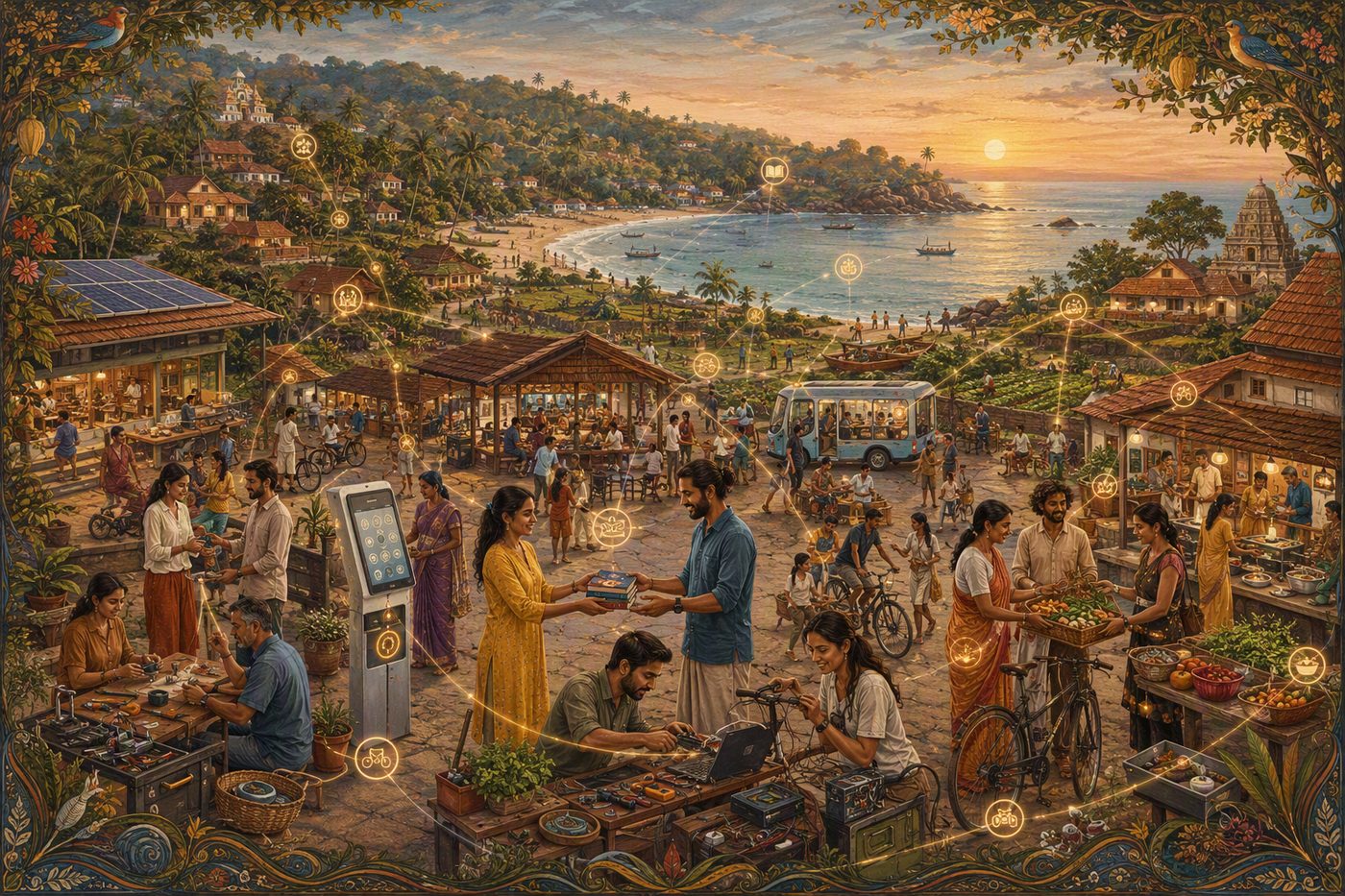
Gokarna is a much more popular tourist destination than Goa. How did it happen? It all started with a RWA startup in Bangalore. One day, its founder was fed up with daily traffic, high rental costs and rising temperatures. He asked his team to nominate a town where they would like to see their next office. Interestingly, two young girls suggested Gokarna on the coastal belt of Karnataka. When asked why they thought so, their answer was the low-cost culture of the city. The founder was not impressed; he asked further what the reason behind low cost was. Their answer was the swapping culture. There were a lot of second-hand clothing shops where people could swap. There were a few restaurants where one could get a coffee if one allowed sharing of spare compute of one’s laptop. The founder had a light-bulb moment and decided to shift the entire team and office to Gokarna. They built a reselling-cum-swap platform where each item was tokenized, and people could exchange their clothes with other clothes or products of whatever brand they wanted. The demand was so great that many hotels and restaurants in Gokarna started dealing as front-ends of the platform. Since they had to hire new workers for running these outlets, they decided to offer two working hours’ swap with a full meal. The young but broke GenZ saw a possibility out of it. Looking at the restaurants, the hotels started offering a five-hour swap for one day of rent. The entire wave was so massive that a big chunk of GenZ started moving into the town. While this was happening, musicians, singers, tattoo artists and lots of digital nomads moved there. Food and rent were not just made available via swaps, but many more things followed the same route. Concert tickets, local travel, old-age care, nanny care, laptops, AI-teaching lessons and many activities were available in the swap model. People used to spend major part of the day on the beach. Some spent their nights while some did so with their days. While this was happening, Google came up with a big announcement. They decided to relaunch their once-closed modular smartphone Project Ara but the first office was established in Gokarna. Suddenly, the government of Karnataka realized that their anti-crypto mindset must be replaced with pro-crypto stance. They declared Gokarna as the Special Economic Zone and allowed full barter economy in the zone. Smartphone spare-parts manufacturers moved there too. The economies of scale chipped in too. The beauty of the whole thing was that almost 80% of all phones used in Gokarna were not new rather they were at least five years old. Gokarna buildings never screamed company logos. The city breathed in living ledgers. The concrete, steel and glass were already pre-claimed by tomorrow’s builders who bid on the demolition rights years in advance. Every object had a biography. You buy a jacket, its NFT passport unfurls: the sheep it came from, the dye vat, the seamstress’s certified stitch-count and so on. The daily on-chain swaps coming from this one city alone were over 4 million in 2040. Buildings themselves were carrying NFT lifecycle passports. Repair guilds have sprung up in every corner. They are half artisans, half auditors. People were not paying each other. Money didn’t disappear rather it just stopped being the point.
Notes
- Hickel, J., & Sullivan, D. (2024). How much growth is required to achieve good lives for all? Insights from needsbased analysis. World Development Perspectives, 35, 100612.
- Talberth, J., & Bohara, A. K. (2006). Economic openness and green GDP. Ecological Economics, 58(4), 743–758.
- Bilal, A., & Känzig, D. (2024). The Macroeconomic Impact of Climate Change: Global vs. Local Temperature. National Bureau of Economic Research.